




"Should I use AI for my website?" is the wrong question. The right question is: "Does AI handle what my specific industry needs from a website?"
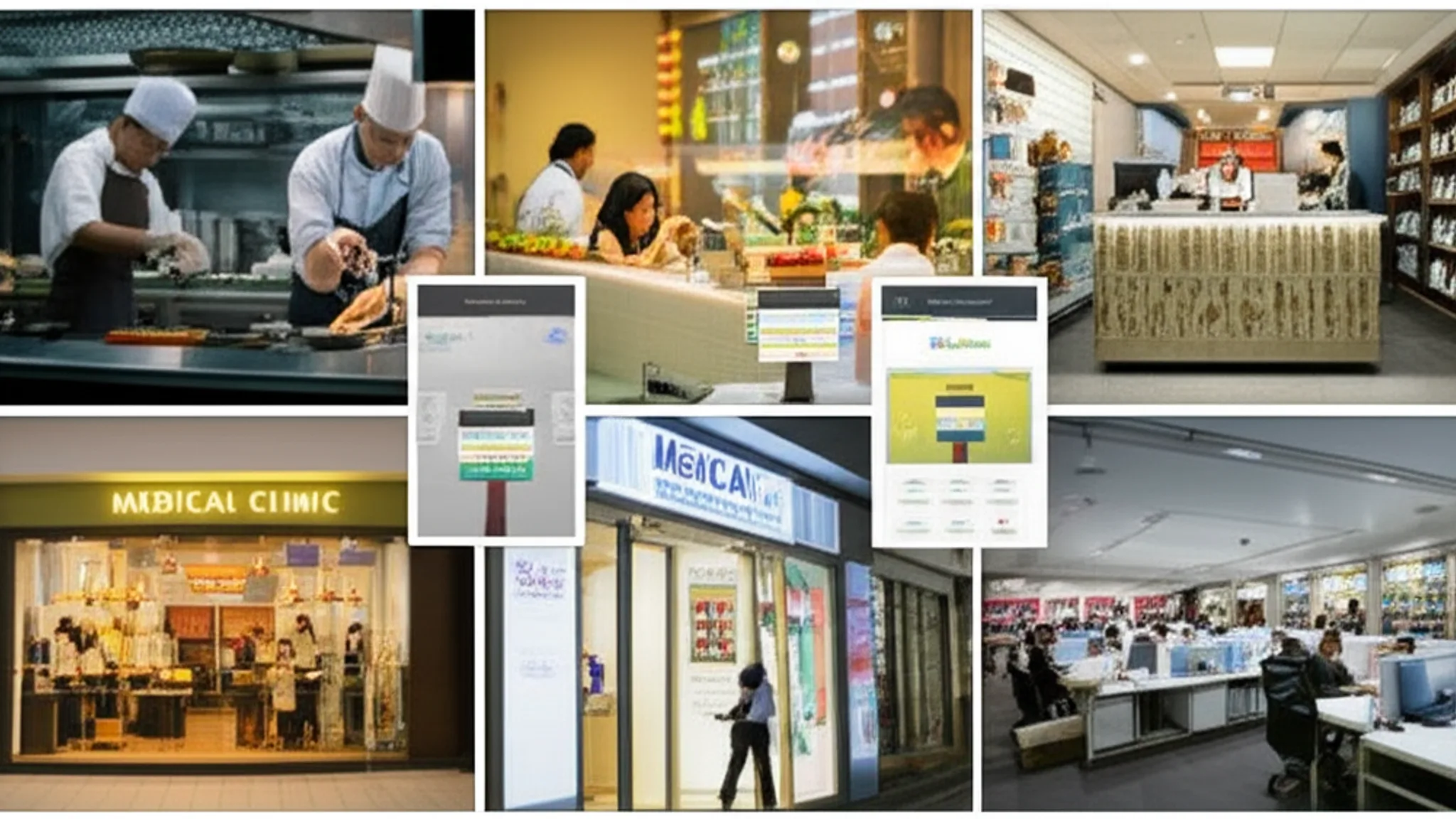
A hawker stall and a medical clinic have completely different website requirements. So do a Shopee seller and a law firm. The tools might be the same, but what they need to do; and what happens when they fall short, varies enormously.
This guide breaks down the AI website builder decision for five major Singapore industries, with honest verdicts on where AI works and where it doesn't. For the broader comparison, read our AI vs agency pillar post.
Key Takeaways
- 1 F&B: restaurants, cafes, and hawkers Jump to this section
- 2 Healthcare: clinics, dental, physiotherapy Jump to this section
- 3 E-commerce: retail, products, online stores Jump to this section
- 4 Professional services: law firms, accountants, consultancies Jump to this section
- 5 Education: tuition centres, enrichment, courses Jump to this section
F&B: restaurants, cafes, and hawkers
Singapore's foodservice market hit USD $28.9 billion in 2026, with online sales accounting for 24.8% of F&B revenue. The Hawkers Go Digital programme has onboarded 11,500+ stallholders to e-payments, with monthly transactions reaching $60 million.
What AI handles well:
- A clean homepage with your menu, location, and opening hours
- Photo galleries of your food and space
- Basic contact information and Google Maps embed
- Mobile-responsive layout (critical: most customers browse on their phone)
Where AI falls short:
- Online ordering and delivery integration. GrabFood, Foodpanda, and in-house ordering systems require custom integrations that AI builders can't handle.
- Reservation systems. Tools like Chope or Quandoo need API connections, not a simple contact form.
- Menu management. If your menu changes regularly (seasonal items, daily specials), you need a CMS that makes updates easy, not an AI template where every change means regenerating the page.
Verdict: AI works for a simple cafe or hawker stall that just needs an online presence with their menu and address. For restaurants that want online ordering, reservations, or delivery integration, an agency build pays for itself quickly.
Healthcare: clinics, dental, physiotherapy
Healthcare is where the AI decision carries the most risk, because getting it wrong has legal consequences.
The PDPA factor: Medical and health data is classified as sensitive personal data under Singapore's Personal Data Protection Act, with higher protection standards than regular personal data. The PDPC Advisory Guidelines for the Healthcare Sector require:
- Explicit consent before collecting patient information
- A designated Data Protection Officer
- Secure storage and handling of health records
- Data breach notification within 3 calendar days
When a patient fills out an appointment request on your AI-built website, that form data typically gets stored on overseas servers. You're responsible for where that data goes; and penalties run up to $1 million or 10% of annual turnover.
Beyond compliance:
- Booking and appointment systems (integration with clinic management software)
- Doctor profiles with verifiable credentials
- Patient portals for repeat visits
- Trust signals that patients look for: especially important in healthcare
Verdict: Agency strongly recommended. The PDPA compliance risk alone makes AI builders a poor fit for healthcare. The cost of a data handling violation dwarfs any savings on web design.
Recommended reads
E-commerce: retail, products, online stores
Singapore's e-commerce market is projected to reach $9.58 billion by 2028, growing at 11% annually. Digital wallets now account for 39% of e-commerce payments, and PayNow is preferred by 68% of Gen Z consumers.
What AI handles well:
- Basic product catalogue and checkout
- Stripe and PayPal integration (standard on most AI builders)
- Simple product pages with images and descriptions
Where AI falls short for Singapore e-commerce:
- Local payment methods. PayNow, GrabPay (used by 29% of shoppers), Atome (BNPL), and FavePay aren't natively supported on most AI builders. For a deeper look at payment options, our e-commerce guide covers the full landscape.
- Inventory management. Connecting to existing POS systems or stock management tools requires custom work.
- Shipping integrations. Local logistics providers like Ninja Van and J&T Express need API connections.
- Product variations and bundles. Complex product configurations (sizes, colours, custom engraving) push beyond what AI templates handle gracefully.
Verdict: AI works for sellers with a small catalogue (under 20 products) who are happy with Stripe/PayPal only. For serious e-commerce with local payment gateways and inventory management, the limitations are dealbreakers. Consider whether your customers will actually complete checkout without PayNow, in 2026 Singapore, many won't.
Professional services: law firms, accountants, consultancies
Professional services have unique website constraints that AI builders are completely unaware of.
Law firms are governed by Singapore's Legal Profession (Publicity) Rules. You cannot advertise success rates, make comparisons with other firms, or breach client confidentiality on your website. Claims of expertise must be justifiable. An AI builder generating your "About Us" content has no idea these rules exist; and a compliance violation can trigger disciplinary proceedings.
Accounting firms providing public accountancy services must meet ACRA and ISCA requirements. Certain claims and representations on websites need appropriate disclaimers.
What professional services websites need:
- Carefully worded service descriptions that comply with industry regulations
- Trust signals: credentials, certifications, association memberships
- Case studies or testimonials (within compliance boundaries)
- Secure client portals or document sharing for existing clients
- Professional brand positioning that reflects the quality of your work
Verdict: Agency recommended. Not because AI can't build a decent-looking site, it can. But because the content compliance risks and the brand perception stakes are too high. Your website is often the first thing a potential client sees, and for professional services, it's a direct reflection of your competence. Looking like a template works against you.
Education: tuition centres, enrichment, courses
Singapore's private tuition industry is massive, household spending reached SGD $1.8 billion in 2024, and nearly 7 in 10 students attend tuition. This means fierce competition, and your website is often where parents decide between you and the centre down the road.
What AI handles well:
- Course listings and programme descriptions
- Teacher profiles and qualifications
- Location and contact information
- Testimonials and results (exam scores, university placements)
Where AI falls short:
- Booking and scheduling. Class registrations, trial lesson bookings, and timetable management require integrations AI builders can't provide.
- Student/parent portals. Progress tracking, attendance records, and payment history need custom functionality.
- Lead generation and nurturing. In a $1.8 billion market, the centres winning aren't the ones with the best teachers, they're the ones parents find first and trust fastest. That requires SEO, conversion optimisation, and strategic content.
Verdict: AI works for a new centre that needs a basic online presence quickly. For established centres competing for market share, an agency-built site with strong SEO and conversion focus is the competitive advantage. When we built MET Interior's site, the same principles of local SEO and lead generation applied, ranking #1 for niche keywords and tripling leads. The same strategy works for tuition centres targeting "math tuition Bishan" or "PSLE science tutor Tampines."
Quick reference: the verdict by industry
Here's the summary for fast decision-making:
- F&B (simple cafe/hawker): AI works
- F&B (restaurant with ordering/reservations): Agency recommended
- Healthcare (any): Agency strongly recommended, PDPA risk
- E-commerce (small catalogue, Stripe only): AI works
- E-commerce (local payments, inventory): Agency recommended
- Law firms: Agency recommended, compliance risk
- Accounting firms: Agency recommended, regulatory requirements
- Tuition (new, basic presence): AI works
- Tuition (established, competitive): Agency recommended
The pattern is clear: AI works for simple, informational sites. The moment your industry has compliance requirements, custom integrations, or competitive pressure that demands lead generation, an agency delivers what AI can't.
The AI vs agency decision isn't universal, it's industry-specific. A hawker stall and a medical clinic have entirely different risk profiles, integration needs, and competitive landscapes. The smartest approach is to match the tool to the job, not force one solution onto every problem.
Not sure where your business falls? Reach out, we'll give you an honest recommendation based on your specific industry and requirements. Sometimes that recommendation is "use Wix, you don't need us." We also offer industry-specific website design for clinics, restaurants, law firms, salons, real estate, and tuition centres.

Written by
Terris
Founder & Lead Strategist
Terris has over 8 years of experience designing high-converting websites for Singapore businesses. From luxury brands to SMEs, he combines aesthetic design with strategic thinking to deliver websites that drive real business growth.
Want to see these strategies in action? Browse our portfolio or get in touch to discuss your project.