
Terris Recommends 16,400+ monthly visitors Pets
8 Best Dog Trainers in Singapore (August 2026)
My picks of the 8 best dog trainers in Singapore for 2026, comparing force-free and positive reinforcement methods.
This guide is part of Terris Recommends, my researched, hands-on picks of the best local businesses and services in Singapore. Every recommendation is researched and ranked by me.
See all recommendationsDog training in Singapore is one of those services where the label on the door tells you almost nothing. Anyone can call themselves a dog trainer here, there is no licence required, and the approaches on offer range from gentle reward-based coaching to old-school correction with prong and electronic collars. I have watched friends spend hundreds on the wrong trainer and undo months of progress, so I researched this properly before recommending anyone.
The single biggest decision is not the price or the location, it is the method. Force-free, positive reinforcement training (rewarding the behaviour you want) is the modern, humane approach that most qualified behaviourists now use, and it is what every trainer on this list practises. The alternative, balanced or correction-based training that relies on leash pops, prong collars or e-collars, is controversial for good reason, and I have deliberately left those operators off this list. After that, it comes down to format: private in-home sessions, group obedience classes, puppy socialisation, or board-and-train.
This is part of my Terris Recommends Pets series. If you are sorting out the rest of your dog's care, it pairs with my guides to pet grooming and pet boarding in Singapore. Below are the eight trainers I would actually recommend, each tagged with who it suits best.
Before the list, some context that saves money and heartache. Dog training itself is unregulated in Singapore, so there is no official register of trainers to check. Dog ownership, on the other hand, is regulated: dogs must be licensed, and the NParks Animal and Veterinary Service (AVS) sets the responsible pet ownership rules and even runs an accreditation scheme for trainers (AVS-ACDT). That AVS accreditation is one of the few local trust signals you can actually rely on.
The method question is the one to settle first. Force-free, positive reinforcement training teaches a dog what to do by rewarding it, builds confidence, and is backed by current behavioural science. Balanced training mixes rewards with corrections (leash pops, prong or e-collars), which can suppress a behaviour fast but often masks the underlying emotion and can make fearful or reactive dogs worse. My bias, and the consensus among certified behaviourists, is firmly force-free, so everyone below works that way.
Here is the checklist I run through:
- Method: reward-based and force-free, with no prong or e-collar work. If a trainer talks about dominance, being the alpha, or corrections, keep looking
- Credentials: real qualifications like CCPDT (CPDT-KA), IAABC, Karen Pryor Academy (KPA CTP), Fear Free, or AVS accreditation, rather than vague years of experience
- Format fit: in-home private sessions for behaviour problems, group classes for socialisation and manners, puppy classes for young dogs, and board-and-train only from a genuinely force-free provider
- The right specialism: reactivity, separation anxiety, aggression and biting need a behaviourist, not a basic obedience instructor. Match the trainer to your actual problem
- They train you too: the honest truth is that good training is really the owner learning to handle the dog. If a trainer promises to fix your dog without involving you, be sceptical
Here is how the eight trainers compare at a glance.
| Trainer | Method | Format | Best for |
|---|---|---|---|
| Pet Coach SG | Force-free, science-based | Private, small group, online | Separation anxiety and serious behaviour |
| Hopefordogs | Force-free, AVS accredited | In-home private, group | Reactivity and behaviour modification |
| Wigglebutts Academy | 100% force-free, fear-free | Dayschool, private, puppy | Puppy foundations and reactive dogs |
| Puppy Colours Academy | Positive, force-free | Group classes, private | Puppy socialisation classes |
| Pawsitive Furkids | Positive, low-stress | Group, private, tricks | Group obedience and trick training |
| Perfect K9 | Reward-based, science-led | Group courses, private | Structured obedience courses |
| Waggie | Science-based, compassionate | Group, private | Established, results-guaranteed school |
| Dog Listener Consultancy | Gentle, relationship-based | In-home private, group | Whole-family in-home training |
Their separation anxiety programme is run one-to-one and largely online, using gradual desensitisation rather than the crate-it-and-cry-it-out advice that often makes things worse. Beyond that, the Private Behaviour Change programme tackles root causes of fear, anxiety, reactivity and aggression, and they also run small puppy classes (capped at five dogs), canine fitness and day training. It is a proper behaviour practice, not a quick-fix obedience shop.
Sessions are by appointment at their Figaro Street studio or in your home for behaviour work. Pricing is transparent by service: day training around S$90 a session, group classes roughly S$80 to S$150, and behaviour modification from about S$180 to S$500 depending on the case. It is not the cheapest option, but for anxiety and aggression it is the one I would trust.
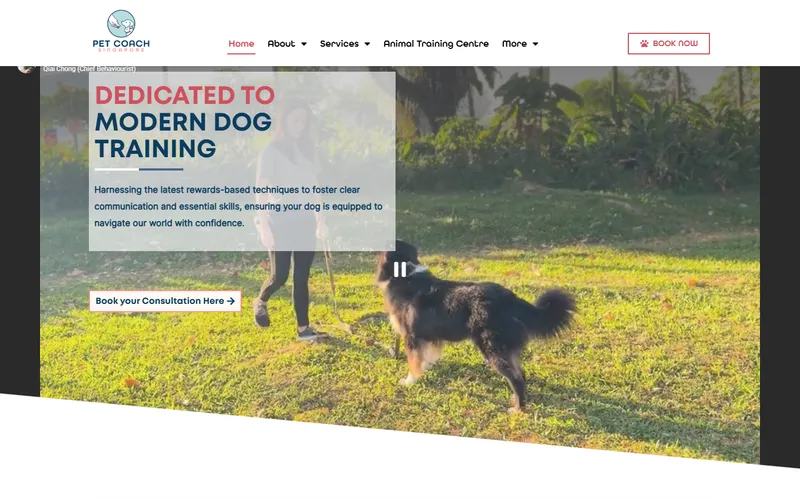
- Best known for
- CSAT-certified separation anxiety programme and deep force-free behaviour credentials.
- Location
- 1D Figaro Street, plus in-home and online, by appointment.
- Google Rating
- 5.0 stars (60+ reviews)
- Website
- petcoach.sg
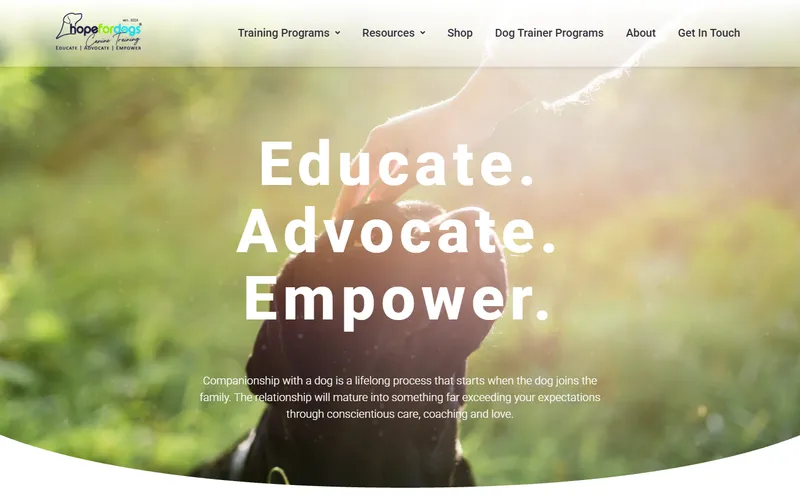
The core offering is private, one-to-one sessions, most of them in your home where the actual problems happen, alongside group classes and puppy training. The behavioural modification track handles reactivity, aggression, phobias and anxiety through a structured assessment and a tailored plan, rather than a generic curriculum. If your dog lunges on lead or shuts down around other dogs, this is the sort of methodical, welfare-first approach that works.
With a 4.8 star Google rating across 144 reviews, the track record is well documented, and owners consistently praise the trainer's patience. Sessions run out of Lengkok Bahru and in-home island-wide. It is a smaller, personal operation rather than a big school, which is exactly what a nervous dog needs.
- Best known for
- AVS accredited, Fear Free reactivity and behaviour modification through in-home private sessions.
- Location
- Lengkok Bahru, plus in-home island-wide.
- Google Rating
- 4.8 stars (144 reviews)
- Website
- hopefordogs.sg
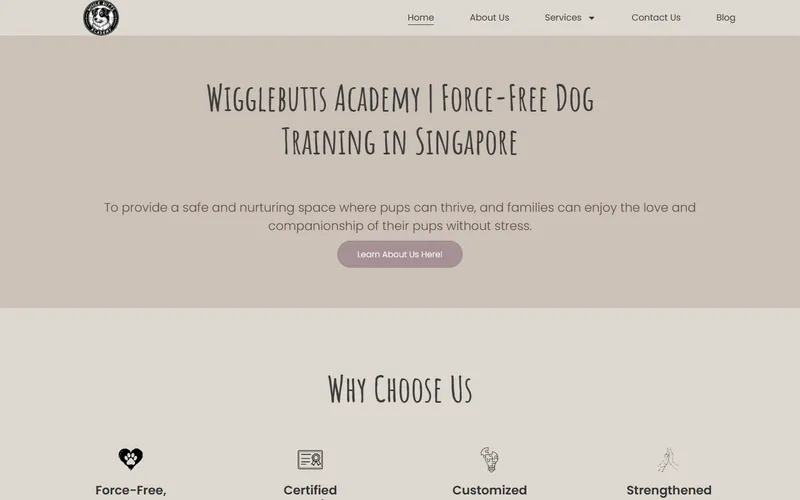
What I like is the range of formats under one roof. There is a Dayschool programme that blends training, enrichment and even swim sessions, private consultations for tailored one-to-one work, dedicated puppy training to get young dogs started right, and a specific reactive dog track. That makes it a strong all-rounder for owners who want a single, consistent force-free relationship from puppyhood through to any wobbles later on.
The academy publishes outcome figures rather than a star rating, reporting that 97% of clients see improved behaviour and that all of them would recommend it to a friend. Sessions run from its Singapore studio plus island-wide private work. If you are starting with a puppy and want to do it the modern way, this is a natural fit.
- Best known for
- Strictly 100% force-free training with KPA and Fear Free certified trainers and a full Dayschool programme.
- Location
- Singapore studio (Dayschool), plus island-wide private sessions.
- Website
- wigglebutts.sg
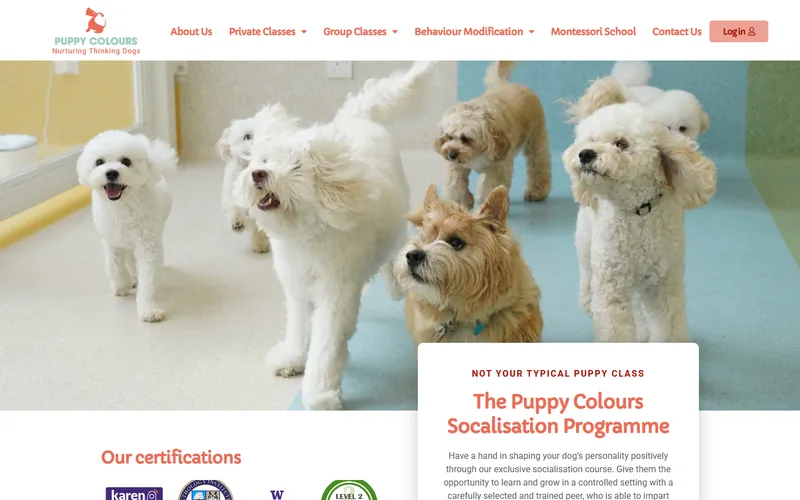
The class structure is thoughtful: Puppy Classes and Teenage Classes for the different life stages, a Montessori-style school built around carefully matched play and peer socialisation, plus private lessons and a behaviour modification track for issues like resource guarding, leash frustration and reactivity. The emphasis on curated, dog-appropriate socialisation, rather than a chaotic free-for-all puppy playgroup, is what sets it apart.
It runs two campuses, on Bukit Timah Road in Newton and at Namly Place, which makes the central and western sides convenient. Testimonials focus on confidence and behaviour transformations across a wide mix of breeds and ages. For a new puppy owner who wants to lay proper foundations in a structured class, this is my top class-based pick.
- Best known for
- Structured, curated puppy socialisation classes led by highly credentialed positive-reinforcement trainers.
- Location
- Newton (182 Bukit Timah Road) and Namly (78 Namly Place).
- Website
- puppycolours.com
The programme menu is one of the widest here. Alongside group obedience classes and puppy kindergarten, they run trick training that leads to internationally recognised certifications, nosework and scent classes, canine fitness, private sessions and behaviour modification. For owners who want to keep going past basic manners, whether that is competitive tricks, nosework or just a more enriched dog, there is a clear pathway.
They lean on group classes for socialisation value while offering private work for anything that needs individual attention. The business appears regularly in local best-of roundups and is contactable directly for the current class schedule. If you want a sociable, do-it-together approach with room to grow, Pawsitive Furkids fits well.

- Best known for
- AVS-ACDT accredited group obedience with a strong trick training and nosework pathway.
- Location
- Singapore, group classes plus island-wide private sessions.
- Website
- pawsitivefurkids.com
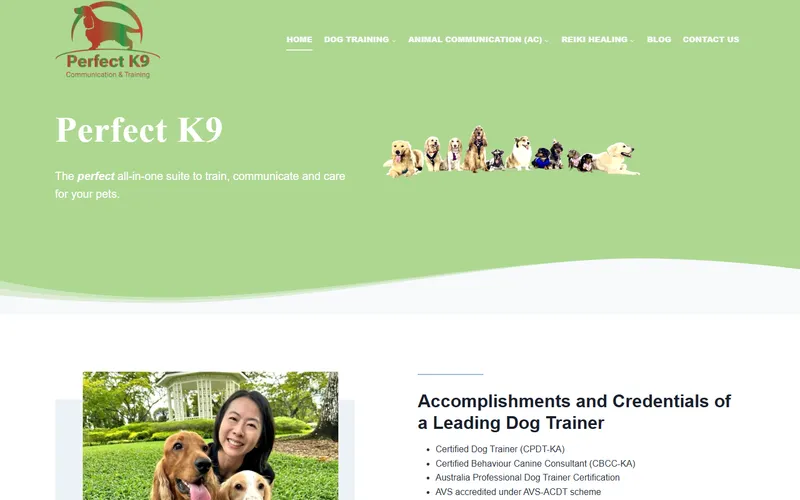
The signature offering is group obedience courses run over a set number of weeks, so you and your dog progress through a clear curriculum with measurable milestones. There are also private and customised sessions, puppy foundation classes, behaviour modification consultations for fear and aggression, and online consults if you cannot get to the centre. The structured format suits owners who want a defined start, middle and end rather than an ongoing arrangement.
The trainer is described as a pioneer of reward-based training locally, and the centre also runs some less conventional extras like animal communication workshops. Fees are described as affordable, though you will want to confirm current course pricing directly. For a methodical obedience grounding, Perfect K9 delivers.
- Best known for
- CPDT-KA led, structured multi-week group obedience courses with a 20-year reward-based track record.
- Location
- Singapore, group courses plus private and online sessions.
- Website
- perfectk9.com
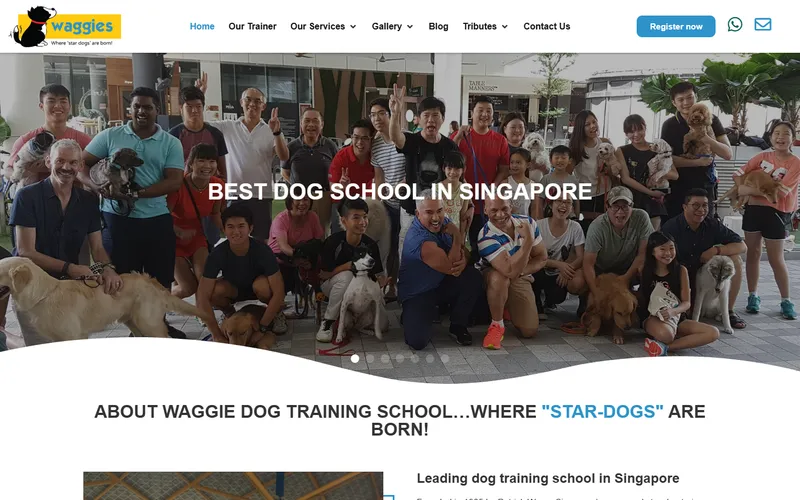
The offering is broad and practical: group classes priced at S$880 for eight weekly 90-minute sessions, private lessons at S$350 a session or S$1,650 for five, plus targeted help for common headaches like toilet training, excessive barking, chewing, biting and dog aggression. Unusually, Waggie also trains dogs for television, film and stage, with its dogs appearing in productions like Annie and Chitty Chitty Bang Bang, which tells you something about the level of reliability they can build.
Two things stand out. First, the sheer volume of feedback, with over 2,700 Google reviews, which is far more social proof than any boutique trainer can offer. Second, a results guarantee: if your dog does not pass the graduation test, you can repeat the course for free. For owners who want an established name with clear pricing and a safety net, Waggie is a dependable choice.
- Best known for
- Established since 1985, 2,700+ Google reviews, transparent course pricing and a free-repeat results guarantee.
- Location
- Singapore, group and private classes.
- Website
- waggie.com.sg
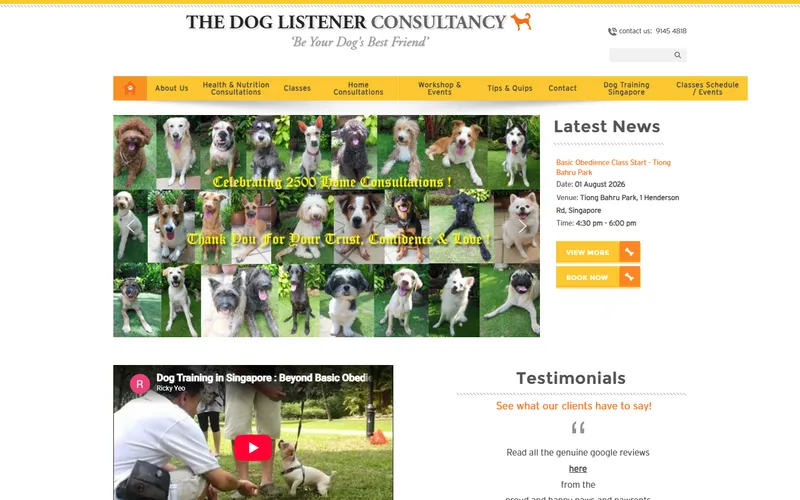
Most of the work happens in your home, one-to-one, with the whole household involved, because the philosophy is that the whole family needs to be consistent for the dog to feel secure. It covers the everyday problems owners actually call about: aggression, barking, toilet training, leash pulling, separation anxiety and the tricky dynamics of a multi-dog household, addressing the root cause rather than drilling tricks.
Sessions run from Jambol Place with a Harbourfront corporate base, and the consultancy has built up a long list of positive testimonials from graduates over the years. If you prefer a calm, in-home, whole-family style of training and the psychology-first framing resonates with you, Dog Listener Consultancy is worth a conversation.
- Best known for
- Gentle, relationship-based in-home training that involves the whole family, with no choke or electric collars.
- Location
- 3 Jambol Place, plus in-home island-wide.
- Website
- doglistenerconsult.com
Dog training in Singapore typically costs from around S$150 for a single private session to S$880 for a full multi-week group course, with specialised behaviour and separation anxiety programmes quoted per case. The price depends mostly on the format you choose and whether you need basic manners or serious behaviour work.
Here are the going rates I see in 2026.
| Service | Typical 2026 price | Good to know |
|---|---|---|
| Private in-home session | S$150 to S$500 each | Higher end is behaviour work, often sold in packages |
| Group obedience course | S$450 to S$880 (multi-week) | Best value per session for basic manners |
| Puppy socialisation class | S$300 to S$720 (multi-week) | Book early, ideally 8 to 16 weeks old |
| Behaviour or separation anxiety programme | Quoted per case | Assessment first, then a tailored plan over weeks |
| Board-and-train | S$1,500 to S$3,000+ | Rare among force-free trainers, verify the method |
| Single online consult | From around S$80 | Good for advice or a second opinion |
What drives the price up is the trainer's credentials and the complexity of the problem. A CSAT-certified separation anxiety programme or aggression rehabilitation costs more than a basic sit-and-stay class because it takes specialist skill and many weeks. Remember that most of the value is in the owner learning to handle the dog, so cheaper is not always better if you end up repeating the work.
You can start gentle training the day your puppy comes home, usually around 8 weeks, and formal puppy socialisation classes typically begin between 8 and 16 weeks once the first vaccinations are done. This early window is genuinely important and does not come back.
From about 8 weeks you can teach simple things at home like name recognition, toilet training and being handled, all with rewards and short, fun sessions. The critical socialisation period runs to roughly 16 weeks, when a puppy forms its lasting impressions of people, dogs, noises and environments, which is why good trainers push you into a structured puppy class during this time rather than waiting.
If you have an older dog or a rescue, do not worry that you have missed the boat. Adult dogs learn perfectly well with positive reinforcement, it just takes patience and consistency. The best age to start training is always now, whatever your dog's age.
For most owners and most dogs, yes. Force-free positive reinforcement is the approach favoured by qualified behaviourists and the one I recommend, because it changes how a dog feels rather than just suppressing what it does.
Balanced training combines rewards with corrections such as leash pops, prong collars or electronic collars. It can stop an unwanted behaviour quickly, which is why it looks impressive in short videos, but the correction often only hides the underlying emotion. With a fearful or reactive dog that can backfire, teaching the dog to stay quiet while still feeling anxious, and in some cases making aggression worse.
Positive reinforcement takes a little more patience up front, but it builds confidence and a dog that chooses to cooperate rather than one that obeys to avoid discomfort. Every trainer on this list works this way, which is not an accident. If a trainer you are considering relies on prong or e-collars, treat that as a reason to look elsewhere.
Yes for basic manners, but a professional is worth it for socialisation and for any real behaviour issue. Plenty of owners teach sit, down, recall and loose-lead walking themselves using reward-based methods and good online resources, and that is a great habit to build.
Where a trainer earns their fee is in the harder stuff. A structured puppy class gives your dog safe, curated socialisation you cannot easily replicate at home. And problems like reactivity, aggression, biting or separation anxiety need an expert eye, because the wrong home fix can entrench the problem or put someone at risk. A behaviourist reads body language and root causes that most owners miss.
The honest reality is that hiring a trainer is really hiring someone to train you. Even a couple of private sessions to learn correct timing, rewards and handling can save months of trial and error, after which you carry on the daily practice yourself.
Basic obedience usually shows progress within a few weeks of consistent practice, while behaviour issues like reactivity or separation anxiety commonly take two to three months or longer. There is no overnight fix with humane training, and anyone promising one should make you cautious.
For everyday manners, most owners see meaningful change over a multi-week course as long as they practise a little every day between sessions. Separation anxiety is a gradual desensitisation process, and while many dogs make real progress in the first month, lasting results often take a further couple of months of steady work.
The biggest variable is you. Dogs learn fastest when the whole household is consistent and the training happens in short, daily doses rather than one weekly session. Treat the class or consult as the instruction manual, and the real progress as what you do at home.
Good dog training in Singapore comes down to two decisions: pick a trainer who works force-free with positive reinforcement, then match the format to your goal. For serious behaviour and separation anxiety I would call Pet Coach SG or Hopefordogs, for a proper start with a puppy I would look at Wigglebutts or Puppy Colours, and for an established school with a results guarantee it is hard to beat Waggie. Whichever you choose, remember that the sessions are really teaching you, so the daily practice at home is where the results are won.
My advice? Shortlist one or two trainers whose method and format fit your dog, book an initial session or class, and see how your dog responds before committing to a longer package. A trainer your dog trusts, and whose approach you can keep up at home, is worth far more than the cheapest quote.
If you run a dog training business or pet service in Singapore and your website is not turning Google searches into enquiries, that is usually the real bottleneck. A clean, fast site with proper local SEO and easy booking makes a measurable difference. See how our web design service works or get a free quote for your project.