Terris Recommends 16,400+ monthly visitors Education & Enrichment
30 Best Enrichment Classes for Kids in Singapore (August 2026)
The 30 best tuition and enrichment classes for kids in Singapore for 2026, compared by programme focus.
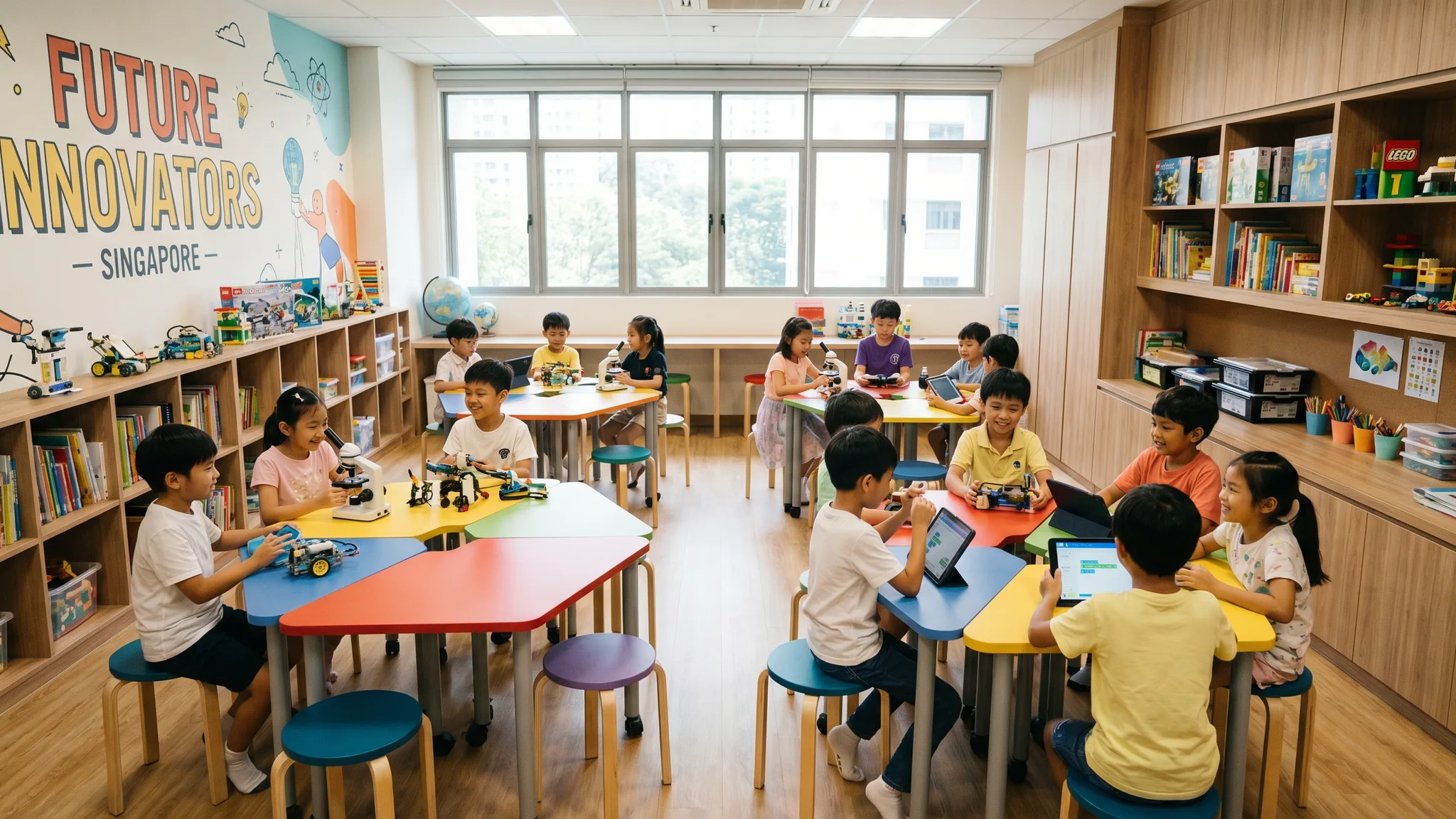
This guide is part of Terris Recommends, my researched, hands-on picks of the best local businesses and services in Singapore. Every recommendation is researched and ranked by me.
See all recommendationsSingapore's early childhood enrichment sector has grown 8.7% annually since 2021, reaching an estimated S$1.2 billion in market value. According to the Ministry of Education, the average Singaporean household spends S$112 per month on tuition and enrichment. But that average hides enormous variation: some families spend S$200 a month on a single Kumon subscription, while others invest upwards of S$1,500 across coding, Mandarin, brain training, and speech and drama.
Finding the best tuition and enrichment classes for kids in Singapore is complicated because "enrichment" covers such a broad spectrum. A right-brain development programme for toddlers has almost nothing in common with a robotics class for 10-year-olds. The right centre depends on your child's age, interests, learning gaps, and what you actually want the enrichment to achieve. This list is designed to cut through the noise.
I spent weeks researching this guide: visiting centre websites, reading parent reviews on KiasuParents and Google, verifying programme details, and comparing pricing where it was publicly available. Every centre here is active in 2026, has a credible track record, and fills a genuinely different niche from the others. If you have already sorted academic tuition, this list covers the rest of your child's development.
Enrichment is a broad category, so I needed clear criteria to avoid comparing apples with oranges. Here is the framework I used:
- Distinct programme focus. Each centre had to offer something genuinely different. I did not want a list of thirty centres that all teach English and Maths slightly differently. The final thirty span brain development, coding, robotics, languages, communication, music, art, mental arithmetic, and academic enrichment across different age groups.
- Verified track record. Established presence in Singapore with verifiable parent reviews, awards, or published outcomes. New centres with no public track record did not make the cut.
- Programme quality over marketing. Some centres spend more on Instagram ads than on teacher training. I looked for evidence of curriculum depth: proprietary methods, qualified instructors, structured progression from level to level.
- Accessibility. Multiple locations across Singapore, or a strong enough reputation to justify travelling to a single outlet. A centre with one branch in Sentosa Cove, no matter how good, is not practical for most families.
- Pricing transparency. Centres that publish their fees openly scored higher. Parents should not need to sit through a 45-minute "information session" just to learn what a term costs.
I deliberately chose a mix of programme types so that this list is useful regardless of whether your child is 6 months old or 12 years old, and regardless of whether you are looking for academic support, creative development, or something your child simply enjoys.
| School | Best for | Pricing |
|---|---|---|
| Seriously Addictive Mathematics (S.A.M) | Children aged 4 to 12 who need to build genuine maths understanding, not just exam technique | Varies by location; contact your nearest centre for current 2026 rates |
| Julia Gabriel Centre | Children aged 6 months to 18 years who need to build communication confidence through speech, drama, and performance | Premium tier; contact the centre for current programme fees |
| Heguru Education Centre | Children aged 6 months to 12 years whose parents want to develop memory, focus, and cognitive processing through right-brain training | Approximately S$599/term (7 lessons), roughly S$85/lesson |
| Coding Lab | Children and teens aged 7 to 18 who want to learn real-world coding skills, from beginner to competition level | S$400 to S$500/term (weekly classes); holiday camps from S$350+ |
| LCentral English | Children from Nursery 1 to Primary 6 who need focused, specialist English enrichment in reading, writing, and oral skills | Contact the centre for current rates; multiple locations across Singapore |
| Berries World of Learning | Pre-school and primary children who resist Chinese and need a fun, engaging approach to build motivation and oral fluency | Approximately S$250 to S$280/month |
| Nullspace Robotics | Children interested in robotics, coding, and STEM, particularly those in or aspiring to GEP or DSA pathways | S$42.50 to S$50/hour (inclusive of GST and materials); approximately S$520/term (10 weeks) |
| Chengzhu Mandarin Centre | Children aged 6 months to 12 years who benefit from immersive, play-based Chinese language learning rather than traditional drilling | Premium tier; contact the centre for current 2026 programme fees |
| The Shichida Method | Parents of children aged 6 months to 12 years who want structured whole-brain development with a strong home practice component | Approximately S$72/class; one-time Parents Education Seminar S$195/person (refundable after 1 year of enrolment) |
| MindChamps Enrichment Academy | Primary school children who need academic enrichment combined with study skills and a growth mindset framework | Contact the centre for current rates; discounts available for returning MindChamps families |
| The Learning Lab | Academically ambitious families targeting top schools, DSA, GEP and scholarships who want an ahead-of-syllabus premium programme | Premium tier; indicatively around S$480 to S$750/term per subject (TLL does not publish a public price list, so confirm on enquiry) |
| Kumon | Younger children building foundational maths and English fluency, and the daily-study discipline that pays off later | S$170/month per subject (inclusive of GST), plus a one-time S$50 registration fee |
| Mind Stretcher | Students wanting affordable exam prep with optional GEP qualification or Maths Olympiad training | Approximately S$218 to S$305/month (four weekly 2-hour lessons, inclusive of GST) depending on level; registration S$76.30 |
| Lil' but Mighty | Primary (and lower-secondary) students who need focused help with English comprehension and composition | Approximately S$414/month (P1 to P2) up to S$458/month (P5 to P6), inclusive of GST, with all materials included |
| The Pique Lab | P5 to P6 students chasing a PSLE Science distinction and secondary students taking O-Level Science | From approximately S$244/month for weekly classes (as of 2025); trial lessons around S$100 |
| Eye Level | Preschool to lower-primary children building maths fundamentals and critical-thinking at their own pace | Roughly S$160 to S$220 per subject per month (as of 2025), plus registration and material fees |
| CMA Mental Arithmetic | Children aged roughly 4 to 10 building mental calculation speed, concentration and number sense | Not publicly published; trial class around S$42, full fees on enquiry |
| Terry Chew Academy | High-ability students preparing for Maths Olympiad competitions or DSA who already cope with school maths | Term fees on enquiry; registration S$70 plus a refundable S$100 deposit |
| Tien Hsia Language School | Families wanting a results-focused, fully immersive Mandarin programme with continuity from preschool to O-Level | Approximately S$380 to S$415 per term (10 lessons) per 2026 third-party estimates; not officially published |
| I Can Read | Young or reluctant readers (from age 2.5) who need a structured, research-based introduction to reading | Approximately S$50 to S$60 per one-hour lesson billed termly, plus materials and a one-time assessment fee of around S$40 to S$60 |
| Lorna Whiston Schools | Children building spoken English confidence and working towards a recognised Trinity College London speech and drama credential | Enrichment fees on enquiry (not published) |
| Speech Academy Asia | Children who need to build confidence and public-speaking skills, including for competitions and DSA | Not published; 90-minute free trial, with fees quoted on enquiry |
| Helen O'Grady Drama Academy | Shy or under-confident children who need to build verbal confidence and self-expression | Weekly term-class fees on enquiry; DSA Preparation module around S$600 plus S$50 registration (as of 2025) |
| Aureus Academy | Families wanting individual-attention instrumental or vocal lessons with month-to-month flexibility | Around S$279/month (30 min), S$399/month (45 min), or S$519/month (60 min), as of 2025 |
| Cristofori Music School | Budget-conscious families wanting accessible group or individual music lessons close to home | Varies by branch (historically around S$321 for ten one-hour lessons, as of 2022); confirm current rates |
| Global Art | Children who benefit from a structured, level-based art syllabus with clear skill progression | Fees on enquiry (vary by centre) |
| Heart Studio | Children aged 4 to 12 building serious art technique, especially those preparing a DSA art portfolio | Fees on enquiry (not published) |
| Saturday Kids | Beginners and younger children who learn coding best through curiosity and project-making rather than grades | Around S$320+ per term for weekly classes (per 2026 third-party guides, verify directly); holiday camps from approximately S$590 |
| Logiscool | Minecraft- and Roblox-loving kids who want to build their own games rather than sit exams | Approximately S$820 to S$900 per semester (around S$164/month); free trial class |
| Bricks 4 Kidz | Young children (especially ages 4 to 8) taking their first hands-on, screen-light steps into STEM and engineering | Fees on enquiry (not published) |
1. Seriously Addictive Mathematics (S.A.M): best for building genuine maths mastery in primary-age children
What separates S.A.M from generic maths tuition is the teaching philosophy. Their worksheets are designed around problem-solving heuristics, the explicit strategies that help children break down unfamiliar problems rather than memorise steps for familiar ones. Students work through varied tasks that build conceptual understanding before speed, which is the opposite of how most enrichment centres approach maths. For children aged 4 to 12, the programme builds a foundation that pays dividends when school maths gets harder.
S.A.M was featured in KiasuParents' 2026 list of best maths enrichment centres for primary school, and the parent community consistently praises the structured, no-shortcuts approach. The main caveat is that S.A.M is not exam prep. If your child needs to cram for PSLE next month, this is not the right fit. But if you are thinking two to three years ahead and want your child to actually understand maths rather than just pass tests, S.A.M is one of the strongest options available.
- Best for
- Children aged 4 to 12 who need to build genuine maths understanding, not just exam technique.
- Standout strength
- Singapore Math methodology created by ex-MOE teachers, used in 200+ centres across 20+ countries.
- Pricing
- Varies by location; contact your nearest centre for current 2026 rates.
- Website
- seriouslyaddictivemaths.com.sg
Their proprietary EduDrama methodology is the foundation of everything they teach. It combines voice, speech, language, music, movement, art, writing, and performance into a cohesive programme that develops confident communicators. Programmes run from as young as six months (parent-accompanied playgroups) through to 18 years old, and students can work towards internationally recognised Trinity College London qualifications from kindergarten level onwards. That external accreditation adds a layer of credibility that most enrichment centres cannot match.
Julia Gabriel is particularly strong for children who are shy, struggle with verbal expression, or need help building confidence before an audience. The teachers are consistently praised in parent reviews for being nurturing and genuinely invested in each child's progress. The trade-off is price: Julia Gabriel is a premium provider, and fees reflect that. They operate at multiple locations across Singapore and have expanded internationally to China, Indonesia, Malaysia, and Thailand.
- Best for
- Children aged 6 months to 18 years who need to build communication confidence through speech, drama, and performance.
- Standout strength
- Nearly 40 years of operation, proprietary EduDrama methodology, Trinity College London accreditation pathway.
- Pricing
- Premium tier; contact the centre for current programme fees.
- Website
- juliagabriel.com
Each Heguru lesson packs a broad variety of hands-on, interactive activities into a fast-paced session. Children cycle through memory games, speed-reading exercises, image training, and analytical challenges in quick succession. The method is designed to stimulate neural pathways during the critical early-development window when the brain is most receptive. Heguru Education has been voted "Best Right Brain Training Enrichment Programme" and "Children Enrichment Centre of the Year" by parents and local parenting publications, and they now operate seven centres across Singapore including SingPost Centre, Waterway Point, Our Tampines Hub, and Serangoon NEX.
The honest consideration: right-brain training is not for every family. If you are looking for something with a direct, measurable link to school grades, a maths or English enrichment centre will give you more visible short-term returns. Heguru's benefits are broader and longer-term. Fees run at approximately S$599 per term (seven lessons), which works out to about S$85 per lesson. For parents who want to invest in cognitive development during the early years, Heguru has one of the most established and well-reviewed programmes in Singapore.
- Best for
- Children aged 6 months to 12 years whose parents want to develop memory, focus, and cognitive processing through right-brain training.
- Standout strength
- Multi-award-winning right-brain programme, 7 centres across Singapore, strong parent reviews for memory and focus improvements.
- Pricing
- Approximately S$599/term (7 lessons), roughly S$85/lesson.
- Website
- hegurueducation.com.sg
The results speak for the programme's depth. Coding Lab graduates have secured coveted DSA (Direct School Admission) placements at top schools including NUS High, Hwa Chong Institution, and St. Joseph's Institution. That is a tangible, competitive advantage for students who can demonstrate genuine coding ability rather than surface-level familiarity with Scratch. Classes accommodate every skill level, from complete beginners to advanced students preparing for national and international coding competitions.
Coding Lab operates from two locations (Parkway Parade and KAP Mall in Bukit Timah) and offers both in-person and live online classes, which adds flexibility for families outside those catchment areas. Pricing runs at approximately S$400 to S$500 per term for weekly classes, with holiday camps from S$350 and above. That positions them in the mid-to-premium range for coding enrichment, but the curriculum depth and instructor quality justify the cost for families serious about building real technical skills.
- Best for
- Children and teens aged 7 to 18 who want to learn real-world coding skills, from beginner to competition level.
- Pricing
- S$400 to S$500/term (weekly classes); holiday camps from S$350+.
- Standout result
- Graduates have secured DSA placements at NUS High, Hwa Chong Institution, and St. Joseph's Institution.
- Website
- codinglab.com.sg
Their curriculum covers reading, writing, grammar, vocabulary, and oral communication through a structured, progressive framework. What parents consistently highlight in reviews is the visible improvement: children who could not read confidently are reading independently within months, and several parents have reported their children going on to score distinctions in O-Level English after building foundations at LCentral during primary school. The teachers are described as experienced and attentive, with regular updates and weekly lesson reviews that keep parents informed of progress.
LCentral operates from multiple locations across Singapore, including Bukit Timah, Serangoon, Punggol, Woodlands, and Buona Vista, which gives decent island-wide coverage. Pricing is not published openly on their website, which is a minor frustration, but parent reviews consistently rate the value-for-money positively given the quality of instruction. For families where English is a second language at home, or where a child needs structured support to build reading and writing confidence, LCentral is the specialist option that generalist centres cannot match.
- Best for
- Children from Nursery 1 to Primary 6 who need focused, specialist English enrichment in reading, writing, and oral skills.
- Standout strength
- English-only specialist since 2008, award-winning curriculum, strong parent reviews for visible reading and writing improvement.
- Pricing
- Contact the centre for current rates; multiple locations across Singapore.
- Website
- lcentral.net
With over 20 centres across Singapore and MOE-accredited teachers, Berries has the scale and credibility to back up the approach. Their programmes cater to pre-school and primary school students, with younger children focusing on building love for the language through play, and upper primary students shifting toward more academic content including composition and comprehension skills. The teachers are consistently praised for being supportive, experienced, and genuinely good at engaging reluctant learners.
The honest caveat, and one that a 2026 parent review flagged specifically: Berries excels at motivation and oral fluency, but vocabulary retention for skills tested in PSLE may require supplementary work. If your primary goal is PSLE Chinese results, a more academically focused Chinese tuition centre might serve you better. But if your child resists Chinese and you need a centre that will make them actually want to learn the language, Berries is the best starting point I have found.
- Best for
- Pre-school and primary children who resist Chinese and need a fun, engaging approach to build motivation and oral fluency.
- Standout strength
- 30+ years of making Chinese enjoyable, 20+ centres, MOE-accredited teachers.
- Pricing
- Approximately S$250 to S$280/month.
- Website
- berriesworld.com
Founded in 2008, Nullspace has enrolled over 2,000 students in robotics and coding classes that teach engineering and programming concepts through hands-on building and experimentation. Students work with LEGO robotics kits and progress through increasingly complex projects: building robots, programming autonomous behaviours, creating electronic circuits, and developing competition-level skills. The centre holds STEM.org accreditation, which validates the educational rigour behind the fun. Locations include Rochester Mall, Siglap, and Kallang Wave Mall.
Pricing is transparent: S$42.50 to S$50 per hour inclusive of GST and materials, with a typical term costing around S$520 for ten weekly one-hour sessions. That is competitive for specialist STEM enrichment. The limitation is age range and geography. Nullspace is best suited for children who already have some interest in building and problem-solving; a child who would rather draw or write stories will not get as much out of it. But for technically curious kids, this is one of the most credible STEM enrichment providers in Singapore.
- Best for
- Children interested in robotics, coding, and STEM, particularly those in or aspiring to GEP or DSA pathways.
- Standout strength
- Appointed by MOE to run enrichment for all 9 GEP primary schools, STEM.org accredited.
- Pricing
- S$42.50 to S$50/hour (inclusive of GST and materials); approximately S$520/term (10 weeks).
- Website
- sg.nullspace.co
The curriculum is built around interactive storytelling, role-play, songs, and creative activities conducted entirely in Mandarin. For primary school students, programmes are aligned with the MOE syllabus and strengthen both language proficiency and cultural understanding. The centre won the TNAP Awards 2024 for Best Interactive Chinese Enrichment Programmes, and parent reviews consistently praise the teachers' dedication and the joyful learning atmosphere. If you have seen how Julia Gabriel teaches English and communication, Chengzhu applies the same proven pedagogy to Chinese.
Chengzhu operates from four locations: Rochester Drive, Greenwich V (Seletar), Woodleigh Mall, and Marina at Keppel Bay. The locations skew toward central and east Singapore, so families in the west or north may find the commute challenging. As a premium provider, fees are higher than mass-market Chinese enrichment, but the immersive methodology and small class sizes justify the investment for families who want their children to develop genuine comfort and confidence in Mandarin, not just pass exams.
- Best for
- Children aged 6 months to 12 years who benefit from immersive, play-based Chinese language learning rather than traditional drilling.
- Standout strength
- EduDrama methodology adapted from Julia Gabriel Centre, TNAP Award winner for Best Interactive Chinese Enrichment.
- Pricing
- Premium tier; contact the centre for current 2026 programme fees.
- Website
- chengzhu.edu.sg
A typical Shichida class combines photographic memory exercises, speed-reading drills, linking memory games, and sensory activities. Parents report genuinely impressive anecdotal results: children memorising 50 cards through linking memory and recalling them in three minutes, or developing intuition and pattern-recognition abilities that carry over into academic performance. The Shichida Companion App adds a home practice component with weekly progress updates, which helps parents reinforce lessons between classes.
School fees average around S$72 per class, with a mandatory one-time Parents Education Seminar at S$195 per person (refundable if your child enrols for over one year). That pricing is slightly more accessible than Heguru on a per-lesson basis. The key difference between Shichida and Heguru is emphasis: Shichida leans more heavily into structured home practice and parental involvement, while Heguru focuses more on in-class stimulation. Neither is objectively better; the right choice depends on how much time you can commit to home practice.
- Best for
- Parents of children aged 6 months to 12 years who want structured whole-brain development with a strong home practice component.
- Standout strength
- 60+ years of Japanese whole-brain methodology, companion app for home practice, global research base.
- Pricing
- Approximately S$72/class; one-time Parents Education Seminar S$195/person (refundable after 1 year of enrolment).
- Website
- shichidamethod.com
The programme range includes MindChamps Writing, Art of Learning (for Primary 1 through 6), the Primary Success Programme, and a dedicated PSLE Champion Mindset course. What differentiates MindChamps from generic academic enrichment is the emphasis on learning strategies and mindset alongside subject content. They teach children how to learn, not just what to learn, which is a distinction that becomes increasingly valuable as academic demands escalate in upper primary and secondary school.
MindChamps operates enrichment centres across multiple locations in Singapore, and the brand recognition provides a degree of consistency and accountability that smaller independent centres cannot always offer. Pricing is not published openly on their website, and you will need to attend an information session or contact them directly for current fees. Parent reviews are generally positive, with particular praise for the structured approach and the integration of confidence-building elements into academic programmes. For families already familiar with the MindChamps preschool ecosystem, the enrichment academy provides a natural continuation.
- Best for
- Primary school children who need academic enrichment combined with study skills and a growth mindset framework.
- Standout strength
- SGX-listed education group, neuroscience-backed Champion Mindset methodology, integrated enrichment and student care options.
- Pricing
- Contact the centre for current rates; discounts available for returning MindChamps families.
- Website
- mindchamps.org/enrichment
What you are paying for is the curriculum and the polish. TLL builds its own materials rather than reselling assessment books, and the programmes are designed to stretch already-capable students rather than fill basic gaps. The centre reports strong distinction rates at JC level and alumni admitted to universities like Stanford, Oxford and Cambridge, though those figures are self-reported, so treat them as marketing rather than independent data.
This is the option for academically ambitious families targeting top schools, DSA, GEP, IP tracks and scholarships, who want a branded premium product and will pay for it. The honest trade-offs: it is the most expensive enrichment provider most parents will consider, and fees are not transparently published, so you enquire per programme. If your child needs remedial support rather than acceleration, this is not the right fit.
- Best for
- Academically ambitious families targeting top schools, DSA, GEP and scholarships who want an ahead-of-syllabus premium programme.
- Standout strength
- Proprietary, ahead-of-syllabus curriculum built by 40+ in-house specialists; the most established premium brand in the market.
- Pricing
- Premium tier; indicatively around S$480 to S$750/term per subject (TLL does not publish a public price list, so confirm on enquiry).
- Website
- thelearninglab.com.sg
The real product is the habit. Daily worksheet practice builds arithmetic and reading fluency alongside something harder to teach directly: self-discipline and the ability to study independently. Because the model is self-paced, it works equally well for a child racing ahead of their grade and one quietly filling foundational gaps. Pricing is refreshingly transparent and flat, the same nationwide regardless of level.
Kumon suits younger children building foundations and parents who value consistency over cramming. The caveats are real, though: worksheet repetition is not PSLE or O-Level exam-technique coaching, so it will not teach question strategy for specific papers. Centres are independently franchised, so the teacher and atmosphere vary by branch, and the drill format genuinely does not suit every child.
- Best for
- Younger children building foundational maths and English fluency, and the daily-study discipline that pays off later.
- Standout strength
- Self-paced mastery model with the largest branch network in Singapore (80+ centres) and flat, transparent nationwide pricing.
- Pricing
- S$170/month per subject (inclusive of GST), plus a one-time S$50 registration fee.
- Website
- kumon.sg
The pitch is value-for-results at scale. Mind Stretcher reports over 250,000 students enrolled to date, with self-reported figures of more than 5,000 students scoring 250 or above in PSLE and over 500 qualifying for GEP through its prep classes. What makes it genuinely interesting is that this competition pipeline sits at among the lowest per-hour fees of any established chain, which is why so many parents chasing GEP qualification start here.
It is the right call for mainstream-to-strong students who want solid, affordable exam preparation, plus families specifically targeting GEP or competition exposure. The trade-off is that a 20-plus-branch operation runs a more standardised, less boutique experience than a premium centre, quality can vary between branches, and the headline statistics are self-reported.
- Best for
- Students wanting affordable exam prep with optional GEP qualification or Maths Olympiad training.
- Standout strength
- Big-chain scale with genuinely strong GEP and Maths Olympiad pipelines at among the lowest per-hour fees of established chains.
- Pricing
- Approximately S$218 to S$305/month (four weekly 2-hour lessons, inclusive of GST) depending on level; registration S$76.30.
- Website
- mindstretcher.com
Two things make it stand out in a crowded English-tuition market. First, the pricing is transparently published per lesson, which is rare. Second, there is no separate materials fee: everything is included, so the headline price is the real price. It appears consistently in 2026 "best English tuition" roundups, which reflects a strong reputation even though the centre publishes little in the way of hard quantified results.
Choose it if your child needs focused help with comprehension or composition technique and you would rather work with a specialist than a generalist multi-subject chain. The honest limitations: it is English only, so it will not be your one-stop solution, the footprint is smaller than the big chains, and a single specialist subject here costs more per month than one subject at a value chain.
- Best for
- Primary (and lower-secondary) students who need focused help with English comprehension and composition.
- Standout strength
- Deep single-subject English specialisation with transparent per-lesson pricing and no hidden materials fees.
- Pricing
- Approximately S$414/month (P1 to P2) up to S$458/month (P5 to P6), inclusive of GST, with all materials included.
- Website
- lilbutmightyenglish.com
That focus on answering technique as a trainable skill is what generic tuition centres rarely isolate, and it is the centre's whole reason for being. The Pique Lab reports a distinction rate of around 84.6% and well over 16,000 students impacted, though as with most centres these are self-reported numbers. For a content-strong child bleeding marks on phrasing, the approach is genuinely targeted.
It is best suited to P5 and P6 students grinding for a PSLE Science distinction, and secondary students taking O-Level Science. The caveats: it is premium-priced and narrow by design, and the physical footprint is small (essentially one Selegie campus plus online cohorts), so it is not a convenient neighbourhood option for most families.
- Best for
- P5 to P6 students chasing a PSLE Science distinction and secondary students taking O-Level Science.
- Standout strength
- Hyper-specialised in science answering technique, drilling the exact phrasing that captures full open-ended marks.
- Pricing
- From approximately S$244/month for weekly classes (as of 2025); trial lessons around S$100.
- Website
- thepiquelab.com
The self-directed mastery model is the draw. Because progression is individual, the programme is particularly good at building independence and quiet confidence in younger learners who benefit from working at their own speed. Globally the brand is well established across more than 20 countries and runs its own Math Olympiad, which adds a stretch pathway for stronger students.
It works best for preschool to lower-primary children building fundamentals and reasoning habits. The honest caveats: the worksheet-based approach is not aligned to the MOE or PSLE syllabus, so treat it as enrichment rather than exam prep, and because centres are franchised, pricing and teaching quality vary between branches.
- Best for
- Preschool to lower-primary children building maths fundamentals and critical-thinking at their own pace.
- Standout strength
- Individualised self-paced mastery; children progress level-by-level only when ready, building genuine independence.
- Pricing
- Roughly S$160 to S$220 per subject per month (as of 2025), plus registration and material fees.
- Website
- eyelevel.sg
What sets CMA apart is depth and scale within this one narrow discipline. With more than 15 years in Singapore, a claimed 50,000-plus students taught, 18-plus centres, and a curriculum used across roughly 18 countries, it has a structured progression that smaller abacus operators cannot match. Beyond calculation speed, parents value what the training builds underneath: concentration, working memory and number sense.
It is best as an early-years foundation for children aged roughly 4 to 10. Be clear-eyed about what it is, though: abacus mental arithmetic builds calculation speed but does not cover word problems, heuristics or the broader PSLE Maths syllabus, so it complements rather than replaces maths tuition, and the biggest gains tend to come in the early years before plateauing.
- Best for
- Children aged roughly 4 to 10 building mental calculation speed, concentration and number sense.
- Standout strength
- Singapore's largest dedicated mental-arithmetic specialist, with a structured Dan-level abacus progression behind it.
- Pricing
- Not publicly published; trial class around S$42, full fees on enquiry.
- Website
- cma.edu.sg
The pedigree is the differentiator. This is not generic enrichment dressed up as "advanced maths"; it is a published, regionally adopted competition curriculum built on the founder's RA*CE framework. The academy reports that since 2014 around 95% of students achieved a two-grade improvement in mainstream maths and over 60% earned competition medals each year, which, self-reported or not, points to a genuinely competition-grade programme.
It is built for high-ability primary students (and some secondary) who already cope well with school maths and want to be stretched towards competitions or top-school DSA. The flip side of that strength is the warning: for an average student struggling with the standard syllabus, this material can be too advanced and demoralising, and current term pricing is enquiry-only.
- Best for
- High-ability students preparing for Maths Olympiad competitions or DSA who already cope with school maths.
- Standout strength
- A published, regionally adopted Olympiad curriculum from a recognised author, with genuine competition pedigree.
- Pricing
- Term fees on enquiry; registration S$70 plus a refundable S$100 deposit.
- Website
- terrychew.com.sg
19. Tien Hsia Language School: best for immersive, results-focused Chinese from preschool to O-Level
The differentiator is consistency. Reviewers repeatedly note very low teacher turnover and reliably strong PSLE and O-Level Chinese results, and the immersion-first approach means children get continuity from their first preschool class right through to national exams. For families who simply want Mandarin handled properly without gimmicks, it is the long-established default.
It suits families committed to a fully immersive, exam-effective Chinese programme. The honest caveats balance the picture: the traditional classroom style can feel dull for restless children, the Chinese-only rule means a child with a weak foundation may initially struggle, and with strong demand and waiting lists, flexibility and customer service are not the centre's priorities.
- Best for
- Families wanting a results-focused, fully immersive Mandarin programme with continuity from preschool to O-Level.
- Standout strength
- Nearly four decades of consistency, native teachers and strict immersion that reliably produces strong PSLE and O-Level Chinese results.
- Pricing
- Approximately S$380 to S$415 per term (10 lessons) per 2026 third-party estimates; not officially published.
- Website
- tienhsia.com
The credibility is unusually strong for an early-literacy chain. The curriculum is certified by Education Alliance Finland, one founder served as a Senior Educational Psychologist at Singapore's MOE, and the brand operates around 25 centres locally and over 200 worldwide. For parents who want reading taught on a research footing rather than a worksheet hunch, that academic validation matters.
It is the right starting point for young or reluctant readers who need a structured, science-based path into reading. The caveats are practical ones: pricing and quality vary by centre and location, the per-lesson cost adds up once materials and the assessment fee are included, and the multi-centre franchise model means the experience is not perfectly uniform.
- Best for
- Young or reluctant readers (from age 2.5) who need a structured, research-based introduction to reading.
- Standout strength
- A research-backed phonemic-awareness method with international academic validation and psychologist founders.
- Pricing
- Approximately S$50 to S$60 per one-hour lesson billed termly, plus materials and a one-time assessment fee of around S$40 to S$60.
- Website
- sg.icanread.asia
21. Lorna Whiston Schools: best for English plus speech and drama with a Trinity College London pathway
Two things distinguish it. First, every centre is 100% owned and operated rather than franchised, a deliberate quality-control decision that keeps the experience consistent. Second, the Trinity College London partnership turns speech and drama from a soft skill into a portable, accredited qualification, which is rare among local enrichment providers and genuinely useful for confidence and presentation.
It fits families who want premium English-and-communication enrichment, particularly a recognised speech and drama credential, and households with an international or expat leaning. The honest trade-offs: it sits at the premium end, enrichment fees are not published so you enquire per programme, and the strong English orientation will suit some families more than others.
- Best for
- Children building spoken English confidence and working towards a recognised Trinity College London speech and drama credential.
- Standout strength
- A 100%-owned (non-franchised) network and an internationally recognised Trinity College London speech and drama pathway.
- Pricing
- Enrichment fees on enquiry (not published).
- Website
- lornawhiston.com
The ecosystem around the classes is what makes it credible. The academy runs "Speak Up Kids," a national-level public-speaking competition, alongside its own inter-branch grand competition, and it reports collaboration with more than 100 MOE schools and over 10,000 students trained. It was also named Franchisor of the Year by the Franchising and Licensing Association in 2018. For a child who needs a competitive and structured speaking pathway, that depth is hard to match.
It is ideal for children who need confidence, stage presence and presentation skills, whether they are shy or gunning for speech competitions and DSA. The caveats: it is communication-focused, not academic tutoring, it markets heavily around trademarked method names, and as a franchise with enquiry-only pricing, cost and quality vary by branch.
- Best for
- Children who need to build confidence and public-speaking skills, including for competitions and DSA.
- Standout strength
- Singapore's largest dedicated children's public-speaking specialist, with its own national competition and tie-ups across 100+ MOE schools.
- Pricing
- Not published; 90-minute free trial, with fees quoted on enquiry.
- Website
- speechacademyasia.com
The strength is consistency. Because the curriculum is globally standardised and refined over more than four decades, you get a structured, repeatable experience rather than the ad-hoc feel of some local drama studios. The focus stays squarely on helping children express themselves and speak with confidence, not on auditions or performance polish.
It is best for under-confident children who need to come out of their shell, or families approaching DSA from a drama and speech angle. Two honest caveats: the Singapore physical presence is relatively small, so check what is near you, and pricing for regular weekly term classes is not published, so you will need to enquire directly.
- Best for
- Shy or under-confident children who need to build verbal confidence and self-expression.
- Standout strength
- A globally standardised, 45-year-old curriculum built squarely around communication confidence rather than performance.
- Pricing
- Weekly term-class fees on enquiry; DSA Preparation module around S$600 plus S$50 registration (as of 2025).
- Website
- helenogrady.com.sg
Scale and flexibility are the real advantages. With more than 18,000 students and around 19 centres, mostly in convenient mall locations, Aureus is easy to access, and its month-to-month billing is genuinely unusual in a market full of term lock-ins. Teachers have been voted best for one-to-one lessons by Parents World, and the in-house grading gives children a clear sense of progression.
It is the right fit for parents who want individual-attention weekly lessons with the freedom to stop or switch without forfeiting a term's fees. The honest trade-off is cost: one-to-one tuition is inherently more expensive than group lessons, placing Aureus among the pricier options, and the free-instrument and grade-reward marketing can feel sales-driven.
- Best for
- Families wanting individual-attention instrumental or vocal lessons with month-to-month flexibility.
- Standout strength
- Singapore's largest music school, with a one-to-one model, internationally accredited in-house grading, and flexible monthly billing.
- Pricing
- Around S$279/month (30 min), S$399/month (45 min), or S$519/month (60 min), as of 2025.
- Website
- aureusacademy.com
The differentiator is reach and price. Where premium one-to-one schools cluster in malls, Cristofori has the widest heartland network on the island, often within walking distance of HDB estates, at noticeably lower price points. Decades of operation and a shelf of heritage and brand awards back up its position as the mass-market option.
It suits budget-conscious families who want convenient, accessible lessons close to home, and young children easing in through the group format. The caveats are the natural consequence of the model: lower prices often mean larger group classes and more variable teacher experience across a 500-strong faculty, current rates are quoted per branch rather than published, and the company's instrument-retail roots mean lessons partly feed instrument sales.
- Best for
- Budget-conscious families wanting accessible group or individual music lessons close to home.
- Standout strength
- The widest heartland music network in Singapore (38 outlets) at notably more affordable price points than premium one-to-one schools.
- Pricing
- Varies by branch (historically around S$321 for ten one-hour lessons, as of 2022); confirm current rates.
- Website
- cristofori.asia
The structure is the selling point. Unlike free-play art studios, Global Art offers a defined syllabus with clear progression and a global competition pathway where Singapore students compete regionally, which appeals to parents who want to see measurable development. The brand carries several franchise and quality awards and explicitly welcomes children "with or without artistic talent."
It is best for children who thrive on structure and clear levels rather than open-ended exploration. The honest caveats: as a franchise, quality and pricing vary by individual centre, fees are quoted on enquiry rather than published, and the heavily structured approach can feel rigid for a child who just wants to create freely.
- Best for
- Children who benefit from a structured, level-based art syllabus with clear skill progression.
- Standout strength
- An internationally standardised, level-based art curriculum with a global competition pathway, more structured than most local studios.
- Pricing
- Fees on enquiry (vary by centre).
- Website
- globalart.com.sg
The standout is its Direct School Admission record. Heart Studio reports that at least 75% of its DSA students secured interviews with their chosen schools, with alumni placements cited at the likes of Raffles Institution, Hwa Chong and the School of the Arts. The teaching blends traditional technique with a "no right or wrong" creative philosophy, building genuine foundations rather than rushing to impressive-looking results.
It is the right choice for children aged roughly 4 to 12 who want serious art skills, and especially for families eyeing an art-track DSA portfolio. The practical caveats: it operates from a single location, so convenience depends on where you live, and pricing is not published, so you will need to enquire.
- Best for
- Children aged 4 to 12 building serious art technique, especially those preparing a DSA art portfolio.
- Standout strength
- A clear DSA art-portfolio pathway with a track record of placements at art-track secondary schools.
- Pricing
- Fees on enquiry (not published).
- Website
- heartstudiosg.com
The credibility comes from its track record and its values. Saturday Kids ran Code In The Community, Singapore's largest free coding programme, in partnership with Google, and has taught more than 5,000 students. Its deliberately screen-light, "learning by doing" approach frames technology as a tool for understanding the world, sometimes tying projects to real issues like climate change.
It is best for younger children and beginners who learn by making, and parents who want coding taught through curiosity rather than competition. The honest caveat is the flip side of that ethos: Saturday Kids publishes little in the way of hard outcome metrics, so parents who want measurable academic returns may find the value harder to pin down.
- Best for
- Beginners and younger children who learn coding best through curiosity and project-making rather than grades.
- Standout strength
- Pioneer credibility and a Google Code In The Community partnership, with a values-first, project-based approach to coding.
- Pricing
- Around S$320+ per term for weekly classes (per 2026 third-party guides, verify directly); holiday camps from approximately S$590.
- Website
- saturdaykids.com
The whole model is "from passive player to active game designer." Every lesson produces something visible the child can show off, which keeps motivation high, and the blocks-to-real-code progression gives a clear sense of advancement. This is a deliberately screen-and-game-first identity, which is exactly what differentiates it from both values-driven, screen-light schools and exam-focused academies.
It is best for Minecraft- and Roblox-loving kids who want to make games rather than sit exams or grind competition problems. The caveats: Logiscool has just two physical centres, in Jurong West and Hougang, both in the north and west, so families elsewhere lean on its online classes, and as a younger franchise here it has limited independent local review volume.
- Best for
- Minecraft- and Roblox-loving kids who want to build their own games rather than sit exams.
- Standout strength
- A gamified, build-a-real-game-every-lesson curriculum on a purpose-built platform, with a clear blocks-to-real-code path.
- Pricing
- Approximately S$820 to S$900 per semester (around S$164/month); free trial class.
- Website
- logiscool.com/sg
The strength is accessibility. For a four- or five-year-old, LEGO is familiar and tactile in a way that a screen and a keyboard are not, which makes Bricks 4 Kidz one of the gentlest "first STEM" experiences available. The structured learning journey moves children from creative builds towards genuine robotics, and the programme carries STEM accreditation badges.
It is ideal for younger children, especially ages 4 to 8, and hands-on learners who need a soft landing into STEM before formal coding. The honest caveats: as a global franchise, curriculum and quality can vary by operator, the LEGO-kit model is about exposure rather than deep coding mastery (children tend to outgrow it by around 10 to 12), and pricing is quoted on enquiry.
- Best for
- Young children (especially ages 4 to 8) taking their first hands-on, screen-light steps into STEM and engineering.
- Standout strength
- The most accessible "first STEM" option for young children, using familiar LEGO bricks to teach engineering and early coding concepts.
- Pricing
- Fees on enquiry (not published).
- Website
- bricks4kidz.sg
The thirty centres above are my top recommendations for 2026, but Singapore's enrichment market runs deep. Here are a few more that narrowly missed the main list:
- Kodecoon Academy: A homegrown coding and tech school running since 2016, with one of the larger footprints in the category across SingPost Centre, Our Tampines Hub, West Coast Plaza and Punggol Digital District. Programmes span ages 4 to 16 with a leadership and future-skills slant. Best for families wanting a broad, progressive coding pathway with island-wide convenience.
- Code Ninja: A Singapore coding centre (codeninja.com.sg, not the global "Code Ninjas" franchise) teaching Scratch and Python to children from around age 9 to 16 in small 1:6 classes. Pricing is transparent, from a S$49 trial to roughly S$54 per class in a 20-class pack. Best for parents who want clear, published coding rates and small group sizes.
- Mulberry Learning: An award-winning Reggio-inspired provider with multiple locations, offering integrated STEAM enrichment alongside preschool and infant care. Their signature Literacy Fun, Math Quest and Chinese Master programmes are structured and outcome-focused. Best for families already in the Mulberry ecosystem who want enrichment continuity.
- The Music Scientist: Award-winning music enrichment for children aged 4 months to 6 years, blending music with sensory play, science and movement. Best for parents who want early childhood enrichment that goes beyond traditional music lessons.
Choosing an enrichment centre is not the same as choosing a tuition centre. Tuition fills academic gaps. Enrichment develops broader skills, interests, and capabilities. The evaluation criteria are different:
- Start with your child's interest, not your anxiety. The most effective enrichment happens when a child is genuinely engaged. Forcing a child who loves drawing into a coding class because "tech is the future" usually results in wasted money and a resentful kid. Observe what your child gravitates toward naturally, then find a programme that channels that interest productively.
- Attend a trial class. Every time. A centre's website and marketing materials will always look polished. The trial class shows you the reality: how teachers interact with students, how the classroom is managed, whether your child responds to the teaching style. Every reputable centre offers trials. Those that don't should raise questions.
- Check the teacher, not just the brand. Large enrichment chains rotate instructors between branches. The quality of your child's specific teacher matters more than the franchise's awards. Ask which teacher will handle your child's class and whether they will remain consistent throughout the programme.
- Be honest about your goals. Are you trying to give your child an edge for DSA? Build confidence? Develop a lifelong skill? Keep them productively occupied on Saturday mornings? All of these are valid, but they point to very different centres. A parent who wants PSLE prep should not be enrolling in Heguru, and a parent who wants creative development should not be enrolling in S.A.M.
- Calculate the real cost. Monthly fees are just the starting point. Factor in registration fees (often S$50 to S$200), material fees, uniform costs, concert or performance charges, and transport. A centre that looks S$100 cheaper per month may cost the same or more once you add everything up.
- Consider the commute. A brilliant enrichment centre 40 minutes away becomes a logistical nightmare by week six. If you are also juggling preschool drop-offs, work commitments, and other siblings' schedules, proximity matters more than prestige.
Enrichment class costs in Singapore vary significantly by programme type, frequency, and the centre's positioning. Here is what the market looks like in 2026:
- Right-brain training (Heguru, Shichida): S$72 to S$85 per class, typically once per week
- Maths enrichment (S.A.M, similar): S$200 to S$350 per month
- Self-paced worksheet programmes (Kumon, Eye Level): S$160 to S$220 per subject per month
- Chinese enrichment (Berries, Chengzhu, Tien Hsia): S$250 to S$415 per month or term
- English enrichment (LCentral, Lil' but Mighty, I Can Read): S$200 to S$460 per month
- Science specialist (The Pique Lab): from around S$244 per month
- Coding and robotics (Coding Lab, Nullspace, Saturday Kids, Logiscool): S$320 to S$900 per term or semester
- Mental arithmetic (CMA abacus): fees on enquiry; trial classes from around S$42
- Music lessons (Aureus, Cristofori): S$279 to S$519 per month for one-to-one; lower for group formats
- Art classes (Global Art, Heart Studio): roughly S$200 to S$400 per month, fees on enquiry
- Speech, drama and public speaking (Julia Gabriel, Helen O'Grady, Speech Academy Asia): S$300 to S$685 per term or module
- General academic enrichment (MindChamps, The Learning Lab, Mind Stretcher): S$218 to S$750+ per month or term depending on subjects
One in two Singaporean parents spends more than S$500 per month on tuition and enrichment combined. The families I see spending wisely are the ones who pick one or two programmes that genuinely match their child's needs rather than stacking three or four out of FOMO. More enrichment does not automatically mean better outcomes. A child who does robotics on Monday, Chinese on Wednesday, maths on Thursday, and swimming on Saturday has very little time left to just be a child.
Tuition focuses on academic subjects aligned with the school syllabus, typically aimed at improving grades or preparing for specific examinations like PSLE, O-Levels, or A-Levels. Enrichment covers a broader range of skills and development areas: coding, robotics, speech and drama, brain training, creative arts, and language immersion. Some centres blur the line (LCentral teaches English, but through an enrichment methodology), but the core distinction is that tuition fills academic gaps while enrichment builds additional capabilities.
Centres like Heguru, Shichida, and Julia Gabriel accept children from 6 months old for parent-accompanied programmes. Whether you should start that early depends on your goals and your child's temperament. Right-brain training programmes argue that the 0 to 6 age window is critical for neural development, and the research supports the idea that early stimulation has lasting benefits. For most families, starting one or two structured enrichment activities between ages 3 and 5 is a practical and effective approach.
There is no magic number, but overscheduling is a genuine risk in Singapore's competitive parenting culture. Most child development experts recommend no more than two to three structured activities per week for primary-age children, with plenty of unstructured play time built in. A child who is perpetually shuttled between classes does not have time to process what they have learned, and burnout is real even for seven-year-olds.
Both have advantages. Large chains (MindChamps, Berries, S.A.M) offer consistency, multiple locations, structured curricula, and accountability. Small independent centres often provide more personalised attention, smaller class sizes, and passionate founder-led teaching. The best approach is to evaluate the specific branch and teacher your child will have, regardless of the brand's size.
Singapore's enrichment market is enormous, growing, and genuinely difficult to navigate as a parent. The thirty centres on this list represent very different strengths: S.A.M for maths mastery, Julia Gabriel for communication confidence, Heguru for cognitive development, Coding Lab and Logiscool for technical skills, Aureus for music, Heart Studio for art, and Berries for making Chinese enjoyable. The right choice depends entirely on your child's age, interests, and what you want the enrichment to achieve.
One principle that applies across every category: the best enrichment centre is the one your child actually wants to attend. A reluctant student in a premium programme will always be outperformed by an enthusiastic student in an average one. Attend the trial. Watch your child's reaction. And give any programme at least a full term before deciding whether it is working.
If you run an enrichment centre and your website is not converting the parents who search for you on Google, that is a problem worth fixing. A well-designed website with strong SEO is how centres on this list fill classes without relying on word-of-mouth alone. Read our guide on website and SEO for tuition and enrichment centres or get a free quote for a site built to attract parent enquiries.
Sources and references (33)
- moe.gov.sg › 20230110 spending by households on tuition and enrichment classes
- themusicscientist.com › emerging enrichment trends in singapore data driven insights for forward thinking parents
- smiletutor.sg › singapore families spent 1 8b on private tuition in 2023 heres what that means for 2025
- seriouslyaddictivemaths.com.sg
- juliagabriel.com
- hegurueducation.com.sg
- codinglab.com.sg
- lcentral.net
- berriesworld.com
- chengzhu.edu.sg
- sg.nullspace.co
- mindchamps.org › enrichment
- shichidamethod.com
- speechacademyasia.com
- thelearninglab.com.sg
- kumon.sg
- mindstretcher.com
- lilbutmightyenglish.com
- thepiquelab.com
- eyelevel.sg
- cma.edu.sg
- terrychew.com.sg
- tienhsia.com
- sg.icanread.asia
- lornawhiston.com
- helenogrady.com.sg
- aureusacademy.com
- cristofori.asia
- globalart.com.sg
- heartstudiosg.com
- saturdaykids.com
- logiscool.com › sg
- bricks4kidz.sg