










Singapore families spent $1.8 billion on private tuition in 2023. That figure has nearly tripled since 2008 and is projected to cross $2 billion by now. Seven in ten parents send their children for extra classes. The industry is enormous, and fiercely competitive.
Yet most tuition centres in Singapore still rely on word-of-mouth and flyer drops at HDB void decks. Meanwhile, the parents they are trying to reach are on Google, typing "PSLE maths tuition Tampines" or "best JC chemistry tuition Singapore" at 11pm after their child brings home a disappointing result. If your tuition centre website in Singapore does not show up (or worse, looks like it was built in 2014), you are handing students to your competitors.
We have worked with education businesses and service-based SMEs across Singapore. This guide covers exactly what a tuition centre needs in its website, how to rank on Google, and where to spend your marketing budget for maximum enrolment.
Key Takeaways
- 1 What parents actually look for on a tuition centre website Jump to this section
- 2 Essential features every tuition centre website needs Jump to this section
- 3 SEO for tuition centres: how to rank when parents search Jump to this section
- 4 Content marketing that attracts parents year-round Jump to this section
- 5 Google Ads for tuition centres: timing and targeting Jump to this section
What parents actually look for on a tuition centre website
Parents searching for tuition are making a high-stakes decision. They are spending $200 to $800 a month per child, sometimes more for specialist subjects or private tutoring. They are not impulse buying. They compare.
Here is what we consistently see parents evaluate when they land on a tuition centre website:
- Teacher credentials: qualifications, teaching experience, ex-MOE teachers. Parents want proof your tutors know their subject
- Track record and results: improvement rates, A-grade percentages, PSLE scores. Concrete numbers, not vague promises
- Curriculum and teaching approach: what makes your method different from the centre down the road?
- Pricing transparency: even a fee range helps. Parents dislike filling in a form just to find out if they can afford you
- Location and accessibility: MRT station, bus routes, parking. A Google Maps embed is non-negotiable
- Trial classes or assessments: a low-commitment entry point. This single feature can double your enquiry rate
If your website buries this information or makes parents hunt for it, they will leave. According to the Department of Statistics' Household Expenditure Survey, the average household spends $104.80 per month on tuition. That is a considered purchase, and parents treat their research accordingly.
Essential features every tuition centre website needs
A tuition centre website is not a brochure. It is an enrolment machine. Every page, every button, every piece of content should move a parent closer to signing up their child. Here are the features that separate centres filling classes from those with empty seats.
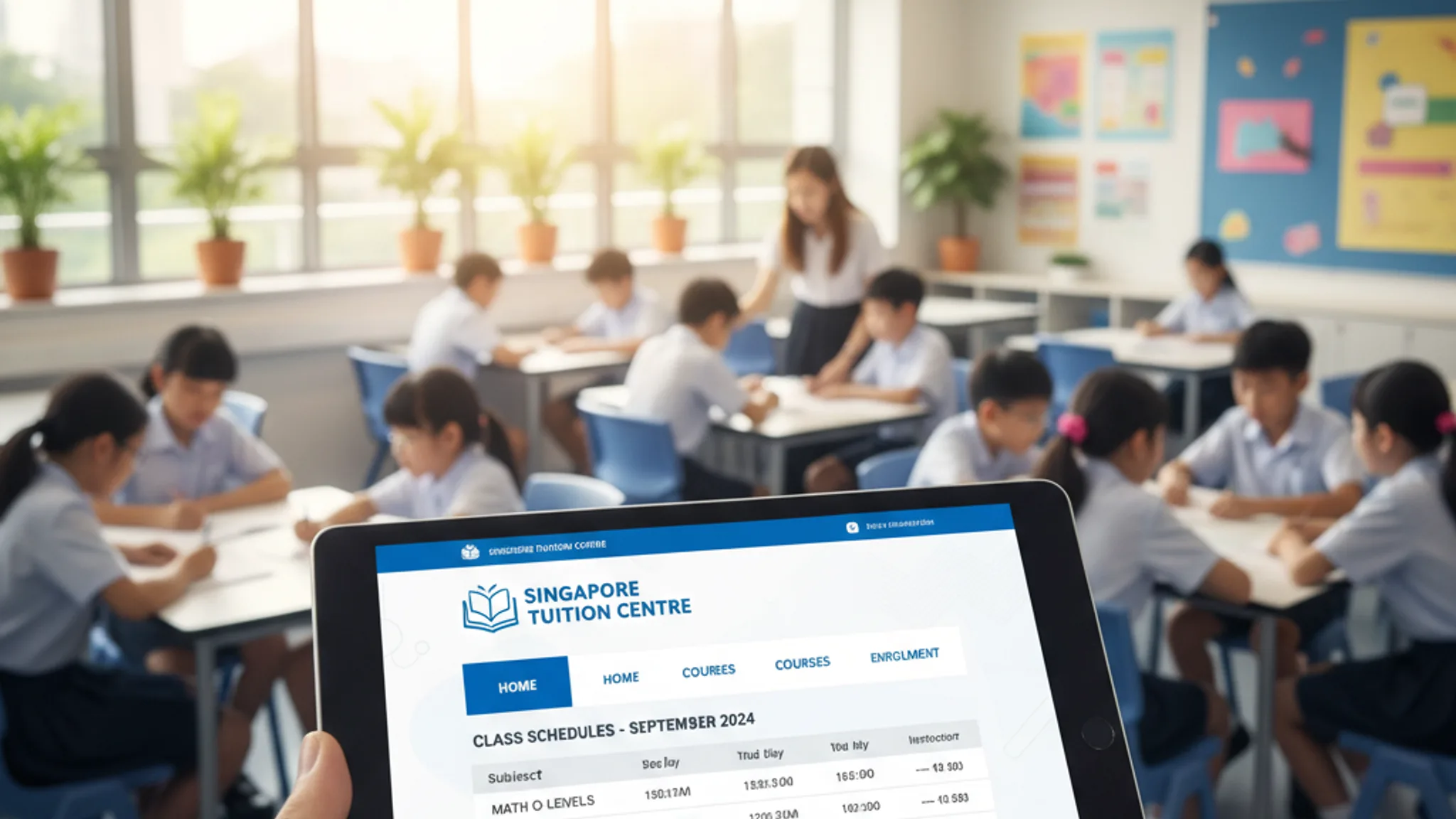
Class schedules and availability. Parents need to see what is available right now. If your Primary 5 Maths class on Saturdays is full, say so; it creates urgency and shows demand. A simple timetable page, updated regularly, saves your admin staff from answering the same questions repeatedly.
Online registration or enquiry forms. A WhatsApp number is fine as a backup, but you need a proper form that captures the child's level, subject, preferred timeslot, and parent contact details. This gives your team structured leads to follow up on, not scattered chat messages. Keep it short: five to six fields maximum.
Teacher profiles. Give each tutor a proper profile page with their photo, qualifications, teaching philosophy, and years of experience. Parents are entrusting their child's education to these people. Anonymous bios do not build trust.
Individual subject pages. This is critical for SEO and we will cover it in detail later, but every subject you teach should have its own dedicated page. "Primary Maths Tuition", "Secondary Science Tuition", "O-Level English Tuition," each one targeting a specific search term.
Testimonials and success stories. Parent testimonials with names (even first name and initial) carry weight. Student improvement stories ("from C5 to A2 in eight months") are even better. Video testimonials, if you can get them, outperform text by a wide margin.
Location map and contact details. Address, phone, email, WhatsApp, and an embedded Google Map. If you have multiple branches, each one needs its own page with unique content, not just a different pin on the same map.
Recommended reads
SEO for tuition centres: how to rank when parents search
Search engine optimisation is where most tuition centres leave the biggest opportunity on the table. When a parent types "PSLE tuition Bishan" into Google, the top three results get roughly 60% of all clicks. If you are not there, you are invisible.
Target location-specific keywords. "Tuition centre" alone is too broad. Parents search by area: "tuition centre Tampines", "maths tuition Jurong East", "tuition centre SEO Singapore" topics that tie subject to location. Create pages that target these specific combinations.
Build subject-specific landing pages. This is the single highest-impact SEO move for a tuition centre. Instead of one generic "Our Subjects" page, create dedicated pages for each subject and level combination:
- Primary Mathematics Tuition Singapore
- Secondary English Tuition Singapore
- O-Level Chemistry Tuition Singapore
- JC H2 Physics Tuition Singapore
Each page should include unique content about your teaching approach for that specific subject, the syllabus covered, common challenges students face, and relevant testimonials. We used a similar scalable-page approach for Citri Mobile, programmatically generating thousands of SEO-optimised pages. The same principle applies at a smaller scale for tuition centres.
Claim and optimise your Google Business Profile. This is free and critically important. A complete profile with photos, reviews, updated hours, and correct categories ("Tuition Centre", "Education") gets you into the local map pack: the three results that appear above organic search. Encourage satisfied parents to leave Google reviews. More reviews with higher ratings directly improve your local ranking. We cover this in depth in our SEO guide for Singapore small businesses.
Technical SEO basics. Fast loading speed (under three seconds), mobile-responsive design, proper heading structure, meta titles with your target keywords, and schema markup for local business and educational organisation. These are not optional extras; they are baseline requirements that Google expects.
Content marketing that attracts parents year-round
Most tuition centre websites go silent between enrolment periods. That is a missed opportunity. Parents research tuition throughout the year, and a steady stream of helpful content keeps your site visible in search results long before sign-up season.
The strategy is straightforward: publish content that answers the questions parents are already Googling. Here are proven content types for tuition centres:
- Exam preparation guides: "How to Prepare for PSLE Science 2026", "O-Level A Maths Revision Checklist". These attract high-intent traffic from parents actively looking for academic support
- Study tips and techniques: "5 Effective Study Methods for Secondary School Students", "How to Help Your Child With Chinese Composition". Genuinely useful content that builds trust
- MOE syllabus updates: whenever the curriculum changes, parents search for explanations. Be the centre that provides clear, timely breakdowns
- Subject-specific advice: "Why Students Struggle With Additional Mathematics" or "Common PSLE English Comprehension Mistakes". These pieces target long-tail keywords and demonstrate your tutors' expertise
Each blog post should link back to your relevant subject page and include a clear call to action: a free trial class or a diagnostic assessment. This turns readers into leads. For a deeper look at building a content strategy, read our guide on content marketing for Singapore SMEs.
Consistency matters more than volume. Two well-researched, genuinely helpful articles per month will outperform ten thin posts that read like they were churned out by a chatbot.
Google Ads for tuition centres: timing and targeting
SEO is a long game. If you need students now (say, to fill a new class next term), Google Ads is the fastest lever you can pull.
Seasonal timing is everything. Tuition searches spike at predictable points: after PSLE results in November, before the new academic year in January, during the mid-year exam period in May and June, and in the lead-up to O-Levels and A-Levels from August to October. Front-load your ad budget during these windows. Running the same spend in December as you do in September is wasting money.
Target by location radius. Most parents prefer tuition centres within 15 to 20 minutes of home or school. Set your Google Ads to target a tight radius around your centre: two to five kilometres depending on the area density. A tuition centre in Woodlands does not need to show ads to parents in Pasir Ris.
Use specific keywords, not broad ones. "Tuition" as a keyword will burn your budget on irrelevant clicks. Go specific:
- "PSLE maths tuition [your area]"
- "secondary science tuition [your area]"
- "O-level chemistry tuition Singapore"
- "best primary English tuition near me"
Send traffic to dedicated landing pages, not your homepage. If someone clicks an ad for "PSLE Maths Tuition Bukit Timah", they should land on a page about your PSLE Maths programme at your Bukit Timah branch, with a registration form above the fold. Sending them to a generic homepage forces them to navigate, and most will not bother.
Parent demographics. Google Ads lets you target by parental status and age range. Layer these demographic filters on top of your keyword targeting to reduce wasted spend on clicks from people who are not parents.
Common website mistakes tuition centres make
We have reviewed dozens of tuition centre websites in Singapore. The same problems come up repeatedly, and they are all fixable.
Outdated information. Nothing kills credibility faster than a timetable from last year or a "2023 results" banner in 2026. If your website still references a promotion from two terms ago, parents assume the business is not actively managed. Set a quarterly review schedule and stick to it.
No mobile optimisation. Over 80% of parents browse on their phones, often while commuting or during their lunch break. If your site requires pinching and zooming to read, or if the enquiry form is unusable on mobile, you are losing the majority of your potential leads. Mobile-first design is not a luxury; it is where your audience is.
No clear pricing. We understand the hesitation. You want to explain your value before quoting a price. But parents who cannot find any pricing indication will not call to ask; they will move to the next centre that is more transparent. Even a "from $X per month" gives parents enough to self-qualify.
Buried contact information. The phone number and WhatsApp link should be visible on every single page, ideally in the header and in a sticky mobile bar. We have seen tuition centre websites where the only contact method is a form on the "Contact Us" page, three clicks deep. That is three clicks too many.
Generic stock photos. A stock image of smiling Western children in a classroom does not resonate with Singaporean parents. Use real photos of your actual classroom, your tutors, and your students (with permission). Authenticity builds trust far more effectively than polished stock imagery.
No social proof. If you have been operating for five years and have no testimonials on your website, parents will wonder why. Collect reviews systematically: after every exam season, email parents of students who improved and ask for a short testimonial. Make it easy: provide a Google review link or offer to write a draft they can approve.
How a well-built website pays for itself
Let us do some quick maths. Say your average student pays $400 per month and stays for 12 months. That is $4,800 in lifetime value per student. A professionally built tuition centre website with proper SEO might cost between $3,000 and $8,000 depending on complexity.
If that website brings in just two additional students in its first year (through organic search, Google Maps visibility, or a better enquiry conversion rate), it has already paid for itself. Most well-optimised education websites generate far more than that.
Compare that to the cost of flyers (low conversion, hard to track), newspaper ads (expensive, declining readership), or relying solely on word-of-mouth (unpredictable and slow to scale). A website works for you 24 hours a day, captures leads while you sleep, and compounds in value as your SEO improves over time.
The tuition centres winning in 2026 are not necessarily the ones with the fanciest classrooms or the most outlets. They are the ones that show up when parents search, make a strong first impression, and make it easy to take the next step. Your website is the foundation for all of that.
Singapore's tuition industry is worth billions and growing. Parents are searching online, comparing options, and making decisions before they ever pick up the phone. The question is whether your tuition centre is part of that conversation or invisible to it.
A strong tuition centre website in Singapore: fast, mobile-optimised, with dedicated subject pages, clear pricing, and genuine testimonials, is not a cost. It is your most efficient student acquisition channel. Pair it with local SEO, helpful content, and well-timed Google Ads, and you have a system that generates enquiries month after month.
If your current website is not pulling its weight, or if you are starting a new centre and need to get online the right way, see our tuition centre website design service or get a free quote.

Written by
Terris
Founder & Lead Strategist
Terris has over 8 years of experience building fast, reliable websites for Singapore businesses. From Astro and React to WordPress and custom solutions, he engineers web experiences that perform as well as they look.
Want to see these strategies in action? Browse our portfolio or get in touch to discuss your project.