










You've launched your website. It looks great, it's generating leads, and you're wondering whether you actually need to keep paying someone to look after it. The short answer: it depends entirely on what you built and how much risk you're comfortable with.
Website maintenance cost in Singapore ranges from as little as $50 per month for a simple static site to well over $1,000 per month for a feature-heavy e-commerce store. That's a wide spread, and most of the "guides" out there throw numbers at you without explaining what drives those costs or whether you genuinely need everything on the list.
We maintain websites for dozens of Singapore businesses, from salons to SaaS companies. Some pay us less than the price of a decent hawker meal each day; others invest significantly more because their site is genuinely mission-critical. Here's an honest breakdown of what you'll actually pay, what's worth spending on, and where you can legitimately cut costs without cutting corners.
Key Takeaways
- 1 What website maintenance actually includes Jump to this section
- 2 Website maintenance pricing by site type Jump to this section
- 3 WordPress maintenance vs custom/static site maintenance Jump to this section
- 4 DIY maintenance vs hiring an agency Jump to this section
- 5 Hidden costs most guides don't mention Jump to this section
What website maintenance actually includes
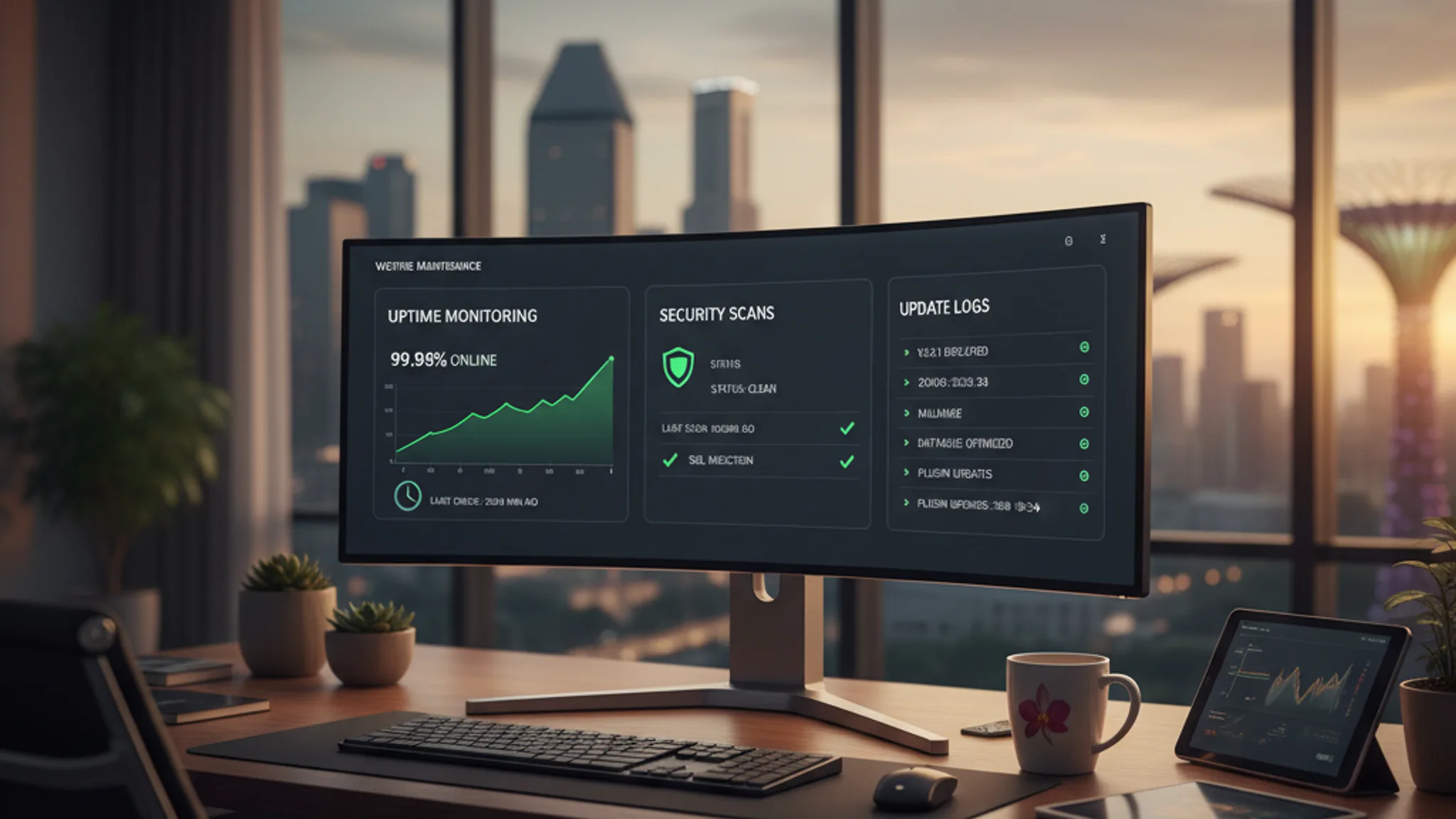
Before talking numbers, it helps to understand what "maintenance" covers. It's not one service, it's a bundle of recurring tasks that keep your site secure, functional, and visible on search engines.
Here's what a typical website maintenance package in Singapore includes:
- Web hosting: the server space your site lives on. Shared hosting runs $5–$25/month; managed cloud hosting (AWS, Vercel, DigitalOcean) costs $20–$100/month depending on traffic
- SSL certificate: encrypts data between your site and visitors. Free options like Let's Encrypt work for most businesses; extended validation certificates for e-commerce can cost $50–$200/year
- Software updates: CMS core updates, plugin patches, theme updates (WordPress sites need this weekly; static sites barely need it at all)
- Security monitoring: malware scanning, firewall configuration, brute-force protection, and DDoS mitigation. Critical for any site handling customer data
- Backups: daily or weekly snapshots of your site files and database, stored off-server so you can restore quickly if something breaks
- Uptime monitoring: automated checks that alert you (or your agency) when your site goes down, typically every 1–5 minutes
- Content updates: swapping out images, updating pricing, adding blog posts, adjusting copy. Some packages include a set number of hours per month for this
- Performance optimisation: image compression, caching, database cleanup, and Core Web Vitals improvements
Not every site needs every item on this list. A five-page brochure site hosted on Vercel has very different maintenance needs from a 500-product WooCommerce store running on a VPS. The key is matching the package to the actual risk and complexity of your setup, and being honest about what you can skip versus what will cost you dearly if neglected. If you are still choosing a host, our guide to the best web hosting in Singapore compares 10 providers with local server speeds and real pricing.
Website maintenance pricing by site type
The single biggest factor in your website maintenance cost is the type of site you're running. Here's what we see across our client base in Singapore:
Brochure websites (5–15 pages)
These are straightforward company sites: an About page, Services, Contact, maybe a blog. If built on a static framework like Astro, maintenance is minimal.
- Monthly cost: $50–$150
- What you're paying for: hosting ($10–$30), domain renewal (amortised to ~$1–$2/month), SSL, occasional content updates, annual security review
- Update frequency: quarterly or as needed
Business websites with a blog or CMS (15–50 pages)
Sites that get regular content updates, have contact forms, integrate with third-party tools, or run on WordPress.
- Monthly cost: $150–$400
- What you're paying for: managed hosting ($20–$60), CMS and plugin updates, weekly backups, security monitoring, 2–4 hours of content changes, basic performance checks
- Update frequency: weekly to fortnightly
E-commerce websites
Online stores with product catalogues, payment processing, inventory management, and customer accounts. The stakes are higher because downtime directly means lost revenue; an hour of downtime during a sale event can cost more than a full year of maintenance.
- Monthly cost: $400–$1,200+
- What you're paying for: managed/dedicated hosting ($50–$200), payment gateway maintenance, product updates, security hardening, daily backups, performance optimisation, 4–8 hours of support
- Update frequency: weekly or more
Custom web applications
Portals, dashboards, booking systems, SaaS products. These require developer-level maintenance, not just content updates.
- Monthly cost: $800–$3,000+
- What you're paying for: cloud infrastructure management, API monitoring, database maintenance, code-level bug fixes, feature updates, load testing, 8+ hours of developer support
- Update frequency: continuous
For a broader picture of upfront and ongoing costs, our complete guide to website costs in Singapore covers the full lifecycle from build to maintenance.
Recommended reads
WordPress maintenance vs custom/static site maintenance
This is where the conversation gets interesting, and where we've seen the biggest misconceptions. WordPress powers roughly 43% of websites globally, but its dominance comes with a maintenance tax that many business owners don't anticipate when they first build.
WordPress maintenance realities
A typical WordPress site uses 15–30 plugins. Every plugin is a potential vulnerability that needs regular updates. WordPress core releases major updates several times a year, and each update can break compatibility with themes or plugins. This creates a cycle:
- WordPress releases an update
- You update WordPress core
- Two plugins break because they haven't been updated for the new version
- You wait for plugin authors to release patches (or pay a developer to find alternatives)
- Repeat every few months
WordPress sites also need regular database optimisation, comment spam cleanup, and ongoing security hardening. WordPress is the most targeted CMS for malware attacks precisely because it's the most popular. According to Wordfence's threat intelligence data, vulnerable plugins account for the vast majority of WordPress compromises. Budget $150–$500/month for proper WordPress maintenance in Singapore.
Custom/static site maintenance
Sites built on frameworks like Astro or Next.js have a fundamentally different maintenance profile. Static sites generate plain HTML at build time; there's no database to hack, no plugins to update, and no server-side code executing on every page load.
The maintenance burden drops significantly:
- No CMS updates or plugin patches
- No database to optimise or back up separately
- Minimal attack surface (no admin login page to brute-force)
- Hosting on CDN platforms like Vercel or Netlify, often free or under $20/month
- Updates only when you actually need to change content
Budget $50–$150/month for a custom static site. The trade-off is that content changes require a developer (or a headless CMS setup), but the ongoing savings are substantial. Over three years, a WordPress site can cost $5,400–$18,000 in maintenance alone, while a comparable static site might cost $1,800–$5,400. That's a difference of $3,600–$12,600, enough to fund a complete site redesign.
We've covered this platform decision in depth in our WordPress vs custom website comparison.
DIY maintenance vs hiring an agency
Can you maintain your own website? Absolutely, if you know what you're doing and you value your time correctly.
Here's the honest maths. Let's say you run a WordPress business site and handle maintenance yourself:
- Time spent per month: 4–8 hours (updates, backups, checking for issues, making content changes, troubleshooting)
- Your hourly value: as a business owner in Singapore, your time is worth at least $50–$100/hour. That means you're spending $200–$800 worth of time on maintenance each month
- Risk factor: if you miss a security update or break something during an update, the cost of emergency repair by a developer is $100–$200/hour, and the cost of downtime (lost sales, lost trust) is harder to quantify but very real
Compare that to hiring an agency at $150–$400/month, someone who does this every day, catches problems before they escalate, and has the expertise to resolve issues in minutes rather than hours. The maths tilts further in the agency's favour when you account for the stress factor. Most business owners don't enjoy debugging white screens of death at midnight.
DIY makes sense in two scenarios:
- You have a simple static site that genuinely doesn't need much attention: no CMS, no plugins, no database. Check in on it quarterly, verify hosting is paid, done
- You enjoy the technical work and want to learn. Nothing wrong with that, just go in with eyes open about the time commitment
For context, when we built Perfect Style Salon's website, we chose a static Astro build specifically to minimise their ongoing maintenance burden. They spend less than an hour a month on their site, and that's mostly adding new portfolio photos. No plugin updates, no database patches, no security scares.
For everything else, outsourcing maintenance is almost always the better investment. You get your evenings back, and your site stays in professional hands.
Hidden costs most guides don't mention
The monthly maintenance fee isn't the whole story. Here are the costs that catch Singapore business owners off guard:
- Domain renewal: typically $10–$80/year depending on the extension. Premium .sg domains can cost $50–$80/year. If you forget to renew and someone else registers your domain, buying it back can cost thousands
- Premium plugin licences: many WordPress plugins offer free versions with limited features. The moment you need the pro version (for WooCommerce add-ons, form builders, SEO tools, page builders), you're looking at $50–$300/year per plugin. A site with five premium plugins costs $250–$1,500/year in licences alone
- Email hosting: Google Workspace or Microsoft 365 for professional email runs $7–$16/user/month. For a team of five, that's $420–$960/year
- Emergency fixes: your site gets hacked on a Saturday night, or a plugin update takes the checkout page offline. Emergency developer rates in Singapore typically run $150–$300/hour with a minimum call-out fee. We've seen emergency malware cleanups cost $500–$2,000
- Third-party tool subscriptions: analytics platforms, heatmap tools, live chat widgets, CRM integrations. Each one is $10–$100/month, and they add up fast
- Content creation: maintaining a blog for SEO purposes means ongoing investment in writing, images, and promotion. Even one post per month costs $200–$600 if you hire a professional writer
When you total everything up, a WordPress business website in Singapore realistically costs $3,000–$8,000 per year to maintain properly, not just the $150/month maintenance fee your agency quoted. Factor these into your budgeting from day one so there are no surprises down the line.
How to reduce your website maintenance costs
Here's where we save our clients real money, and yes, we benefit from this advice too, because lower-maintenance sites mean fewer late-night support calls.
1. Choose the right platform from the start
This is the single highest-leverage decision. A static site built on Astro and deployed to Vercel costs a fraction of what a WordPress site on managed hosting costs to maintain. If your site is primarily informational (services, portfolio, blog, contact), you likely don't need a full CMS. We've written extensively about how Astro compares to WordPress and Next.js for Singapore businesses.
2. Minimise plugins and third-party dependencies
Every plugin is a recurring cost (updates, compatibility, licences) and a security liability. Before adding a plugin, ask: can this be done with native code? A custom contact form costs nothing to maintain; a plugin-based form builder costs $49–$199/year and needs quarterly updates.
3. Use free-tier hosting where appropriate
Platforms like Vercel, Netlify, and Cloudflare Pages offer generous free tiers that handle most brochure and small business websites comfortably. You get global CDN distribution, automatic HTTPS, and zero server management, all for $0/month. That's not a promotional offer; it's the permanent free tier. Move to paid plans only when traffic demands it.
4. Automate backups and monitoring
Don't pay someone to manually back up your site. Use automated tools. UpdraftPlus for WordPress (free tier available), or Git-based deployment workflows for custom sites that inherently version every change. Set up free uptime monitoring through UptimeRobot or Better Stack.
5. Bundle services with your web development agency
If the same team that built your site also maintains it, they already understand the codebase, hosting setup, and business context. No onboarding time, no knowledge gaps. Most agencies (ourselves included) offer discounted maintenance rates for clients whose sites we built, because it's more efficient for both sides.
6. Invest in quality upfront
A cheaply built website costs more to maintain. Poor code means more bugs. Bloated themes mean slower performance. Weak security means eventual breaches. Spending an extra $1,000–$2,000 on a well-architected build saves multiples of that in reduced maintenance over the site's lifetime.
Think of it like buying a car. A reliable vehicle with a solid engine costs more upfront but doesn't leave you stranded on the side of the road every other month. The same principle applies to websites: the build quality determines the maintenance burden for years to come.
Website maintenance isn't optional, but overpaying for it is. Too many Singapore business owners either spend far more than they need to (because their agency bundles unnecessary services) or spend nothing at all (and pay the price when their site gets hacked or breaks). The key is understanding what your specific site needs and choosing a maintenance approach that matches.
For a simple brochure site on a modern static framework, $50–$150/month covers everything. For a WordPress business site, budget $150–$400/month plus annual plugin licences. For e-commerce, expect $400–$1,200/month; the stakes justify the spend.
If you're building a new site and want to keep long-term costs down, consider a static-first approach. If you're stuck with a WordPress site that's becoming expensive to maintain, a rebuild might pay for itself within 12–18 months through reduced website upkeep cost.
We help Singapore businesses build websites that perform well and cost less to run. Whether you need a new website built right the first time or a website maintenance plan for your existing site, we're happy to give you an honest assessment, no upsell, just practical advice.
Get a free quote, or drop us a message on WhatsApp if you'd prefer a quick chat.
Sources & References (2)

Written by
Terris
Founder & Lead Strategist
Terris has built and maintained over 120 websites for Singapore businesses, from five-page brochure sites to large-scale e-commerce platforms. He brings hands-on technical experience to every recommendation, having managed hosting infrastructure, security patching, and performance optimisation across WordPress, Astro, and custom-coded projects.
Want to see these strategies in action? Browse our portfolio or get in touch to discuss your project.