

Terris Recommends 16,400+ monthly visitors Weddings
9 Best Wedding Solemnisers in Singapore (August 2026)
My guide to engaging a wedding solemniser in Singapore for 2026, how the ROM process works, appointing your own licensed solemniser.
This guide is part of Terris Recommends, my researched, hands-on picks of the best local businesses and services in Singapore. Every recommendation is researched and ranked by me.
See all recommendationsChoosing a wedding solemniser in Singapore works differently from almost everywhere else, and it trips couples up. Here there are no independent wedding celebrants: every solemniser is licensed by the Registry of Marriages, or ROM. So the decision is not whether to use a licensed official, it is whether to accept a ROM-appointed solemniser or invite your own for a more personal ceremony.
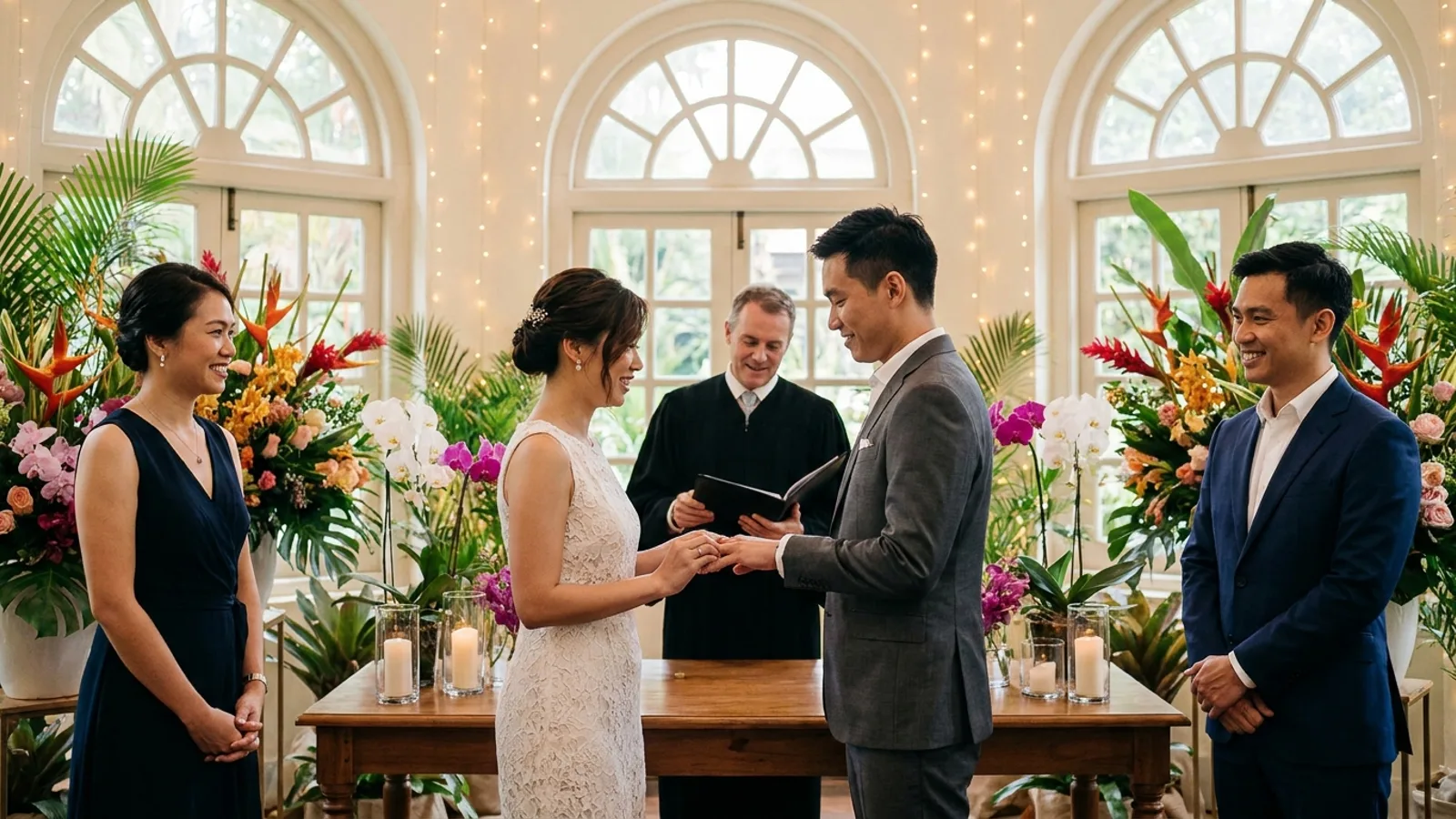
Inviting your own licensed solemniser lets you hold the ceremony at your venue, with a customised script and your choice of language, which is what most couples marrying outside the registry office want. In this guide I will walk through how the ROM process actually works, explain the appointed-versus-your-own choice, and share solemnisers who are frequently recommended, sorted by the languages they cover.
This is part of my Terris Recommends Weddings series. It pairs with my guides to wedding photographers and, for the celebration around it, my party venue picks.
The legal process is run through the official Registry of Marriages portal. Here is the sequence.
- File the Notice of Marriage. Log in to the marriage.gov.sg portal with Singpass and file your notice between 21 days and 6 months before your chosen date. The filing fee is around S$42 if at least one of you is a citizen or PR, and more if both are foreigners.
- Appoint your solemniser. You either accept a ROM-appointed solemniser at the registry office, or invite your own licensed solemniser for an external venue. You browse the directory, contact the solemniser to confirm availability, get their consent and licence number, then invite them online.
- Submit the application. Enter your date, time, venue and the solemniser's name and licence number.
- Two witnesses. You need two witnesses aged 21 or above, of any nationality, whose ID goes into the application and who attend on the day.
- Be present. Both of you and both witnesses must be physically in Singapore, and you reconfirm with your solemniser a few days before.
You can always browse the full, current pool on the official ROM solemniser directory, which is the authoritative list and where you should verify any solemniser's licence before booking.
This is the choice that matters most, so it is worth understanding clearly.
A ROM-appointed solemniser is assigned to you when you solemnise at the registry office or the Marriage Booth. It is simple and free, but the ceremony is standard and you do not choose the person or the script. You may not pay or tip a ROM-office solemniser.
Engaging your own licensed solemniser means picking one from the directory for a ceremony at your own venue, on your date, with a personalised script, your choice of language or dialect, and your vows. This is what couples holding their solemnisation at a restaurant, hotel or garden want. Because every solemniser is ROM-licensed, the ceremony is equally legally valid either way. The only difference is how personal it is, and that you offer a goodwill ang bao, customarily S$100 to S$200, when you engage your own for an external venue.
Solemnisers in Singapore are volunteers, often Justices of the Peace or community leaders, and they do not charge a fee. The costs around a solemnisation are the government filing fee, around S$42 for couples with a citizen or PR, and a customary goodwill ang bao when you engage your own solemniser for an external venue, usually S$100 to S$200.
You should not pay or tip a ROM-appointed solemniser at the registry office. Some solemnisers who offer a highly personalised, scripted ceremony with consultations may indicate a higher token of appreciation, in the region of S$200 to S$500, but this is for the extra work rather than a fixed charge. Always clarify expectations politely when you first make contact.
| Solemniser | Languages | Style |
|---|---|---|
| Dr Shirley Low | English, Mandarin | Warm and personalised |
| Mr Cheong Khim Teck | English, Mandarin | Traditional civil, clear and dignified |
| Ms Jennifer Lim Lay Choo | English, Mandarin, Hokkien, Cantonese | Professional and articulate |
| Mr Alex Tan Yan Boon | English, Mandarin, Cantonese | Light-hearted and personable |
| Dr Jasbir Singh | Punjabi, English, Malay | Civil |
| Mr Anbarasu s/o Rajendran | English, Tamil | Civil |
| Ms Chandra Mallika | English, Tamil | Civil, warm |
| Mdm Lim Seok Bee | English, Mandarin, Hokkien, Teochew | Civil, multi-dialect |
| Dr Chew Tuan Chiong | English, Mandarin | Civil, dignified |
Dr Shirley Low is one of the most-requested solemnisers in Singapore, and for good reason. Couples consistently describe her ceremonies as warm and genuinely personalised, and she conducts in both English and Mandarin, which suits most mixed-generation families.
Because she is so sought-after, she books out early, so approach her well ahead of your date. For a heartfelt, bilingual ceremony from a widely loved solemniser, she is my first suggestion.
Languages: English, Mandarin
Style: Warm and personalised
Good to know: Very popular, so book early and verify her licence on the ROM directory
Mr Cheong Khim Teck is a long-serving, reliable solemniser who is widely recommended for a clear, dignified civil ceremony. He conducts in English and Mandarin, and couples value his calm, dependable manner on the day.
For a couple who want a traditional, well-run solemnisation without fuss, he is a safe and respected choice. His experience shows in how smoothly the ceremony flows.
Languages: English, Mandarin
Style: Traditional civil, clear and dignified
Good to know: Long-serving and reliable; confirm availability early
Ms Jennifer Lim, a lawyer by profession, is my pick for a family that spans dialects. She conducts in English, Mandarin, Hokkien and Cantonese, which is a genuinely useful range when older relatives are more comfortable in dialect than in English or Mandarin.
Her professional background brings a polished, articulate delivery to the ceremony. For a multi-generational family that wants everyone to follow along, she is an excellent choice.
Languages: English, Mandarin, Hokkien, Cantonese
Style: Professional and articulate
Good to know: Strong multi-dialect coverage for mixed families
Mr Alex Tan is my pick for a light-hearted, personable ceremony. He conducts in English, Mandarin and Cantonese, and his warm, sometimes emcee-like style suits couples who want their solemnisation to feel fun and relaxed rather than formal.
That crossover between solemniser and host works well for an informal venue ceremony. For a couple who want a bit of personality and warmth on the day, he is a lovely choice.
Languages: English, Mandarin, Cantonese
Style: Light-hearted and personable
Good to know: Bilingual with an emcee-style warmth
Dr Jasbir Singh is my pick for a Punjabi-speaking ceremony, which is a rare and valuable option. He conducts in Punjabi, English and Malay, so he suits couples and families for whom a Punjabi-language solemnisation matters.
That specific language coverage is hard to find, so he is worth approaching early if it fits your family. For a Punjabi or multilingual ceremony, he is a standout choice.
Languages: Punjabi, English, Malay
Style: Civil
Good to know: A rare Punjabi-speaking solemniser; book ahead
Mr Anbarasu is my pick for a Tamil-language ceremony. He conducts in English and Tamil, which makes him well suited to Indian weddings and families who want the solemnisation delivered in Tamil so everyone can follow.
Tamil-speaking solemnisers are in shorter supply, so he is a valuable option to secure early. For a bilingual English-and-Tamil solemnisation, he is a strong choice.
Languages: English, Tamil
Style: Civil
Good to know: Tamil-speaking; useful for Indian weddings
Ms Chandra Mallika is another excellent Tamil-speaking option, conducting in English and Tamil. Having more than one strong Tamil-speaking solemniser to consider is genuinely helpful, since availability on a given date can be tight.
She is well regarded for a warm, clear bilingual ceremony. For an Indian family wanting a Tamil-and-English solemnisation, she is a dependable choice alongside Mr Anbarasu.
Languages: English, Tamil
Style: Civil, warm
Good to know: A second strong Tamil-speaking option
Mdm Lim Seok Bee is my pick for the broadest Chinese-dialect range. She conducts in English, Mandarin, Hokkien and Teochew, which is a rare combination, and it means a ceremony that grandparents and older relatives can genuinely follow in their mother tongue.
For a Chinese family with Teochew or Hokkien-speaking elders, that inclusiveness is a real gift. For the widest dialect coverage, she is a wonderful choice.
Languages: English, Mandarin, Hokkien, Teochew
Style: Civil, multi-dialect
Good to know: The broadest Chinese-dialect range on this list
Dr Chew Tuan Chiong rounds out the list as a well-established English and Mandarin solemniser. He is a dependable, dignified option for a couple who want a straightforward bilingual civil ceremony from an experienced official.
For a classic English-and-Mandarin solemnisation delivered with gravitas, he is a solid choice. As with everyone here, confirm his current availability and licence on the ROM directory.
Languages: English, Mandarin
Style: Civil, dignified
Good to know: An established English-Mandarin option
Because Singapore solemnisers are volunteers who are booked directly rather than businesses with websites, I focused on names that are consistently recommended by couples and wedding sources, and I sorted them by the languages and dialects they cover, which is the most useful way to choose. I have deliberately included scarcer Tamil, Hokkien, Teochew and Punjabi speakers, since those are the hardest to find.
Solemnisers' licences lapse and are renewed, and availability changes, so always verify a solemniser's current licence and book them through the official ROM directory, and reconfirm with them a few days before your ceremony.
After you file your Notice of Marriage on the marriage.gov.sg portal, go to the appoint-a-solemniser step and choose to invite your own licensed solemniser rather than accept a ROM-appointed one. You browse the official directory, contact your chosen solemniser directly to confirm they are available on your date, obtain their signed consent and licence number, and then formally invite them through the portal. You then submit your marriage application with the date, time, venue and their details. This is how couples hold a personalised solemnisation at their own venue.
Solemnisers are volunteers and do not charge a fee. When you engage your own solemniser for a ceremony at an external venue, it is customary to give a goodwill ang bao, usually S$100 to S$200, as a token of appreciation. You may not pay or tip a ROM-appointed solemniser at the registry office. The only compulsory cost is the government filing fee for your Notice of Marriage, which is around S$42 if at least one of you is a citizen or PR. Clarify expectations politely when you first contact a solemniser.
You need two witnesses for a solemnisation in Singapore, both aged 21 or above. They can be of any nationality and are usually close friends or family members. Their identification details are entered into your marriage application in advance, and they must be physically present at the ceremony to sign the marriage certificate. Choose two people who will reliably be there on the day, as the solemnisation cannot be completed without them.
Yes. By inviting your own licensed solemniser rather than using a ROM-appointed one, you can hold your solemnisation at a venue of your choice, a restaurant, hotel, garden or even your home, on your own date and time. You can personalise the script, include your own vows, and have the ceremony conducted in your preferred language or dialect. It is legally identical to a registry-office solemnisation because the solemniser is ROM-licensed, but it is far more personal, which is why most couples marrying outside the office choose this route.
Couples shortlisting wedding solemnisers in Singapore usually have six tabs open, and they are comparing packages line by line.
The vendor whose site states what is in each package, how many hours, how many edits, and roughly what it costs is the one who gets the reply. Everyone else gets "may I know your price?" and then silence. I build websites for Singapore wedding vendors that make the comparison easy on purpose, and handle the SEO so you appear during the months couples are actually searching.
Wedding work is seasonal and referral-heavy, which makes a quiet stretch expensive. Send me your site and I will tell you where the enquiries are going.
The best wedding solemniser in Singapore is a licensed one whose language and style fit your ceremony, so the real decision is to invite your own rather than accept a ROM-appointed solemniser if you want a personal, venue-based ceremony. Match the solemniser to your family's languages, from the common English and Mandarin to scarcer Tamil, Teochew or Punjabi, and book the popular names early.
File your notice in good time, appoint your solemniser through the official portal, line up your two witnesses, and your solemnisation will be both legally sound and genuinely yours.
The solemniser is the legal part. For everything around it, my guides to the best wedding planners in Singapore and the best wedding car rentals cover the two bookings people most often leave until it is too late.
If you run a wedding business and your website is not bringing in enquiries, that is what I do. I design websites for businesses across Singapore. Get in touch for a free consultation.