







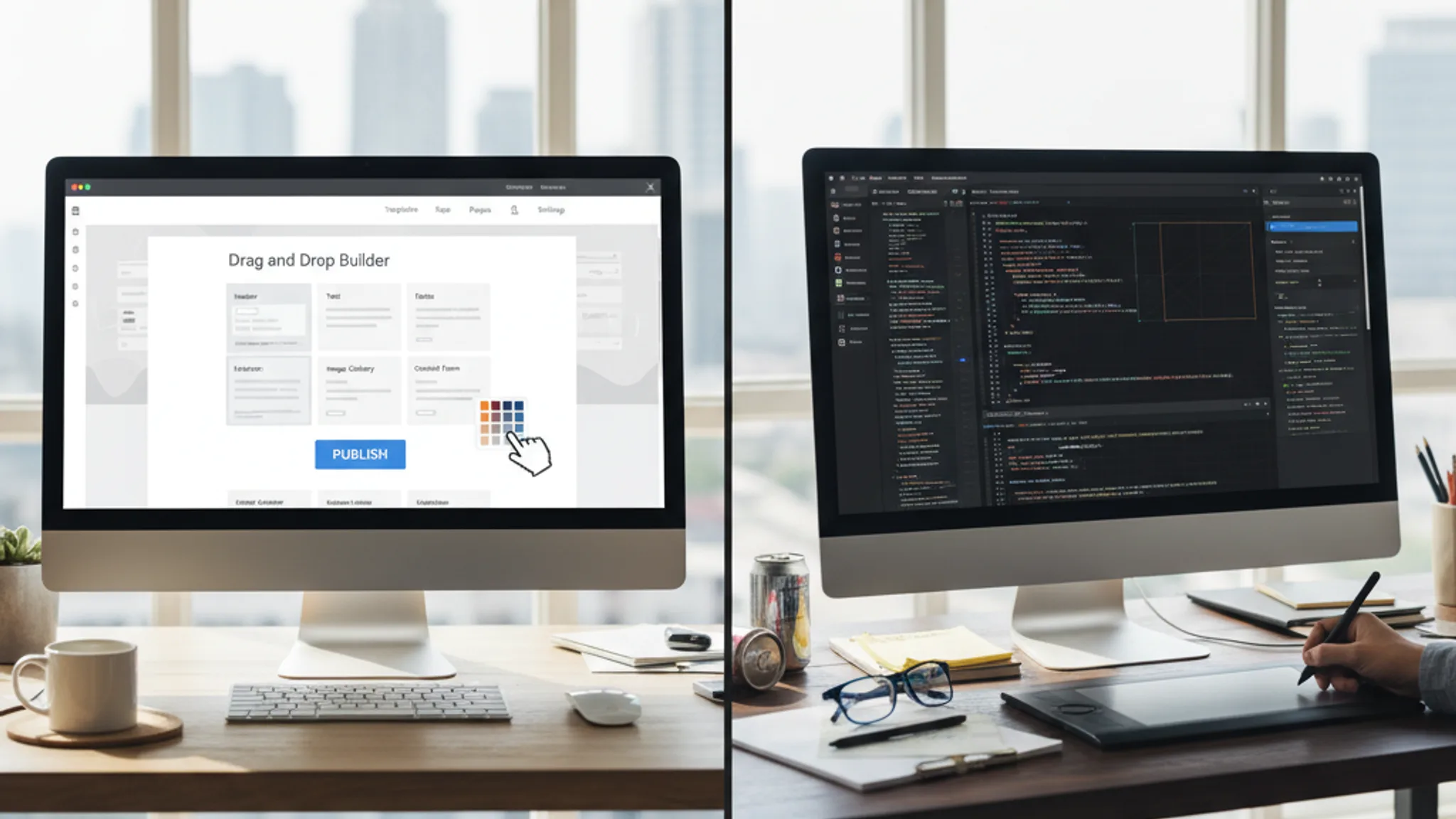
DIY websites cost S$0 to S$50 per month but take 20 to 40 hours of your time. A professional web designer costs S$3,000 to S$10,000 but delivers in 3 to 6 weeks with SEO, mobile optimisation, and conversion strategy built in. That is the short answer.
The longer answer depends on your business, your goals, and how you value your time. We have built websites for over 100 Singapore businesses since 2018, and we have also told prospective clients to start with Wix or Squarespace when that genuinely made more sense for them. This post gives you the honest breakdown so you can make the right call.
If you are weighing up the full cost of a website in Singapore, this comparison will give you the practical details most articles leave out.
Key Takeaways
- 1 Quick verdict: DIY vs freelancer vs agency Jump to this section
- 2 DIY website builders: the honest truth Jump to this section
- 3 What you actually get from a professional web designer Jump to this section
- 4 The real cost comparison (Singapore pricing) Jump to this section
- 5 When DIY makes sense Jump to this section
Quick verdict: DIY vs freelancer vs agency
Before we get into the details, here is a side-by-side comparison of the three main routes Singapore businesses take when building a website.
| Factor | DIY (Wix, Squarespace) | Freelance Designer | Agency / Studio |
|---|---|---|---|
| Cost | S$0 to S$600/year | S$2,000 to S$6,000 | S$5,000 to S$30,000+ |
| Timeline | 1 to 4 weeks (your time) | 3 to 6 weeks | 6 to 12 weeks |
| Design quality | Template-based, generic | Custom, brand-aligned | Premium, fully bespoke |
| SEO | Basic (limited control) | Solid foundation | Comprehensive strategy |
| Ongoing support | Self-managed | Varies (ask upfront) | Included in retainer |
| Best for | Hobby, side project, testing ideas | SMEs, service businesses, startups | Large businesses, e-commerce, complex needs |
Choose DIY if you are testing a business idea, running a hobby project, or have a very tight budget with no revenue yet. Hire a professional if your website needs to generate leads, sell products, or represent a revenue-generating business.
Now let us break down exactly what each option involves.
DIY website builders: the honest truth
Website builders have improved dramatically. The drag-and-drop editors in 2026 are genuinely good, and we are not going to pretend otherwise. Here is what the main platforms offer and where they fall short.
Wix
- Best drag-and-drop editor on the market. Very flexible layout control.
- Over 900 templates to start from. Good for restaurants, portfolios, and small shops.
- Wix ADI can generate a basic site in minutes using AI.
- Limitations: slower page load speeds compared to custom sites, limited SEO control (improving but still behind WordPress), and your site lives on Wix's infrastructure permanently. You cannot move it.
- Pricing: free plan with Wix branding, or S$22 to S$50 per month for business plans.
Squarespace
- The most visually polished templates. If aesthetics matter and you want something that looks professional out of the box, Squarespace is the strongest choice.
- Built-in e-commerce, booking, and email marketing tools.
- Less flexible than Wix in terms of layout customisation, but the constraints actually help non-designers avoid making ugly sites.
- Limitations: fewer integrations than Wix or WordPress, and SEO options are more basic.
- Pricing: S$23 to S$65 per month.
Shopify
- The best option if your primary goal is selling products online.
- Inventory management, payment processing, and shipping integration all built in.
- Large ecosystem of apps and themes.
- Limitations: for a content-heavy or service-based business, it is overkill and the blogging tools are weak. Transaction fees apply unless you use Shopify Payments.
- Pricing: S$39 to S$399 per month.
WordPress.com (hosted version)
- Familiar name, huge ecosystem. Good for content-heavy sites and blogs.
- The hosted version (WordPress.com) is simpler to manage than self-hosted WordPress.org.
- Limitations: the free plan is very restrictive. You need the Business plan (S$45/month) to install custom plugins. The gap between WordPress.com and self-hosted WordPress confuses many people.
For a deeper dive, we compared all the best website builders for Singapore businesses. We also covered AI website builders vs professional agencies if you are curious about tools like Framer AI or Durable.
The bottom line on DIY builders: they are good for getting something live quickly and cheaply. They are not good for standing out from competitors, ranking well on Google, or converting visitors into paying customers at a high rate.
What you actually get from a professional web designer
Hiring a professional web designer in Singapore is not just paying someone to make a prettier version of what you could build yourself. The deliverables are fundamentally different.
Business strategy and positioning
A good designer starts by understanding your market, your competitors, and your ideal customer. Before a single pixel is designed, they will audit competitor websites, identify gaps in how you present your services, and map out a site structure that guides visitors toward conversion. With a DIY builder, you skip this step entirely and jump straight to choosing a template.
Custom design that reflects your brand
Templates are used by thousands of other businesses. A custom design is built around your brand identity, your colour palette, your photography style, and your unique selling points. Your visitors can tell the difference, even if they cannot articulate it. A custom site communicates: "this business is established and professional." A template site communicates: "this business just started."
SEO foundation from day one
Professional designers build SEO into the site architecture. That means proper heading hierarchy, optimised meta titles and descriptions, structured data markup (Schema.org), fast load times, clean URL structures, and internal linking strategies. These are not things you can easily bolt on later. A well-built WordPress site or a custom-coded site will outperform a Wix or Squarespace site in search rankings, all else being equal.
Mobile optimisation that actually works
DIY builders claim to be "mobile responsive," and technically they are. But responsive does not mean optimised. A professional designer tests on real devices, adjusts layouts for thumb-friendly navigation, ensures touch targets are large enough, and prioritises the content hierarchy for mobile users. With over 70% of Singapore web traffic coming from mobile devices, this matters.
Conversion-focused design
Where should the call-to-action button go? What colour should it be? Should the phone number be in the header or a sticky bar? Should the contact form have three fields or seven? These decisions are informed by data and experience, not guesswork. Professional designers make hundreds of these micro-decisions, each one backed by conversion research and real-world testing.
Ongoing support and maintenance
When something breaks on a DIY site, you are on your own (or in a support queue). With a professional, you have a direct line to someone who knows your site inside out and can fix issues quickly. Most freelancers and agencies offer maintenance plans that include security updates, content changes, and performance monitoring.
The real cost comparison (Singapore pricing)
Most articles compare the sticker price of DIY vs professional and call it a day. That is misleading. The true cost includes your time, opportunity cost, and hidden expenses. Here is a more honest comparison.
DIY website: total cost of ownership (Year 1)
- Platform subscription: S$300 to S$600 per year
- Domain name: S$15 to S$30 per year
- Premium template (optional): S$50 to S$150 (one-time)
- Premium plugins/apps: S$100 to S$500 per year
- Stock photos: S$50 to S$200
- Your time (30 to 50 hours at opportunity cost): this is the big one. If your hourly rate is S$50, that is S$1,500 to S$2,500 of your time. If you bill S$100/hour, it is S$3,000 to S$5,000.
Realistic DIY total: S$2,000 to S$6,000 when you factor in your time.
Professional website: total cost (Year 1)
- Design and development: S$3,000 to S$8,000 (freelancer) or S$5,000 to S$30,000 (agency)
- Domain name: S$15 to S$30 per year (often included)
- Hosting: S$100 to S$300 per year (often included in Year 1)
- Maintenance plan (optional): S$100 to S$300 per month
- Your time: 5 to 10 hours for briefing, feedback, and content approval
Realistic professional total: S$3,500 to S$10,000 for a freelancer. S$6,000 to S$35,000 for an agency.
The surprise for most people: when you account for time, the gap between DIY and hiring a freelancer is much smaller than they expected. And the freelancer delivers a significantly better result.
For a complete breakdown including hosting, maintenance, and ongoing costs, read our full guide to website costs in Singapore.
When DIY makes sense
We are not going to tell you that everyone needs a professional designer. That would be dishonest. Here are the situations where building it yourself is the right call.
You are testing a business idea. If you are not sure whether your concept has legs, spending S$5,000 on a website before you have validated the idea is wasteful. Build a simple Wix or Squarespace site, run some ads, see if people are interested. If the idea works, invest in a proper site later.
It is a hobby or personal project. A blog about your travel adventures, a portfolio of your photography, a fan site for your football club. These do not need conversion optimisation or SEO strategy. A clean template and your own content is all you need.
You have a very tight budget with no revenue yet. If you are bootstrapping and every dollar counts, getting something live on a free or low-cost plan is better than having no web presence at all. A basic website beats no website every time.
You enjoy building websites. Some business owners genuinely like tinkering with their site. If learning Wix or Squarespace is something you find fun rather than frustrating, go for it. The skills you build will be useful even when you eventually hire a professional.
Your business is purely word-of-mouth. If 100% of your customers come through referrals and you just need a simple online presence to validate your legitimacy, a template site does the job. Think: a one-page site with your services, contact details, and a few client testimonials.
Recommended reads
When you should hire a professional
Conversely, here are the scenarios where DIY will cost you more in the long run.
Your website needs to generate leads. If your business depends on enquiries, consultations, or quote requests coming through your website, a professional site will outperform a DIY site by a wide margin. We have seen businesses double or triple their monthly enquiries after upgrading from a template site. The difference comes from better positioning, clearer calls-to-action, faster load times, and proper SEO.
You sell products online. E-commerce success depends on user experience, trust signals, and a smooth checkout flow. A professional can optimise your product pages, implement upselling and cross-selling, set up abandoned cart recovery, and ensure your site loads fast enough to prevent drop-offs. Shopify is great, but a professionally customised Shopify store outperforms a default one.
You are spending money on ads. If you are running Google Ads or Facebook Ads and sending traffic to a DIY website, you are likely wasting ad spend. Paid traffic converts at higher rates on professionally designed landing pages. Even a 1% improvement in conversion rate can mean thousands of dollars in additional revenue. We cover this in detail in our website mistakes that kill sales guide.
You are a professional services firm. Lawyers, clinics, consultancies, financial advisors, architects. Your website is your first impression for prospective clients. A template site with stock photos undermines the credibility you have spent years building. Your website should reflect the quality of your work.
You need to rank on Google. If organic search traffic is part of your growth strategy, the SEO advantages of a professionally built site are significant. Custom sites give you full control over page speed, structured data, internal linking, and technical SEO factors that DIY builders limit.
Your competitors have professional websites. If the other businesses in your space have polished, custom websites and you are using a Wix template, visitors will notice. They may not consciously think "this site looks cheap," but they will feel less confident in your business. Perception matters.
The hidden costs of DIY that nobody talks about
The sticker price of DIY is attractive. The actual cost is often higher than people expect. Here are the hidden costs we see clients run into before they come to us.
Your time is not free. This is the biggest one. Every hour you spend dragging and dropping elements, watching YouTube tutorials, troubleshooting mobile layout issues, and tweaking fonts is an hour you are not spending on sales, client work, or growing your business. Most business owners underestimate this by a factor of two or three. What you think will take a weekend ends up taking three to four weeks of evenings.
Opportunity cost. A professional site goes live faster and starts generating leads sooner. If your site is generating even one additional client per month worth S$500, a three-month delay in getting a proper site live costs you S$1,500 in missed revenue. Over a year, that adds up to more than the cost of hiring a designer.
Plugin and app costs accumulate. Want a proper contact form? S$10/month. SEO tools? S$15/month. Booking integration? S$20/month. Live chat? S$15/month. Analytics? S$10/month. These individually small costs add up to S$70 to S$150 per month, which is S$840 to S$1,800 per year on top of your platform subscription.
Poor SEO costs you traffic. DIY sites typically have slower page load speeds, less control over technical SEO, and weaker site architecture. The result: lower Google rankings, less organic traffic, and higher dependence on paid advertising. The SEO gap between a DIY site and a well-built professional site widens every month.
You will probably redesign it. Most businesses that start with DIY end up hiring a professional within 12 to 18 months. They outgrow the template, get frustrated with the limitations, or realise their site is not generating results. Now they have spent money on the DIY version and money on the professional version. If they had started with a professional site, they would have saved time and money overall.
Security and compliance risks. Professional developers implement SSL, regular backups, PDPA-compliant forms, and security best practices. DIY builders handle some of this, but if you are adding third-party plugins or handling customer data, the responsibility for compliance falls on you. Getting this wrong can be costly.
The middle ground: a hybrid approach
You do not have to choose one extreme or the other. Here is a practical approach we often recommend to Singapore business owners who are just starting out.
Phase 1: Launch fast with DIY (Month 1 to 3). Build a simple, clean site on Squarespace or Wix. Focus on getting the basics right: clear description of what you do, contact information, and a few client testimonials or project photos. Do not try to make it perfect. The goal is to get online and start testing your messaging with real visitors.
Phase 2: Validate with data (Month 3 to 6). Install Google Analytics and track what is happening. Are people visiting? Are they enquiring? What pages are they spending time on? This data becomes invaluable when you brief a professional designer later, because you will know what works and what does not, rather than guessing.
Phase 3: Invest in professional design (Month 6 to 12). Once your business is generating revenue and you have real data on how people use your site, hire a professional to build a proper website. You will get a much better result because you can give the designer concrete information: "most of our visitors land on the services page," "our highest-converting traffic comes from Google," "clients always ask about pricing before they enquire."
This phased approach means you are not spending S$5,000 before you have earned a dollar. But you are also not stuck with a mediocre DIY site once your business outgrows it.
When you are ready for Phase 3, our guide on how to choose a web design agency in Singapore will help you find the right partner.
Is Wix good enough for a small business in Singapore?
For a very small business that relies on word-of-mouth and just needs a basic online presence, yes. For a business that needs to attract new customers through Google search, social media, or advertising, a professionally built site will deliver significantly better results. The gap is most noticeable in page speed, SEO performance, and conversion rates.
How much does a web designer charge in Singapore?
Freelance web designers in Singapore typically charge S$2,000 to S$6,000 for a standard business website (5 to 10 pages). Agencies charge S$5,000 to S$30,000 or more depending on complexity. Ongoing maintenance ranges from S$100 to S$300 per month. You can read our full pricing guide for a detailed breakdown.
Can I build a website myself with no experience?
Yes. Platforms like Wix and Squarespace are designed for non-technical users. You can build a functional website without writing any code. However, "functional" and "effective" are different things. You will be able to create a site that looks decent, but optimising it for search engines, conversions, and mobile performance requires knowledge that takes years to develop.
Should I use WordPress or Wix for my Singapore business?
If you plan to manage the site yourself, Wix is easier. If you want maximum flexibility and plan to hire a developer for customisation, WordPress is the stronger choice. WordPress powers over 40% of websites globally and offers far more control over SEO, design, and functionality. The trade-off is a steeper learning curve.
How long does it take a web designer to build a website?
A typical 5 to 10 page business website takes 3 to 6 weeks from briefing to launch. Complex projects with custom functionality, e-commerce, or extensive content can take 8 to 12 weeks. The timeline depends on how quickly you provide content, feedback, and approvals. For comparison, a DIY site takes 20 to 50 hours of your own time spread over 2 to 4 weeks.
What if I start with DIY and want to upgrade later?
This is a common and perfectly valid path. Keep your original content, analytics data, and any customer feedback you have gathered. A professional designer can use all of this to build a better version. The only downside is that you cannot migrate a Wix or Squarespace site to another platform; your designer will build from scratch. That is actually a good thing, because the new site will be purpose-built rather than constrained by a template.
The decision between DIY and professional comes down to this: if your website is a cost centre (personal project, hobby, or early-stage experiment), DIY makes sense. If your website is a revenue driver (lead generation, e-commerce, professional credibility), hiring a professional is an investment that pays for itself.
Most Singapore business owners who try DIY first end up hiring a professional within a year. That is not a failure; it is a natural progression. The important thing is making the right choice for where your business is right now, not where you hope it will be in five years.
If you are at the stage where your website needs to generate real business results, we can help. We build conversion-focused websites for Singapore SMEs, with transparent pricing and no lock-in contracts. See how our web design process works, or reach out for a free consultation to discuss whether DIY or professional is the right move for your specific situation.

Written by
Terris
Founder & Lead Strategist
Terris has built websites professionally for Singapore businesses since 2018. He gives honest advice about when DIY makes sense and when hiring a professional delivers better ROI, based on real project experience.
Want to see these strategies in action? Browse our portfolio or get in touch to discuss your project.