





Yes, in 2026 most Singapore businesses need a website. But not every business, and not right away. This guide gives you a clear decision framework so you can figure out whether a website is essential for your situation, or whether you can hold off and invest your money elsewhere first.
We build websites for a living, so you might expect us to say "everyone needs one." But we have turned away clients who genuinely did not need a website yet. A hawker stall with a loyal queue every lunchtime does not need a S$3,000 website. A law firm competing for high-value clients absolutely does.
The honest answer depends on your business model, your price point, how customers find you, and where you are in your growth journey. Here is the framework we use when advising Singapore business owners.
Key Takeaways
- 1 The quick answer: do you need a website? Jump to this section
- 2 Why websites still matter in 2026 Jump to this section
- 3 Website vs social media only: the honest comparison Jump to this section
- 4 Website vs Google Business Profile only Jump to this section
- 5 Types of businesses that absolutely need a website Jump to this section
The quick answer: do you need a website?
If you sell products or services above S$500, you almost certainly need a website. If customers search Google for what you offer, you need a website. If you spend money on any form of advertising, you need a website. Full stop.
You need a website if:
- You sell services priced above S$500 (consulting, legal, medical, renovations, education)
- You rely on Google or online advertising to attract new customers
- You operate in a competitive industry where credibility matters (professional services, B2B, healthcare)
- You want to rank in Google search results for your products or services
- You are running Google Ads, Facebook Ads, or any paid campaigns
- You sell products online or want to accept orders digitally
- Your competitors all have websites (and in Singapore, most of them do)
You might not need a website yet if:
- You are pre-revenue and still testing a business idea
- You get 100% of your customers through personal referrals and word of mouth
- You run a micro business or side hustle with no plans to scale
- Your entire customer base is on a single platform (e.g., a Carousell seller doing well)
Notice the word "yet" in that second list. Most businesses that start without a website eventually need one as they grow. The question is timing.
Why websites still matter in 2026
Social media platforms come and go. TikTok faces regulatory pressure globally. Instagram changes its algorithm every few months. Facebook organic reach has dropped to around 2% for business pages. But your website? That is digital real estate you own outright.
Here is why websites remain essential for serious businesses in Singapore:
1. Credibility and trust
75% of consumers judge a company's credibility based on its website design. When a potential client searches for your business and finds nothing but a Facebook page, it raises questions. Do they have an office? Are they legitimate? Have they been in business long? A professional website answers all of those questions before a single conversation happens.
2. 24/7 availability
Your website works while you sleep. It answers questions, showcases your portfolio, explains your pricing, and captures enquiries at 2am on a Sunday. In Singapore's always-on economy, that matters. We have clients who receive 30 to 40% of their leads outside business hours.
3. Search engine visibility
88% of consumers research online before making a purchase. If your business does not appear in Google search results, you are invisible to the majority of potential customers. Social media profiles do appear in Google, but they rank far below dedicated websites for most commercial search terms. A properly optimised website with good SEO fundamentals gives you a fighting chance at appearing when people search for what you sell.
4. Ownership vs renting
Building your business on social media alone is like renting a shophouse on someone else's terms. The landlord (Meta, TikTok, Google) can change the rules overnight. Algorithm changes, account suspensions, platform shutdowns: these are not hypothetical risks. They happen regularly. Your website is property you own. Your email list, your content, your customer data: all under your control.
5. Lead generation and conversion
A well-designed website with clear calls to action, contact forms, and trust signals (testimonials, case studies, certifications) converts visitors into leads far more effectively than a social media profile. We consistently see conversion rates of 3 to 5% on optimised business websites, compared to under 1% on social media pages directing to DMs.
Website vs social media only: the honest comparison
This is the question we get asked most often by small business owners in Singapore. "Can I just use Instagram and skip the website?" Here is the truthful breakdown.
Social media strengths:
- Free to set up and maintain
- Built-in audience and discovery tools
- Excellent for visual businesses (food, fashion, beauty, events)
- Direct messaging makes customer communication easy
- Content can go viral and reach new audiences organically
Social media limitations:
- You do not own your audience. Algorithm changes can cut your reach overnight
- Limited customisation: every profile looks roughly the same
- Poor for SEO: social profiles rarely rank for commercial keywords
- No structured lead capture (contact forms, quote requests, booking systems)
- Difficult to present detailed service information, pricing, or case studies
- Platform risk: account bans, data loss, policy changes
Website strengths:
- Full control over design, branding, and user experience
- Google search visibility through SEO
- Professional credibility signal
- Custom lead capture forms and conversion funnels
- Analytics and tracking for data-driven decisions
- Content ownership: your blog posts, case studies, and pages are yours forever
When social-only works: If you run a home-based food business selling kueh to your neighbourhood via Instagram, social media alone is fine. If you are a freelance photographer sharing your work to attract wedding gigs through word of mouth, Instagram does the job. The pattern is clear: low price point, visual product, local or community-based audience, and growth through personal connection rather than search.
When social-only fails: If you are a renovation contractor competing for S$50,000 projects, relying on Instagram alone is leaving money on the table. Homeowners searching "renovation contractor Singapore" on Google will find your competitors, not you. For a deeper look at building an effective social media strategy alongside your website, we have a dedicated guide.
Website vs Google Business Profile only
Google Business Profile (GBP) is free, powerful, and often underused. For some businesses, it can be the single most important digital asset they have. But can it replace a website entirely?
When GBP alone might be enough:
- You run a single-location service business (plumber, locksmith, electrician) and get most customers from "near me" searches
- Your services are straightforward and do not require detailed explanation
- You have strong reviews (50+ with 4.5 stars or above) that do the selling for you
- Your business is well-established with a physical location customers visit
When you need both GBP and a website:
- You offer multiple services that need detailed descriptions and pricing
- You serve customers across Singapore, not just your immediate area
- You want to run paid advertising (Google Ads require a landing page)
- You compete in a crowded market where reviews alone are not enough to differentiate
- You need to showcase a portfolio, case studies, or detailed credentials
The best approach for most Singapore businesses is both. Your Google Business Profile captures local and "near me" searches, while your website captures broader informational and commercial searches. They work together, not as substitutes. Your GBP listing can link to your website, and your website content (service pages, blog posts, location info) strengthens your GBP ranking.
One important detail: Google Business Profile allows you to add a website link. Businesses with a website linked in their GBP receive significantly more clicks and calls than those without one. Even if GBP is your primary lead source, having a website makes your GBP listing perform better.
Types of businesses that absolutely need a website
Based on our experience working with over 100 Singapore businesses, here are the categories where a website is not optional.
Service businesses above S$500 per engagement
Renovation contractors, interior designers, wedding planners, corporate trainers, IT consultants. When customers are spending serious money, they research extensively before making contact. Your website is where that research happens. Without one, you are asking people to spend thousands of dollars based on an Instagram page and a WhatsApp conversation. Some will, but most will not.
Professional services
Lawyers, accountants, financial advisors, clinics, dental practices. These industries rely on trust and credentials. A professional website that showcases your qualifications, experience, and client testimonials is a basic cost of entry. We have written specific guides for law firm website design and healthcare clinic website design if you are in these sectors.
E-commerce and product businesses
If you sell physical or digital products, you need a platform where customers can browse, compare, and buy. While marketplace platforms like Shopee and Lazada have their place, your own e-commerce website gives you control over branding, margins, and customer data. Our e-commerce guide for Singapore covers this in detail.
B2B companies
If your clients are other businesses, a website is essential. B2B buyers do extensive online research before shortlisting vendors. According to multiple studies, 70% of B2B buyers fully define their needs online before engaging with a sales representative. If your website does not come up during that research phase, you are not on the shortlist.
Anyone spending money on advertising
If you are running Google Ads, Facebook Ads, or any form of paid advertising, you need a website. Sending paid traffic to a social media page is one of the most expensive mistakes we see. Ad platforms charge per click. When that click lands on a page you do not control, with distractions, competitor ads, and no clear conversion path, you are wasting money. A dedicated landing page on your own website converts 2 to 5 times better than a social media profile page.
Recommended reads
When you might NOT need a website yet
We promised an honest guide, so here is the part where we talk ourselves out of a sale. Some businesses genuinely do not need a website right now.
Pre-revenue startups still validating an idea
If you have not made your first dollar yet and you are still testing whether your product or service has market demand, spending S$2,000 to S$5,000 on a website is premature. Use that budget for product development, a simple landing page on a free website builder, or paid experiments to test demand. Once you have paying customers and a clear value proposition, invest in a proper website.
Sole traders relying entirely on referrals
If you are a freelance tutor, personal trainer, or consultant who gets 100% of clients through referrals and word of mouth, and you are fully booked, a website might not be a priority. The caveat: this only holds if you are genuinely at capacity. If you want to grow beyond your referral network, a website becomes necessary.
Micro businesses testing a side hustle
Selling handmade jewellery on Carousell on weekends? Doing part-time baking from your HDB kitchen? A full website is overkill at this stage. Start with a social media presence, see if the business has legs, and invest in a website when you are ready to take it seriously.
Businesses with a single, dominant platform
Some food delivery businesses operate entirely through GrabFood and Foodpanda. Some sellers live on Shopee. If 95%+ of your revenue comes from a single platform and you have no intention of diversifying, a website may not add enough value to justify the cost. But be aware of the risk: platform dependency means one policy change can upend your business overnight.
Even in these cases, we generally recommend at minimum a one-page website or landing page. It costs very little, gives you a professional online presence, and serves as a "home base" that you own. But it is not urgent, and there are higher priorities for your budget.
What kind of website do you actually need?
Not every business needs a 20-page website with a blog, portfolio section, and booking system. Here is a simple framework to figure out what you actually need.
One-page website (S$500 to S$1,500)
A single scrolling page with your business name, what you do, key services, contact information, and a simple contact form. This is your minimum viable website. It works for freelancers, consultants, and small service providers who need a professional online presence without complexity. Think of it as a digital business card that works 24/7.
Multi-page business website (S$2,000 to S$5,000)
Separate pages for your homepage, services (with individual pages for each service), about page, portfolio or case studies, and contact page. This is what most Singapore SMEs need. It gives you enough space to rank for multiple keywords in Google, showcase your work, and present a credible professional image. If you are a startup building your first proper website, this is usually the sweet spot.
Full business website with content (S$5,000 to S$15,000+)
Everything above, plus a blog, advanced SEO optimisation, lead generation funnels, integrations with CRM tools, and possibly e-commerce functionality. This is for businesses that are serious about using their website as a growth engine, not just a brochure. Companies investing in content marketing or SEO need this level of depth.
The minimum viable website concept
If budget is tight, start with what we call a "minimum viable website." It has five essential elements:
- Clear headline: what you do and who you do it for, in one sentence
- Services overview: brief descriptions of your main offerings
- Social proof: at least three testimonials or client logos
- Contact form: a simple way for prospects to reach you
- Mobile-friendly design: because over 70% of your visitors will be on phones
You can always expand later. A lean website that exists today is infinitely better than a perfect website that never launches.
How much does a basic business website cost in Singapore?
This is a quick overview. We have a comprehensive guide to website costs in Singapore that breaks down every factor in detail.
DIY website builders (S$0 to S$50/month)
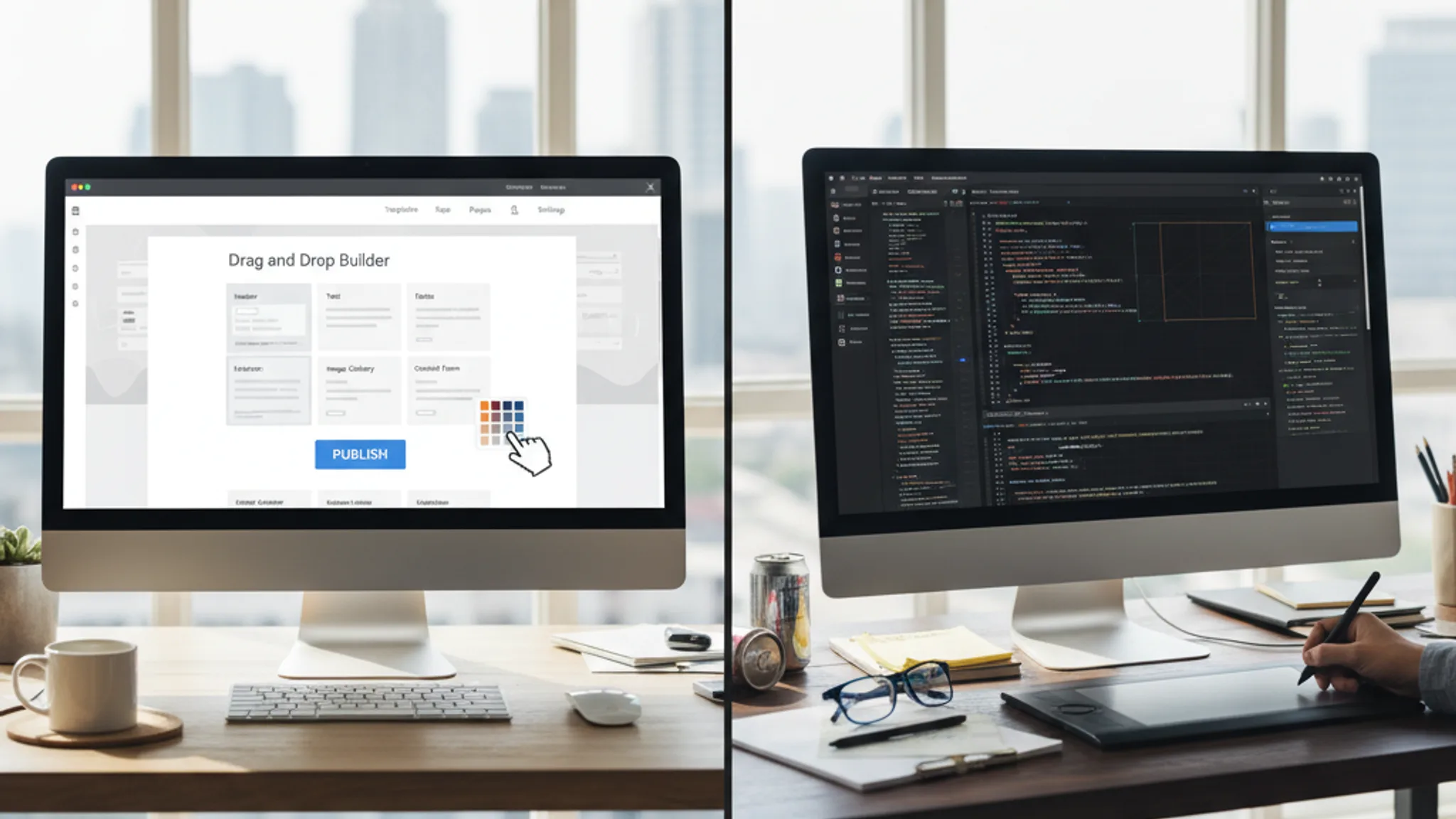
Platforms like Wix, Squarespace, and WordPress.com let you build a basic website yourself. The upfront cost is low, but you invest your own time (typically 20 to 40 hours for a decent result) and the end product is limited by templates. For a comparison of the best options, see our website builder guide.
Freelance web designer (S$1,000 to S$5,000)
Hiring a freelance web designer in Singapore gives you a custom design without agency overheads. Ideal for SMEs that need a professional result on a moderate budget. Timelines typically range from 2 to 6 weeks.
Web design agency (S$3,000 to S$20,000+)
Agencies provide a full team (designer, developer, copywriter, project manager) and handle everything from strategy to launch. You are paying for expertise, reliability, and a polished end product. If you go this route, our guide on how to choose a web design agency in Singapore will help you avoid common pitfalls.
Ongoing costs to factor in:
- Domain name: S$15 to S$50 per year for a .com or .sg domain
- Hosting: S$5 to S$50 per month depending on the platform
- SSL certificate: free with most modern hosts (essential for security and SEO)
- Maintenance: S$50 to S$300 per month for updates, backups, and security patches
For Singapore businesses, there is also the Productivity Solutions Grant (PSG) which can subsidise up to 50% of your website costs if you use an approved vendor. It is worth checking your eligibility before committing to a project.
Can I use only social media instead of a website?
You can, but it limits your growth. Social media profiles rarely rank in Google for commercial searches, offer no SEO benefit, and give you zero control over the platform. For businesses earning under S$5,000 per month with a purely local, word-of-mouth customer base, social-only can work temporarily. For everyone else, a website is essential.
Is a free website good enough for a small business?
Free websites (Wix free plan, Google Sites) come with significant limitations: no custom domain, visible platform branding, limited features, and poor SEO capabilities. They are fine for testing an idea, but not for a business you want customers to take seriously. At minimum, get a custom domain (S$15/year) and a basic hosting plan.
How long does it take to build a business website?
A simple one-page website takes 1 to 2 weeks. A multi-page business website takes 3 to 6 weeks. A complex website with e-commerce, custom features, or extensive content takes 6 to 12 weeks. The biggest delay is usually content: gathering text, photos, and approvals from the business owner.
Do I need a website if I already have a Google Business Profile?
For most businesses, yes. A Google Business Profile captures "near me" and local searches, but a website captures broader search queries, allows you to rank for specific service keywords, and provides a proper conversion path. Businesses with both a GBP and a website receive more total enquiries than those with GBP alone.
What is the minimum a Singapore business should spend on a website?
For a professional result, budget at least S$1,500 to S$2,000 for a simple multi-page business website built by a freelancer, or S$3,000 to S$5,000 from an agency. Spending less than S$1,000 usually means DIY or heavily templated designs that may look unprofessional. The full cost breakdown covers all options.
Should I build my website myself or hire a professional?
If you have time but limited budget, DIY can work for a basic site. If your time is better spent running your business (which it usually is), hire a professional. A poorly designed website can hurt your credibility more than having no website at all. Consider this: if you earn S$50 per hour in your business and a DIY website takes 30 hours, you have "spent" S$1,500 in opportunity cost, plus you end up with an amateur result.
The answer to "do I need a website for my business?" is yes for the vast majority of Singapore businesses in 2026. The exceptions are narrow: pre-revenue startups, referral-only sole traders at full capacity, and micro businesses still testing an idea.
For everyone else, a website is not a luxury. It is the foundation of your digital presence. It builds credibility, captures leads while you sleep, ranks you in Google searches, and gives you ownership over your online identity in a way that social media platforms never will.
The good news is that getting started does not have to be expensive or overwhelming. A minimum viable website with a clear message, social proof, and a contact form can be live within two weeks and start generating enquiries immediately.
If you are ready to build your first business website, or upgrade from a DIY site to something professional, explore our web design services or get in touch for a free consultation. We will give you an honest assessment of what you need, even if the answer is "not yet."

Written by
Terris
Founder & Lead Strategist
Terris has helped over 100 Singapore businesses establish their online presence. He gives honest advice about when a website is essential and when other options might be more practical for your situation.
Want to see these strategies in action? Browse our portfolio or get in touch to discuss your project.