



Terris Recommends 16,400+ monthly visitors Legal Services
8 Best Muslim Matrimonial Asset Lawyers in Singapore (August 2026)
My personal pick of the best Muslim matrimonial asset lawyers in Singapore for 2026. Starting with PKWA Law and A.W. Law.

This guide is part of Terris Recommends, my researched, hands-on picks of the best local businesses and services in Singapore. Every recommendation is researched and ranked by me.
See all recommendationsIf you are going through a Muslim divorce in Singapore, the money questions work differently from what most people expect. They are not decided by the civil family courts. They are decided by the Syariah Court under the Administration of Muslim Law Act (AMLA), and they come with their own names and their own rules. That is exactly why a good matrimonial asset lawyer in Singapore for a Muslim divorce is not the same as a general divorce lawyer.
Here is the part no one explains clearly. Your jointly acquired property is divided as harta sepencarian, which the court splits based on each party's direct and indirect contributions to the marriage. Separately from the assets, a wife may claim nafkah iddah, maintenance during the three-month iddah period after the divorce, and mutaah, a consolatory gift that is often worked out as a daily sum across the length of the marriage. These are distinct claims, and they are assessed in ways the civil courts simply do not use.
I am a web designer, not a lawyer, but I have spent a lot of time researching how Singapore law firms present this area, and the difference between a firm that lives in Syariah family law and one that dabbles is obvious. Below are nine firms I would happily point a friend to for the financial side of a Muslim divorce, plus the context that makes the whole process less frightening. For the wider field, see my best Muslim lawyers in Singapore guide.
The financial side of a Muslim divorce rewards specialists. The Syariah Court has its own framework, and the difference between a lawyer who knows it cold and one who is improvising shows up in your settlement. When I look at how a firm presents this work, these are the five things I weigh.
- Genuine strength in harta sepencarian and asset division. The lawyer should be comfortable arguing how jointly acquired property is identified and split, including the home, savings, and CPF monies.
- A clear grasp of how nafkah iddah and mutaah are assessed. These are separate from the assets, and a lawyer who can explain how each is calculated is one who has done this many times.
- Discipline with financial disclosure and valuations. Asset division turns on what is on the table, so proper disclosure and sensible valuations matter more than rhetoric.
- Skill at negotiation. Most matters settle. A lawyer who can negotiate a fair division without dragging you through a contested hearing usually saves you money and stress.
- Transparent fees. You want to know early whether you are looking at a fixed fee or an hourly arrangement, and what a contested matter could realistically cost.
What I like most is the fixed-fee approach to Syariah family matters. For something as anxious as splitting a home and working out maintenance, knowing the cost up front removes a real source of stress. The firm handles a high volume of family matters, so the asset-division experience is there. For the wider picture of Muslim legal services, it also sits comfortably on my list of the best Muslim lawyers in Singapore.

- Best for
- clear, fixed-fee handling of asset and maintenance claims
- Location
- HDB Hub, Toa Payoh, Singapore
- Recognised by
- a high-volume firm with fixed-fee Syariah family services and asset-division experience
- Website
- pkwalaw.com
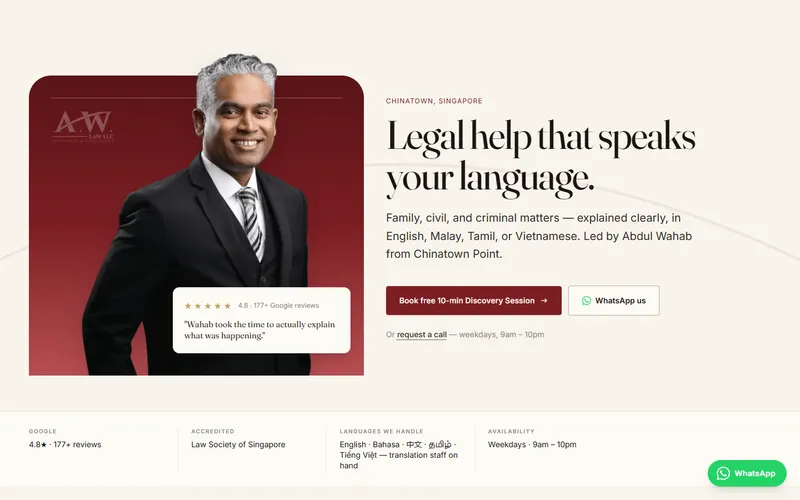
The thing that stands out is the client-first posture. A.W. Law works on flat fees with instalment plans, which matters a great deal when you are already managing the financial shock of a divorce. If you want a firm that treats the money side as its core skill and is honest about cost, this is a strong choice. It pairs naturally with my guide to the best Syariah divorce lawyers.
- Best for
- a client-first practice for the financial side of divorce
- Location
- Chinatown Point, Singapore
- Recognised by
- led by Abdul Wahab; handles division of matrimonial assets and maintenance claims with flat fees and instalment plans
- Website
- awlaw.com.sg
For a contested division where the home, business interests, or CPF monies are in play, that experience is exactly what you want in your corner. ARLC is a firm I would shortlist for anyone who values a settled, seasoned hand over the financial questions of a Muslim divorce.

- Best for
- experienced harta sepencarian representation
- Location
- North Bridge Road, Singapore
- Recognised by
- an established Muslim and Syariah family law firm
- Website
- arlc.com.sg
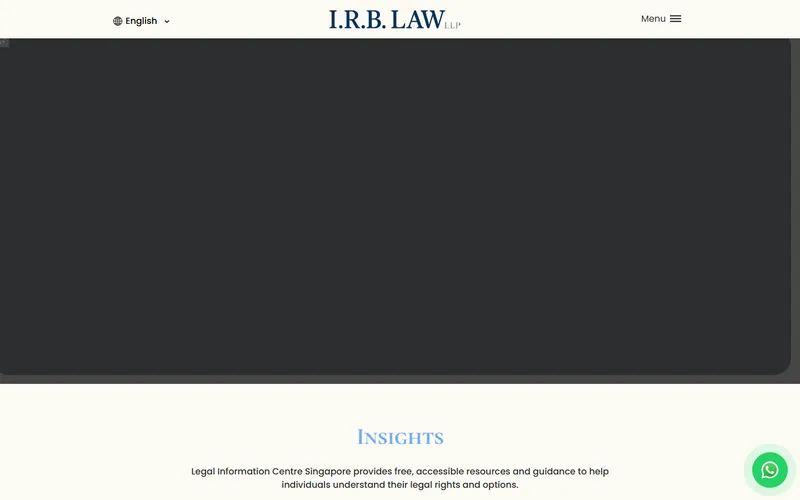
With offices in Jalan Sultan and Jurong East, it is also easy to reach from both the city and the west. For a straightforward division or a nafkah and mutaah claim where you want competent help without a premium price tag, I.R.B. Law is worth a call. It also overlaps with my guide to the best Muslim child custody lawyers if children are part of the picture.
- Best for
- accessible, affordable maintenance and asset claims
- Location
- Jalan Sultan / Jurong East, Singapore
- Recognised by
- a large, affordable full-service firm with a Syariah practice
- Website
- irblaw.com.sg
Based in the Shenton Way area, Emerald Law is convenient for anyone working in the CBD. If your priority is careful, attentive handling of the maintenance side of a Muslim divorce, it is a firm I would put on the shortlist.

- Best for
- attentive handling of nafkah and mutaah claims
- Location
- Shenton Way, Singapore
- Recognised by
- a Muslim family and Syariah practice
- Website
- emeraldlaw.com.sg
Also based at Peninsula Plaza on North Bridge Road, it is easy to reach and well placed for Syariah work. If you want practical, down-to-earth advice on the money questions, High Street Chambers is worth considering.

- Best for
- approachable advice on the financial side
- Location
- Peninsula Plaza, North Bridge Road, Singapore
- Recognised by
- a Syariah and family practice
- Website
- highstchambers.com
Located at Chin Swee Road, it is a practical choice for a measured division or a nafkah and mutaah claim. For anyone keeping a close eye on legal spend during a difficult time, it deserves a look.
- Best for
- value-conscious asset and maintenance claims
- Location
- Chin Swee Road, Singapore
- Recognised by
- a family and Syariah practice
- Website
- prestige.com.sg
Based at Peninsula Plaza on North Bridge Road, it keeps you close to the centre of Syariah practice in Singapore. If you prefer a smaller firm where a senior hand stays on your matter from start to finish, Netto & Magin is a fitting choice.

- Best for
- boutique, senior-led attention
- Location
- Peninsula Plaza, North Bridge Road, Singapore
- Recognised by
- a boutique firm handling family and Syariah matters
- Website
- nmlawcorp.com.sg
Fees vary a lot depending on what you are claiming and whether the other side fights it. Maintenance claims sit at the lower end, while a contested division of a home and CPF monies can climb quickly. These are indicative market ranges for 2026, not quotes from any single firm.
| Matter | Indicative fee (2026) |
|---|---|
| Nafkah iddah and mutaah claim | S$1,500–5,000 |
| Harta sepencarian (asset division) within a divorce | S$3,000–8,000 |
| Contested asset division | S$8,000–20,000+ |
| Enforcement of a maintenance order | from S$2,000 |
What moves the number is the value and complexity of the assets and whether the matter is contested. A clean settlement over a single flat costs far less than a fight over a home, a business, and competing valuations. Always confirm the fee structure directly with the firm before you engage them.
Harta sepencarian is the Syariah law concept of jointly acquired property: the assets a couple builds up during their marriage through their joint efforts. In a Muslim divorce in Singapore, this is the pool the Syariah Court looks at when it divides matrimonial assets.
It typically covers things like the matrimonial home, savings, and CPF monies accumulated during the marriage. It is not simply split down the middle. The court decides each party's share based on their contributions, which is why having a lawyer who can present those contributions properly makes a real difference to the outcome.
The Syariah Court divides harta sepencarian according to each party's contributions to the marriage, and contributions are read broadly. Direct financial contributions, such as paying for the home or the loan, count. So do indirect contributions, such as homemaking and caring for the family, which is why a spouse who earned less can still receive a meaningful share.
This is where the Syariah approach differs from how the civil courts handle a divorce. The framework, the language, and the way contributions are weighed follow AMLA and the practice of the Syariah Court. A lawyer fluent in that approach will frame your contributions and the asset pool in the terms the court actually uses, rather than borrowing arguments from the civil system.
Nafkah iddah and mutaah are maintenance claims a wife may make on divorce, and they are separate from the division of assets. Nafkah iddah is maintenance for the iddah period, the roughly three-month waiting period after the divorce. It is meant to support the wife during that time.
Mutaah is a consolatory gift from the husband to the wife on divorce. In practice it is often calculated as a daily sum multiplied across the length of the marriage, so a longer marriage tends to produce a larger mutaah figure. The daily rate reflects the husband's means, among other factors. Because both claims turn on the specific facts, a lawyer who assesses them regularly can give you a realistic range rather than a guess.
Yes. A wife can claim nafkah iddah and mutaah as part of the divorce proceedings in the Syariah Court, and these are distinct from any division of harta sepencarian. They are about maintenance and a consolatory gift, not about splitting the assets.
If a maintenance order has already been made and is not being paid, that is a separate problem with its own process, and enforcement can be pursued. A lawyer experienced in Syariah maintenance can advise on what you can claim and how to enforce an order that is being ignored.
Choosing a matrimonial asset lawyer in Singapore for a Muslim divorce really comes down to fit. The Syariah Court decides the financial side under AMLA, harta sepencarian is divided by contributions, and nafkah iddah and mutaah are assessed on their own terms, so you want someone who works in this framework every week rather than now and then. Any of the nine firms above would be a sensible place to start a conversation. Asset division is one strand of the wider divorce process, so it is worth reading alongside my guide to the best divorce lawyers in Singapore.
On a practical note, the way a firm presents itself online tells you something about how it communicates. As a web designer, I spend my days on web design services and building a clear, trustworthy law firm website, and the firms that explain harta sepencarian, nafkah, and mutaah in plain language on their sites tend to do the same in a consultation. If you run a practice and want that clarity for your own site, you can always request a free quote.
Editorial note: This guide reflects my own research and opinion, not legal advice. I am a Singapore web designer, not a lawyer. How matrimonial assets and maintenance are decided turns on the facts of each case, and no lawyer can guarantee an outcome. Firm details were accurate at the time of writing (last updated June 2026) but can change. Always confirm fees and a lawyer's current standing directly with the firm before engaging them.