



Terris Recommends 16,400+ monthly visitors Health & Fitness
7 Best Nutritionists & Dietitians in Singapore (September 2026)
The 7 best nutritionists and dietitians in Singapore for 2026, and the accreditation letters that matter because neither title is protected here.

This guide is part of Terris Recommends, my researched, hands-on picks of the best local businesses and services in Singapore. Every recommendation is researched and ranked by me.
See all recommendationsIf you are looking for a nutritionist Singapore patients actually rate, there is something you should know before you book, and it surprised me when I checked it: neither "nutritionist" nor "dietitian" is a protected title here. Singapore has no statutory regulation of either profession. Anyone may use both words on a website tomorrow.
That is not a scare story, it is a shopping instruction. The five allied health professions the government does regulate, through the Allied Health Professions Council, are diagnostic radiographers, occupational therapists, physiotherapists, radiation therapists and speech-language therapists. Dietitians are not on that list, even though they work in hospitals beside people who are.
What exists instead is a voluntary accreditation from the Singapore Nutrition and Dietetics Association, and the letters it grants are the closest thing to a credential in this field. Below are seven practices worth your money, what each is genuinely good at, and how to check the person you will actually sit with.
Four things, and the first one does most of the work.
- Look for ADS or ANS, and check the list. The Singapore Nutrition and Dietetics Association runs an accreditation scheme producing two credentials: Accredited Dietitian of Singapore and Accredited Nutritionist of Singapore. Both signal credible qualifications, both are voluntary, and SNDA publishes the accredited lists so you can verify a specific name rather than trusting a website. Overseas equivalents are also meaningful, and Accredited Practising Dietitian from Dietitians Australia is the one you will see most often here.
- Understand which of the two letters you need. An ADS has additional clinical nutrition training and is equipped to work with disease across healthcare settings. An ANS advises the healthy population. If you have diabetes, kidney disease, coeliac disease, IBS or you are managing nutrition around cancer treatment, you want a dietitian with clinical training. If you are healthy and want to eat better, either can help and you may be overpaying for the clinical one.
- Notice the regulatory gap and what it does not mean. The absence of statutory regulation does not mean practitioners here are unqualified. Most hold real degrees and hospital experience. It means the burden of checking has been handed to you, because there is no register the state maintains and no offence committed by someone who simply calls themselves a nutritionist. The Allied Health Professions Council register is the contrast worth seeing, since it shows what a statutory list looks like for the professions that do have one.
- Ask what the plan is after the first session. Nutrition work is iterative and the first appointment is assessment. A practitioner who sells you a single consultation with no follow-up structure, or conversely a twelve-session package before knowing anything about you, is optimising for something other than your outcome. Ask how many sessions they typically expect and what happens between them.
One thing worth saying plainly because the market blurs it: a dietitian is not a slimming consultant and not a supplement seller. If the first conversation moves quickly toward proprietary products, meal replacements or a package priced before any assessment, you are in a different kind of business. My picks of the best slimming centres in Singapore cover that lane honestly, and my guide to the best weight loss clinics in Singapore covers the medical one.
| Practice | Best for | Credential noted | Format |
|---|---|---|---|
| Eat Right Nutrition Consultancy | Accredited clinical dietetics | Accredited Dietitian of Singapore | Private practice |
| PULSE+ Allied Health | Medical nutrition therapy | Accredited Practising Dietitian | Clinic, Orchard Boulevard |
| The Nutrition Clinic | Testing-led investigation | Confirm on booking | Clinic plus programmes |
| Osler Health International | Structured programmes | In-house dietitian | GP practice, Star Vista |
| Dietitian.sg | One named practitioner | Dietitian and nutritionist | Private practice |
| Nutri.sg | Comparing several at once | Varies by practitioner | Directory, Zoom or in person |
| Mount Elizabeth | Care alongside a diagnosis | Hospital-employed | Hospital, in person or teleconsult |
Where I have written "confirm on booking" I mean that the practice did not publish the specific accreditation of the person you would see. That is not a red flag on its own, since plenty of good practitioners simply do not put letters on a homepage. It is a question to ask.
It is an independent private practice rather than an arm of a larger clinic group, which tends to mean the person you speak to on the phone is the person you will see, and that continuity matters more in nutrition than in most health services. Dietary change happens over months, and the value compounds when the same practitioner tracks how you have actually responded rather than reading someone else's notes.
This suits people who want proper clinical dietetics without the price of a private hospital or an expatriate GP practice. If your situation is medical, from diabetes to a gastrointestinal condition, an ADS-accredited dietitian is exactly the credential to look for and this is the clearest example of it on this list.

- Best for
- Clinical dietetics without hospital pricing
- Best known for
- Stating its accreditation where you can see it
- Led by
- Derrick Ong, Accredited Dietitian of Singapore
- Type
- Independent private practice
- Website
- eatright.sg
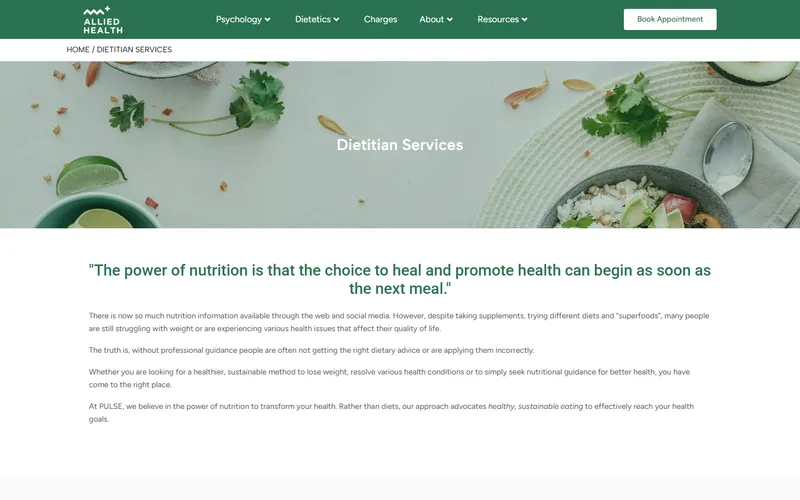
The dietitian here is an Accredited Practising Dietitian with Dietitians Australia, with more than nine years of experience and over 3,000 clients seen. The Australian APD credential is a well-established one and translates readily to Singapore practice, so it is a legitimate alternative to the local ADS letters rather than a lesser substitute. The clinic sits by Orchard Boulevard MRT, which is convenient if you are coming from the office.
Choose this when you have a diagnosis and want the diet side handled as part of clinical management. It is more than you need if you are healthy and simply want to eat better, in which case a general nutrition consultation costs less and does the same job.
- Best known for
- Medical nutrition therapy rather than general advice
- Credential
- Accredited Practising Dietitian, Dietitians Australia
- Experience
- 9+ years, 3,000+ clients
- Location
- By Orchard Boulevard MRT
- Website
- pulseallied.health
For a certain kind of problem this is genuinely the right shape. Persistent symptoms that have not resolved through obvious changes, suspected intolerances, or a gut issue that has been rumbling for years all benefit from investigation rather than another round of eat-more-vegetables. Having data to work from also makes the follow-up sessions considerably more productive.
Two things to ask, and I would ask them at the free session. Which tests are being proposed and what will each one change about the plan, because nutrition testing varies enormously in evidence quality and some panels are far more useful than others. And what the accreditation of your specific practitioner is, since the site leads with the method rather than the letters.

- Best known for
- Investigating symptoms that have not resolved
- Approach
- Testing-led, plan built from results
- Free discovery session
- Yes
- Ask about
- Which tests, and what each one changes
- Website
- thenutritionclinic.com.sg
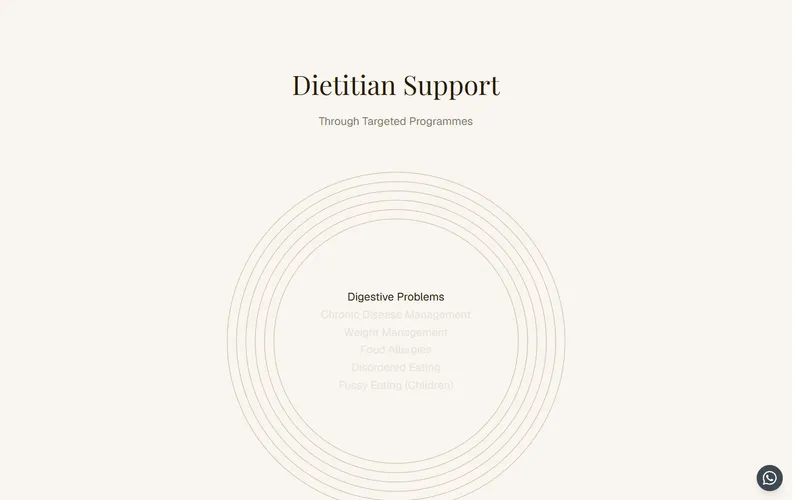
The real argument for it is the integration. When the dietitian sits inside a general practice, your blood results, your medications and your history are in the same place, and the doctor and dietitian can actually confer. For anything where diet interacts with medication, or where you want the whole picture handled by one practice, that is worth paying for.
It is priced for that convenience and oriented toward the expatriate community around Holland Village, so it is not the value option. If you simply want a dietitian and already have a GP you like, an independent practice will cost you considerably less for the same clinical work. If you want everything under one roof and an hour of unhurried time, this is a fair deal.
- Best known for
- A dietitian and a GP in the same practice
- Location
- Star Vista, near Holland Village
- First appointment
- One hour
- Programmes
- From S$650 plus GST
- Website
- osler-health.com
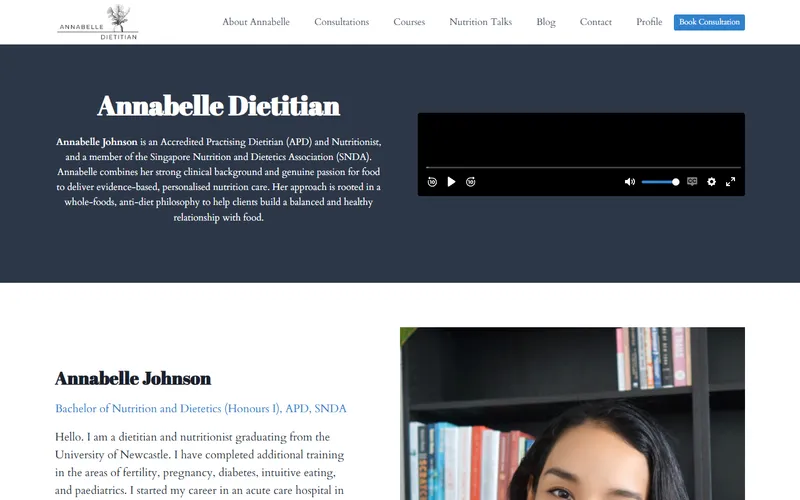
The advantage is consistency. You are seen by the same person every time, they remember what you tried in March and why it did not stick, and there is no handover. Dietary change is unglamorous and iterative, and the practitioner who has watched your last four months is worth more than a better-credentialled stranger reading your file for the first time.
The trade-off is capacity and coverage. A solo practice has limited appointment slots and no colleague to cover an absence or bring a second opinion on an unusual case. Ask about typical waiting times when you enquire, and ask about accreditation as you would anywhere else in this category.
- Best known for
- Seeing the same person every time
- Practitioner
- Annabelle Johnson, dietitian and nutritionist
- Format
- Single-practitioner private practice
- Ask about
- Waiting times and accreditation
- Website
- dietitian.sg
What it is genuinely good for is the comparison problem this whole guide is about. Instead of visiting seven websites and trying to work out who holds which accreditation and charges what, you can see several practitioners against each other with the rates stated. For a first-time buyer of nutrition services in a market with no public register, that is real value.
What it does not do is take responsibility for the clinical relationship, which stays between you and the practitioner. So use it to shortlist, then apply the same checks as anywhere else: which accreditation this specific person holds, whether it is ADS, ANS or an overseas equivalent, and whether their clinical experience matches your situation. A platform listing is not itself a credential.

- Best known for
- Solving the comparison problem in a market with no register
- Type
- Directory and booking platform, not a practice
- Formats
- Zoom and in person across Singapore
- Strength
- Comparing rates and practitioners in one place
- Website
- nutri.sg
The case for going this way is strongest when your nutrition question sits alongside a medical one. Hospital dietitians work daily with renal disease, oncology, diabetes and post-surgical nutrition, which is a depth of exposure a general private practice will not match. If you are already under a specialist there, the referral is straightforward and everything stays in one record.
There is also a cost argument that runs against the usual assumption. A hospital outpatient dietitian appointment attached to an existing course of treatment can be cheaper than a private programme, and is more likely to be claimable on insurance when it forms part of managing a diagnosed condition. Ask your specialist rather than assuming private is the only option. Mount Elizabeth's site blocks automated access, which is why there is no screenshot below.
- Best known for
- Depth of clinical exposure, and often claimable on insurance
- Serves
- Inpatients and outpatients
- Formats
- In person and teleconsultation
- Strongest on
- Renal, oncology, diabetes and post-surgical nutrition
- Website
- mountelizabeth.com.sg
In Singapore both titles are unprotected, so the legal difference is none: there is no statutory regulation of either profession and no offence in using either word. The meaningful difference comes from voluntary accreditation. The Singapore Nutrition and Dietetics Association accredits practitioners as Accredited Dietitian of Singapore or Accredited Nutritionist of Singapore, and those letters carry different scopes.
An ADS holds additional knowledge and skills in clinical nutrition and is trained to work with patient populations across healthcare settings. An ANS provides expert nutrition and dietary advice to the healthy population. Both are recognised as having credible qualifications; only one is oriented toward managing disease through diet.
The practical rule is to match the letters to your situation. A diagnosed condition, a medication interaction or a hospital referral calls for an accredited dietitian. General healthy eating, sports nutrition or weight management in an otherwise healthy adult is well served by either, and the dietitian may simply cost more for work an accredited nutritionist does equally well.
A private dietitian consultation in Singapore typically starts around S$150 to S$250 for an initial appointment of 45 to 60 minutes, with follow-up sessions costing less. Structured multi-session programmes run considerably higher, and Osler Health lists targeted dietitian programmes at S$650 plus GST.
The hospital route is priced differently and is worth checking before assuming private is the only option. An outpatient dietitian appointment attached to treatment for a diagnosed condition can be cheaper than an equivalent private consultation, and is more likely to be claimable under an insurance policy or an integrated shield plan when it is part of managing that condition.
Budget for more than one session whichever route you take. Nutrition work is iterative, and a single consultation that produces a plan nobody follows up on is usually money wasted. Two or three sessions across a few months does far more than one expensive appointment.
I started with the regulatory position, and it changed the whole shape of this guide. I had assumed dietitians were registered under the Allied Health Professions Act like physiotherapists, and they are not: the Act covers five professions and dietetics is not one of them. Checking that rather than assuming it is why this post leads with accreditation instead of star ratings.
From there I looked for practices that state a credential you can verify, which is the only meaningful quality filter available in an unregulated field. That put Eat Right and PULSE+ near the top, because both name the accreditation of the person you will actually see. Where a practice did not publish that, I have said so and turned it into a question for you to ask rather than treating silence as a fault.
I checked every domain was live and captured each practice's own page. Mount Elizabeth's site blocks automated access, so that entry has no screenshot and says so. Prices are what was published or what the market showed at the time of writing. None of these links earns me anything.
If you have a diagnosed condition, book an accredited dietitian and check the letters first. Eat Right and PULSE+ Allied Health are the two clearest examples here, and if you are already under a specialist, ask about the hospital dietitian before paying private rates for the same expertise.
If you are healthy and simply want to eat better, you do not need clinical dietetics and should not pay for it. An accredited nutritionist will do the job, and Nutri.sg is the most efficient way to compare a few on rate and availability without visiting seven websites first.
Whichever way you go, do the one thing this field makes necessary: ask which accreditation the specific practitioner holds and check it against SNDA's published lists. It takes two minutes, it is the only verification available, and in a category where the titles mean nothing on their own it is the whole difference between choosing well and choosing blind. If fitness is the other half of your plan, my picks of the best personal training studios in Singapore and the best gyms in Singapore are the natural next stop, and health screening in Singapore is where to start if you want the numbers before the plan.
A closing note on why I write these guides. I build websites for Singapore businesses, and this category makes the point better than most: the two practices I would call first are the two that put their accreditation where a reader can see it. Saying the thing your customer actually needs to know is not a marketing trick, it is just good business. If your website is burying yours, take a look at my web design services in Singapore, or get a quote.