Terris Recommends 16,400+ monthly visitors Health & Fitness
7 Best Sports Massage Clinics in Singapore (September 2026)
The 7 best sports massage clinics in Singapore for 2026, real prices, and the licensing question that tells you who is actually qualified to work on you.
This guide is part of Terris Recommends, my researched, hands-on picks of the best local businesses and services in Singapore. Every recommendation is researched and ranked by me.
See all recommendationsSearch for sports massage Singapore and you get a wall of listicles that rank places by star rating and never once mention that massage is a licensed activity here. It is, and understanding how it is licensed is genuinely the most useful thing you can know before booking someone to work on your hamstring.
Here is the thing almost nobody explains. There is no professional register of sports massage therapists in Singapore, and the title is not protected. But every legitimate operator sits inside one of two regimes: either the premises holds a Massage Establishment licence from the police, which carries a staffing standard, or the place is exempt from that licence because the treatment is delivered by a registered physiotherapist or Traditional Chinese Medicine practitioner, who is individually registered and publicly checkable.
So the question that sorts a shortlist in one phone call is not how many stars they have. It is which of those two applies. Below are seven places worth your money across both lanes, what each actually does, and roughly what it costs.
Four things, and the first one is the one no other guide will tell you.
- Ask which regime they operate under. The Singapore Police Force licenses massage establishments, defining massage as rubbing, kneading or manipulating the body to relax muscle tension, stimulate circulation or increase suppleness. That is exactly what a sports massage is. A licensed establishment must, under the police licensing framework, keep at least 80% of its registered therapists holding PLRD-recognised certification, with trainees capped at 20% and required to certify within six months. The alternative is an exempted establishment, where treatment is provided by a licensed physiotherapist or occupational therapist or a registered TCM practitioner. Both are legitimate. A place that is neither is the problem.
- If it is physio-led, verify the individual. Physiotherapists are regulated under the Allied Health Professions Act, and the Allied Health Professions Council publishes a searchable register of everyone holding a valid practising certificate. Practising without one is an offence. It takes a minute to check a name, and it is the strongest single verification available anywhere in this category.
- Know which of the three things you actually want. Sports massage works on healthy tissue for performance and recovery: pre-event preparation, post-event flushing, and maintenance for people who train. Physiotherapy treats a diagnosed injury and comes with assessment and a rehabilitation plan. A spa massage is for relaxation. These get sold interchangeably and priced very differently, and buying the wrong one is the most common way to waste money here.
- Ask what happens if they find something. A good sports therapist who suspects a real injury refers you rather than working through it. Ask that question directly when you book. An operator who says they can treat anything is telling you something about their judgement, not their skill.
On price, expect S$80 to S$180 for a 45 to 60 minute session, with packages bringing that down if you go regularly. The variation tracks therapist experience and rent far more than it tracks technique, so a cheaper session in a heartland location is often the same treatment as an expensive one in Orchard.
| Clinic | Lane | Best for | Locations |
|---|---|---|---|
| PhysioActive | Physio-led | Sports massage with a physio on hand | Camden, Orchard, Jurong |
| The Rehab Lab | Physio-led | Recovery alongside a rehab plan | Central |
| Heartland Rehab | Physio-led | Value outside the central belt | Heartland locations |
| ACE Physio Sport | Physio-led | Musculoskeletal and sports focus | Central |
| Aylwin Sports Therapy | Sports therapy | Dedicated sports therapy practice | Central |
| SMC Post Rehab | Post-rehab | Recurring pain after an injury has healed | Central |
| Healing Touch Spa | Licensed spa | Deep tissue on a budget | Multiple outlets |
The lane column is the one to read first. The four physio-led entries can assess and refer if what you have is an injury rather than tightness. The bottom entry is a licensed spa doing deep tissue work well and cheaply, which is a different and perfectly valid purchase.
The clinic has been operating here since the early 2000s and is led by Denis and Diana Mecklenburg, both recognised by the Allied Health Professions Council, with a combined clinical experience of over 45 years. Alongside manual therapy it runs exercise therapy, dry needling, electrotherapy and extracorporeal radial shockwave therapy, which matters mainly because it means the recommendation is not always going to be more massage.
Locations are Camden Medical Centre in Orchard and Vision Exchange in Jurong East, so it covers both ends of the island reasonably. This is the premium end of the market and priced accordingly, and if all you want is a maintenance rub after a long run, it is more clinic than you need.
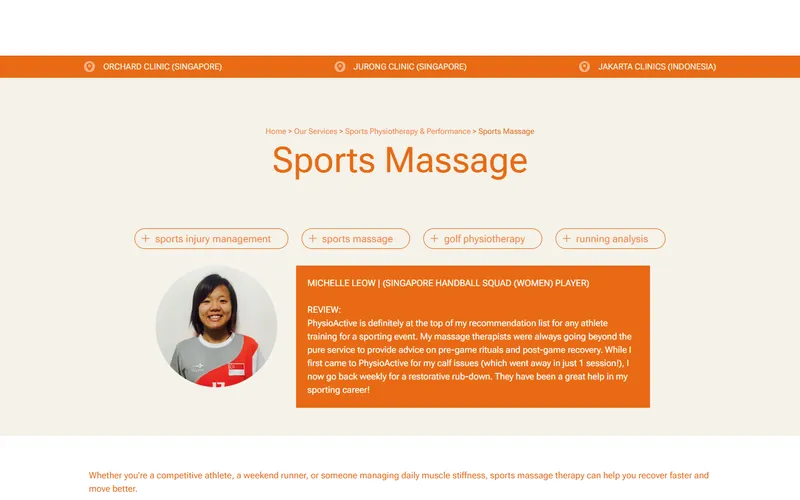
- Best known for
- Catching the cases that are not actually a massage problem
- Location
- Camden Medical Centre (Orchard) and Vision Exchange (Jurong East)
- Lane
- Physiotherapist-led, AHPC-recognised clinicians
- Also offers
- Dry needling, shockwave therapy, exercise therapy
- Website
- physioactive.sg
The positioning is muscle recovery and injury prevention for people who train regularly, rather than one-off relief. That suits the reader this post is really for: someone running, lifting or playing something a few times a week, who has an area that keeps tightening up and wants it managed rather than fixed once.
Because it sits on the physiotherapy side, the therapists are individually registrable and checkable on the AHPC register. Ask for the name of the person who will treat you when you book, then look it up. Any clinic operating properly will give you that without hesitation.
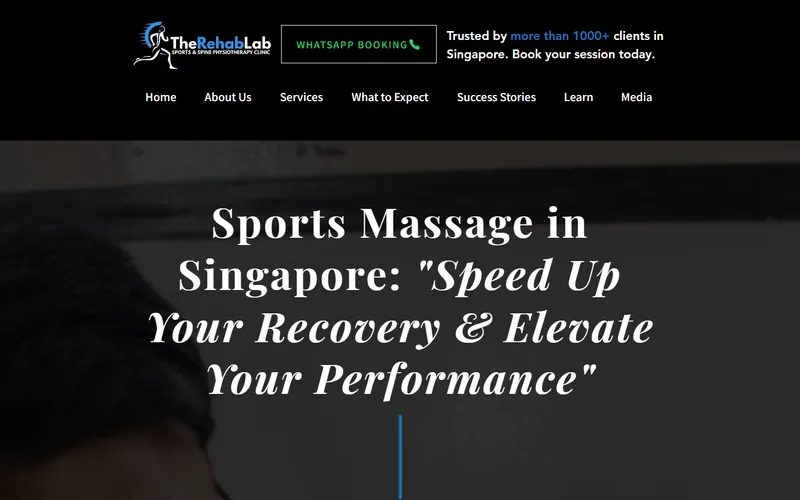
- Best known for
- Keeping massage and physiotherapy as distinct products
- Lane
- Physiotherapist-led
- Focus
- Muscle recovery and injury prevention for regular trainers
- Worth doing
- Ask for the therapist name and check the AHPC register
- Website
- therehablabsg.com
The sports massage service is aimed at muscle pain, tightness and fatigue, using deep tissue technique to restore movement rather than simply to relax. That framing is the right one: the goal of a good sports massage is measurable range of motion, not how pleasant the hour was.
Pricing in heartland locations generally sits at the lower end of the S$80 to S$180 band, and the treatment is not meaningfully different from a central clinic charging more. If you train consistently and want this as an ongoing cost rather than a treat, this is the sensible end of the market. It pairs naturally with a regular training routine, and my picks of the best gyms in Singapore and best personal training studios in Singapore cover the other half of that.
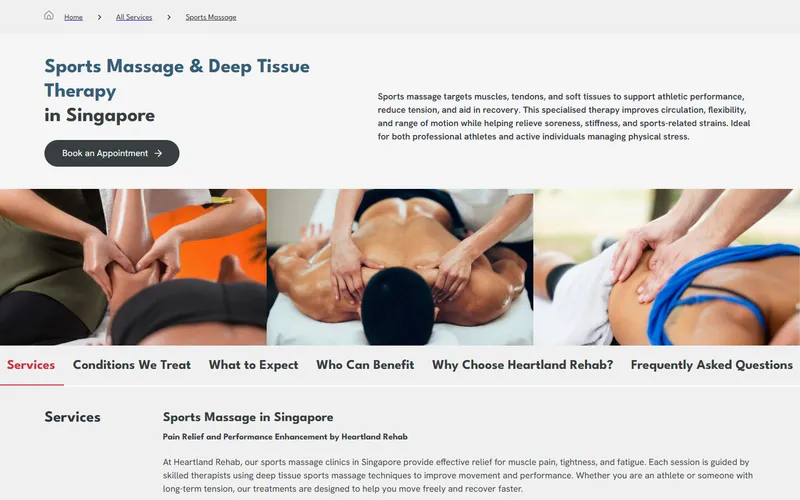
- Best known for
- Making regular recovery affordable and convenient
- Lane
- Physiotherapist-led
- Focus
- Muscle pain, tightness and fatigue, deep tissue technique
- Locations
- Heartland, outside the central medical belt
- Website
- heartlandrehab.sg
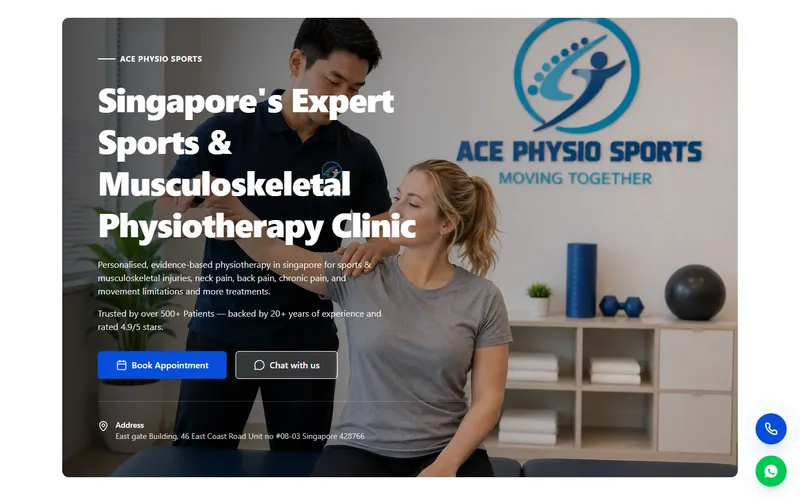
That distinction matters more than people expect. A tight calf that is actually compensating for a stiff ankle will loosen for two days after any massage and then return, indefinitely, because the massage is treating the symptom at the wrong end of the chain. A clinic doing musculoskeletal assessment is looking for that pattern; a therapist working only on the tight muscle is not.
This is the right choice when something has been recurring for months and you have already tried the obvious. It is more than you need for straightforward post-training tightness, where one of the cheaper options here will do the same job. If the recurring problem is in your feet or lower limb, my picks of the best podiatrists in Singapore cover the other profession that catches these chains.
- Best for
- Recurring problems that massage alone has not fixed
- Best known for
- Looking further up the chain than the sore muscle
- Lane
- Physiotherapist-led, musculoskeletal and sports
- Strength
- Movement assessment before treatment
- Website
- acephysiosport.com
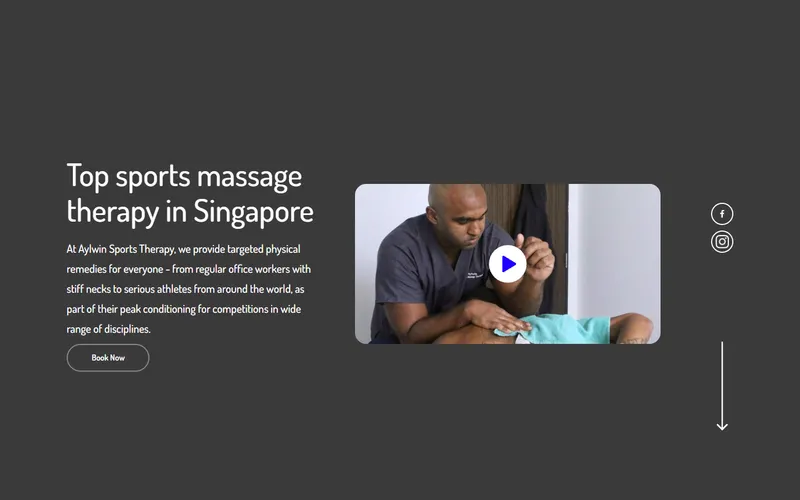
Practices like this tend to be strongest on the things general clinics treat occasionally: pre-event preparation, post-event recovery in the days after a race, and maintenance through a training block. If you are training for a specific event and want someone who understands where you are in the cycle, a dedicated sports therapy practice is usually a better fit than a clinic.
Because sports therapy is not itself a registered profession in Singapore, ask about the practitioner's training and which regime the premises operates under, in the same way you would anywhere else on this list. A specialist practice will answer that comfortably.
- Best for
- Training blocks, pre-event and post-event work
- Best known for
- Doing one thing rather than everything
- Lane
- Dedicated sports therapy
- Ask about
- Practitioner training and the premises licensing
- Website
- aylwinsportstherapy.com
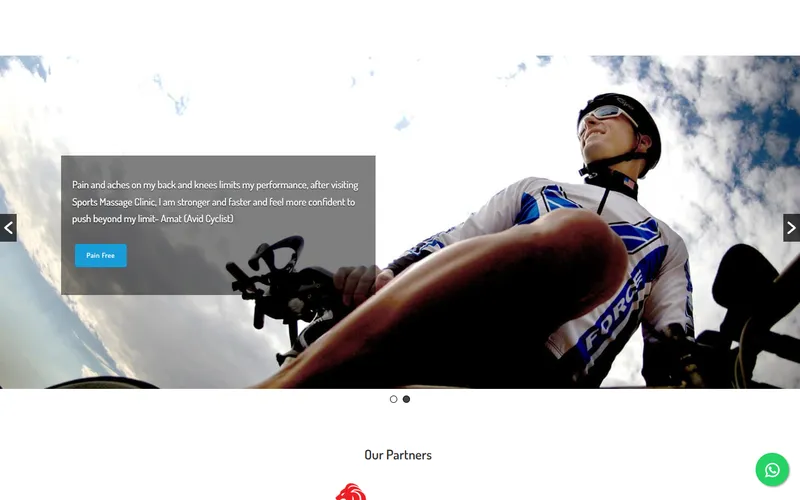
That gap is real and most people fall into it. Formal physiotherapy ends when the clinical goal is met, which is usually well before you feel like yourself again, and a standard sports massage is not designed to bridge that. Post-rehab work is specifically about restoring normal function after the medical episode has closed.
Go here if you were discharged from physiotherapy some months ago and something still is not right. Do not go here instead of getting an acute injury properly assessed, which is a different and more urgent problem. If the recurring issue is spinal, my picks of the best chiropractors in Singapore and the best physiotherapy clinics in Singapore are the two neighbouring lanes worth comparing.
- Best for
- The gap after physiotherapy has been discharged
- Best known for
- The stage of recovery nobody else sells for
- Focus
- Post-rehabilitation, pain relief, recurring muscle problems
- Commonly treats
- Knee, lower back and shoulder complaints
- Website
- postrehabspecs.com
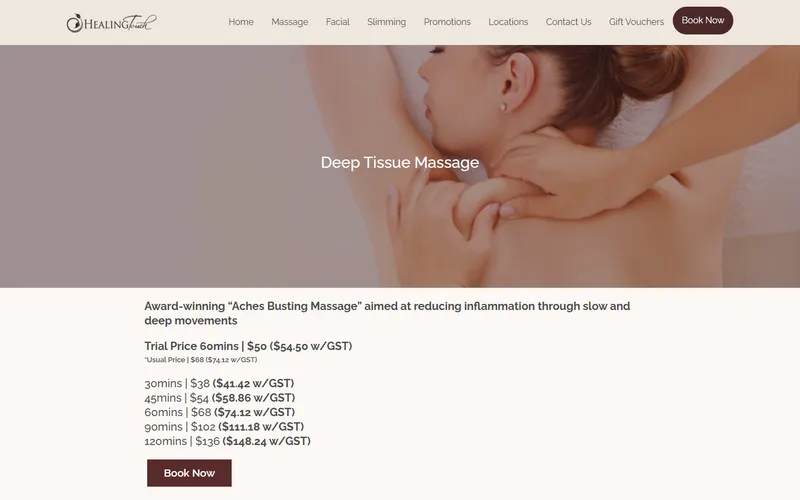
If what you have is general tightness from sitting at a desk and training a couple of times a week, with no specific complaint and nothing recurring, a good deep tissue massage at a licensed spa will do the job. Paying clinical rates for that buys you an assessment you do not need. The technique here is slow and deep rather than the relaxation-style work most spas default to, which is what makes it a genuine substitute.
The line to hold is what it cannot do. A spa cannot assess an injury, cannot refer you, and is the wrong place for anything sharp, radiating or recurring. Use it as the cheap maintenance option and go clinical when something is actually wrong. My picks of the best spas in Singapore cover this lane properly if relaxation is the real goal.
- Best for
- Maintenance and desk-job tightness on a budget
- Lane
- Licensed massage establishment
- Trial price
- From S$50, or S$54.50 with GST
- Not for
- Anything sharp, radiating or recurring
- Website
- healingtouchspa.com
Sports massage in Singapore costs S$80 to S$180 for a session of 45 to 60 minutes. Clinical, physiotherapist-led practices sit at the upper end, heartland clinics in the middle, and licensed spas offering deep tissue work start from around S$50 on trial rates. Packages typically reduce the per-session cost if you go regularly.
The price mostly reflects rent, therapist experience and whether an assessment is included, rather than the technique itself. A deep tissue session in a heartland location and one in Orchard are often the same hour of work, so if you are buying maintenance rather than diagnosis, location is the cheapest variable to change.
Where paying more is genuinely worth it is when you are not sure what is wrong. A physiotherapist-led session that identifies a stiff ankle behind a recurring calf problem saves you a year of monthly massages that keep not working, and that is a far bigger number than the difference between an S$80 and an S$150 session.
Sports massage is soft-tissue work on healthy muscle to aid performance and recovery. Physiotherapy is a regulated healthcare profession that assesses and treats a diagnosed injury or dysfunction with a rehabilitation plan. In Singapore physiotherapists must be registered with the Allied Health Professions Council and hold a valid practising certificate, and practising without one is an offence.
The practical test is whether you have a problem or a sensation. Tightness, stiffness and post-training fatigue are sensations, and massage addresses them well. Pain that is sharp, radiating, worsening, or tied to a specific movement is a problem, and it needs assessment before anyone works on it.
The two are not rivals and the better clinics offer both, which is why four of the seven entries above are physiotherapy practices that also do sports massage. That combination lets one appointment answer which of the two you actually needed.
I started from the licensing rather than the reviews, because in a category where the job title is unprotected, the regulatory position tells you more than a star average does. That is what produced the two-lane structure: places running on a police Massage Establishment licence, and places exempt from it because a registered physiotherapist or TCM practitioner delivers the treatment. Both are legitimate, and knowing which you are dealing with is the useful part.
I checked every domain was live, captured each clinic's own page, and kept prices to what the businesses or the market visibly show. Most clinical practices here quote on enquiry rather than publishing a rate card, so I have given the market band and named the one trial price that was published rather than inventing figures.
I have not been treated by all seven and I am not going to pretend otherwise. What I have done is check what each one is, how it is regulated and who it suits, which is the part that is genuinely checkable. None of these links earns me anything.
If something has been bothering you for more than a few weeks, book a physiotherapist-led clinic and let them assess it. PhysioActive and ACE Physio Sport are the two I would call first, and the money you spend on the assessment is usually the cheapest part of the whole episode.
If you train regularly and simply want maintenance, Heartland Rehab is the sensible ongoing cost, and Healing Touch Spa is the honest budget answer for desk-job tightness that is not really a sports problem at all. Aylwin is the specialist if you are working toward an event, and SMC Post Rehab is the one for the awkward stretch after physiotherapy has finished with you.
Whoever you pick, ask the licensing question when you book. Either they hold a police Massage Establishment licence, or a registered physiotherapist is delivering the treatment. It takes ten seconds, both answers are good ones, and no answer at all is the only result you need to act on.
A note on why this series exists. I build websites for Singapore businesses, and this category is a good example of the opportunity: not one of the pages ranking for this term explains the licensing, which is the single most useful thing a customer could be told. If your business knows something worth saying and your website is not saying it, take a look at my web design services in Singapore, or get a quote.
Sources and references (9)
- physioactive.sg › sports massage
- therehablabsg.com › sports massage
- heartlandrehab.sg › sports massage
- acephysiosport.com
- aylwinsportstherapy.com
- postrehabspecs.com
- healingtouchspa.com › deep tissue massage
- police.gov.sg › Apply for Massage Establishment Licence
- ahpc.gov.sg › registers of allied health professionals