









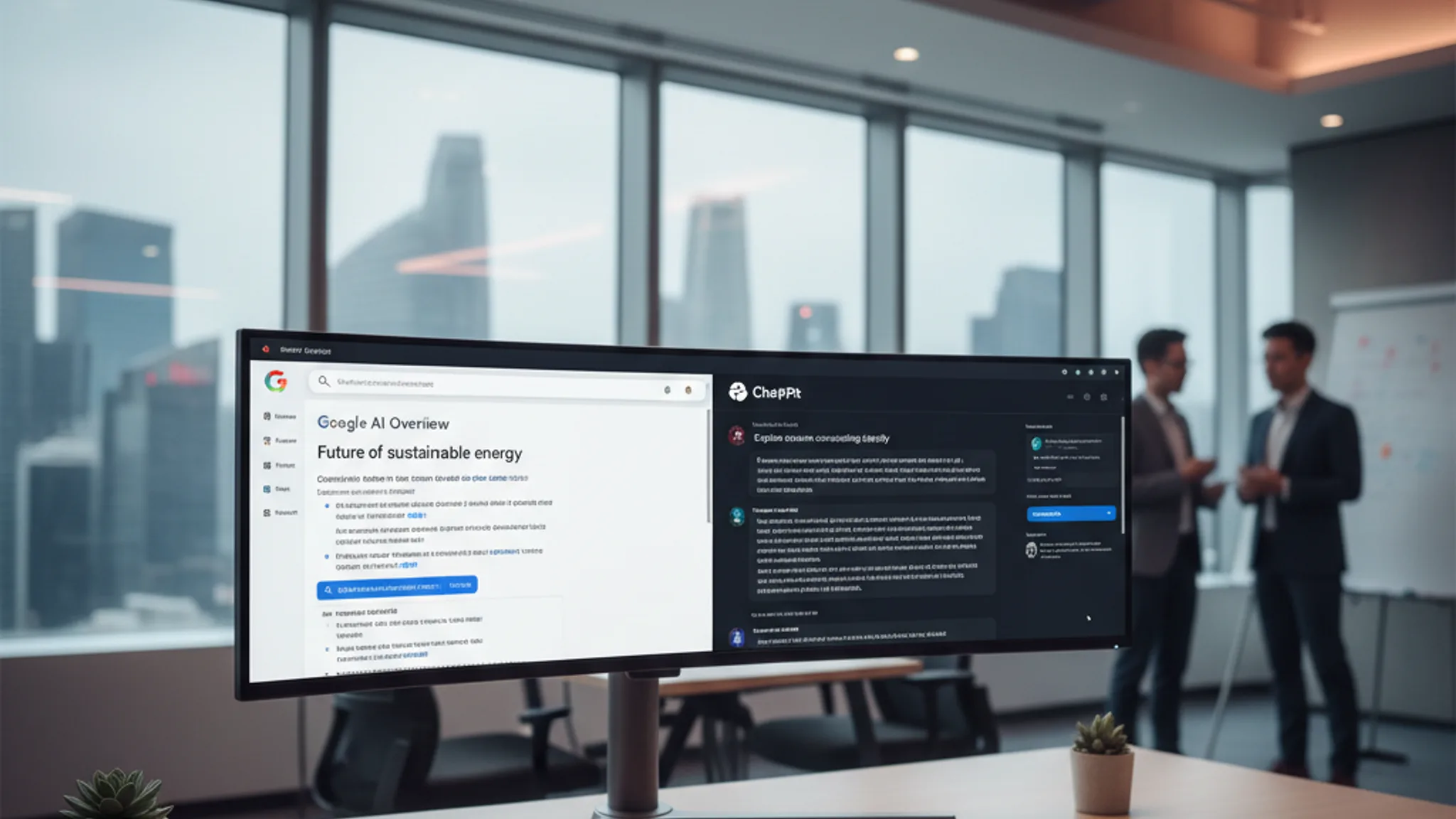
Singapore ranks second in the world for AI adoption, with 60.9% of the working-age population actively using AI tools, according to Microsoft's 2026 AI Diffusion Report. That statistic has a direct consequence for your business: when 57% of Gen Z and 49% of Millennials already use AI to research purchases, the question is no longer whether your customers use AI search. It is whether AI search engines are citing your business when they do.
Generative engine optimisation (GEO) is how you make that happen. It is the practice of structuring your website and content so that AI-powered search engines (ChatGPT, Google AI Overviews, Perplexity, Claude) cite your business in their answers. If traditional SEO is about ranking in a list of blue links, GEO is about being quoted inside the AI-generated answer itself.
This is not a future concern. ChatGPT has over 800 million weekly active users. Google AI Overviews appear on billions of searches monthly. Perplexity processes 780 million queries per month. And Gartner projects that traditional search volume will drop 25% by the end of 2026 as AI search absorbs queries. The shift is happening right now, and Singapore is at the front of it.
This guide covers everything Singapore businesses need to know about generative engine optimisation: what it is, how AI engines choose what to cite, practical strategies you can implement today, platform-specific tactics, realistic costs, measurement approaches, common mistakes, and a step-by-step GEO audit you can run on your own website.
Key Takeaways
- 1 What is generative engine optimisation (GEO)? Jump to this section
- 2 Why does GEO matter for Singapore businesses in 2026? Jump to this section
- 3 How do AI search engines decide which websites to cite? Jump to this section
- 4 What is the difference between GEO, SEO, and AEO? Jump to this section
- 5 How do you optimise content for AI search engines? Jump to this section
What is generative engine optimisation (GEO)?
Generative engine optimisation is the practice of making your content maximally citable by AI-powered search engines. Unlike traditional SEO, which focuses on ranking your page in a list of results, GEO focuses on getting your information quoted, referenced, or attributed inside AI-generated answers.
The distinction matters because AI search works fundamentally differently from traditional search. When someone asks ChatGPT "best web design agency in Singapore" or triggers a Google AI Overview, the AI does not simply list links. It synthesises an answer by pulling information from multiple sources and presenting it as a cohesive response. Your business is either part of that answer, or it is invisible.
Research from Princeton, Georgia Tech, and the Allen Institute for AI, published in their GEO paper (KDD 2024), found that specific GEO strategies can boost content visibility in AI-generated responses by up to 40%. The key strategies they identified were adding statistics, using quotations from credible sources, and structuring content with clear headings and lists.
The core principle of GEO is specificity. A page that says "our prices are competitive" is useless to an AI summariser. A page that says "a 5-page business website in Singapore costs between SGD 3,000 and SGD 8,000" gives the AI something concrete to cite. The more specific your content, the more likely it is to appear in AI answers.
Why does GEO matter for Singapore businesses in 2026?
GEO matters because AI search is not a future trend; it is the current reality in Singapore. With the second-highest AI adoption rate globally, Singapore consumers are already using AI to research, compare, and choose businesses. If your content is not optimised for AI citation, you are missing a channel that is growing faster than any other in digital marketing.
The numbers tell the story. AI-referred web sessions jumped 527% year-on-year in the first five months of 2025, and that growth has continued into 2026. Meanwhile, 65% of Google searches now end without a click, meaning users get their answer directly from the search results page, often from an AI Overview. For Singapore businesses, this means traditional rankings are delivering fewer clicks even when you hold a top position.
Here is what makes this urgent for the Singapore market specifically:
- Singapore's AI per-capita usage is 7x higher than expected for its population size (Microsoft 2026)
- 37% of consumers now start their product searches with AI rather than Google (Search Engine Land, January 2026)
- AI search visitors convert at 14.2% compared to 2.8% from traditional Google search, making AI referral traffic roughly 5x more valuable per visitor
- 95% of B2B buyers purchase from their "Day One" shortlist, and AI increasingly shapes that list (6sense)
The early-mover advantage is real. Most Singapore businesses have not begun optimising for AI search. The SERP for "generative engine optimisation Singapore" is dominated by thin agency service pages with minimal educational content. Businesses that build comprehensive, citable content now will establish themselves as the default sources AI engines reference as this channel grows.
How do AI search engines decide which websites to cite?
AI search engines use a process called retrieval-augmented generation (RAG) to select and cite sources. RAG is a two-step process where the AI first retrieves relevant pages from its index, then generates an answer by synthesising information from those pages. Understanding RAG is essential to GEO because it reveals exactly what makes content citable.
Here is how the process works in practice:
- Query interpretation. The AI breaks down the user's question into sub-queries. A question like "how much does web design cost in Singapore and what should I look for in an agency" gets split into separate retrieval tasks for pricing and evaluation criteria.
- Source retrieval. The AI searches its index for pages that match each sub-query. It typically retrieves between 2 and 7 sources per answer, evaluating them for relevance, authority, and specificity.
- Quality evaluation. The AI assesses each source against signals including domain authority, content freshness, factual specificity, structured formatting, and source attribution.
- Answer synthesis. The AI combines information from the strongest sources into a cohesive answer, attributing claims to specific sources where appropriate.
The five signals AI engines evaluate most heavily are:
- Specificity: pages with concrete numbers, prices, and data points are cited more often than pages with vague claims
- Structure: content with clear headings, lists, and Q&A formats is easier for AI to extract from
- Authority: domain reputation, backlinks, and brand mentions across the web all influence citation likelihood
- Freshness: content updated within the past 3 months is significantly more likely to be cited than older content
- Source attribution: content that cites its own sources (studies, official data, industry reports) is treated as more credible by AI engines
One critical insight from AirOps: 85% of AI citations come from third-party sources rather than your own domain. This means your off-site presence (reviews, industry directories, media mentions, social platforms) matters as much as your website content for GEO.
What is the difference between GEO, SEO, and AEO?
SEO targets rankings in traditional search results, GEO targets citations in AI-generated answers, and AEO targets featured snippets and knowledge panels. The three disciplines overlap significantly, with strong SEO providing the foundation for both GEO and AEO, but they optimise for different outcomes on different platforms.
Answer engine optimisation (AEO) is a subset of GEO focused specifically on earning featured snippets, knowledge panels, and direct answers in traditional search results. Think of AEO as the bridge between SEO and GEO: it optimises for the same structured, answer-first content that GEO requires, but within Google's traditional results rather than AI-generated responses.
Here is how the three compare:
- SEO goal: rank your page in the top 10 blue links for a target keyword
- AEO goal: earn the featured snippet or knowledge panel for a specific query
- GEO goal: get your content cited inside AI-generated answers across ChatGPT, Google AI Overviews, Perplexity, and Claude
The good news: these are not competing priorities. Companies that invest in both SEO and GEO capture 60 to 70% of available search visibility, compared to businesses that focus only on traditional SEO. The strategies overlap heavily. Strong on-page structure, authoritative backlinks, and specific, well-sourced content all improve your performance across SEO, AEO, and GEO simultaneously.
If your SEO foundations are not yet solid (slow site, thin content, no schema markup), start there. GEO builds on SEO; it does not replace it. As we tell our clients: SEO gets you into the index, GEO gets you into the answer.
How do you optimise content for AI search engines?
The most effective GEO strategies focus on making your content specific, structured, and easy for AI to extract. Research from Princeton and IIT Delhi confirmed that pages with statistics, quotations, and structured lists achieved 30 to 40% higher visibility in AI responses. Here are the strategies that deliver the highest impact for Singapore businesses.
1. Lead every section with a direct, citable answer. AI engines extract the first 1 to 2 sentences after each heading. If those sentences directly answer the heading's question with specific detail, your content becomes citable. If they open with vague context-setting ("There are many factors to consider..."), the AI skips to a competitor who answers faster.
2. Replace every vague claim with a specific number. The recommended statistic density for GEO-optimised content is one data point per 150 to 200 words. Instead of "affordable pricing," write "from SGD 1,500." Instead of "fast results," write "measurable improvements within 3 to 6 months." When we rebuilt Perfect Style Salon's website, we did not say they got "more enquiries"; we reported a 180% increase in enquiries and a speed improvement from 5.8 seconds to 2.4 seconds. Those are the kinds of specifics AI engines cite.
3. Structure content for extraction. Use clear headings that match the questions people ask. Include numbered lists for processes, bulleted lists for features, and comparison structures for alternatives. A practical test: paste any section of your content into ChatGPT and ask it to summarise. If it produces a clean, accurate summary, your content is well-structured for GEO.
4. Add FAQ sections with schema markup. FAQ sections are the highest-impact GEO element you can add to any page. A clear question followed by a concise 2 to 4 sentence answer is almost directly extractable by AI engines. Pair this with FAQ schema markup and you serve both traditional search (featured snippets) and AI engines simultaneously.
5. Cite your sources with specifics. Content that attributes claims to specific, verifiable sources performs better in AI citation. "According to Google's 2025 Search documentation" is citable. "Studies show" is not. AI engines can cross-reference claims, and well-sourced content signals the trustworthiness they need to cite you confidently.
6. Build topical authority through content clusters. AI engines assess whether your entire domain is an authority on a topic. One article about SEO is useful. A cluster of 10 to 15 interlinked articles covering keyword research, technical SEO, content strategy, and link building makes you the topical authority AI engines trust. This is exactly the approach behind our Citri Mobile project: 16,000+ pages of structured, specific content that now ranks #1 for hundreds of keywords and generates over 10,000 monthly impressions.
7. Build your off-site presence. Given that 85% of AI citations come from third-party sources, your off-site presence matters enormously. AI engines crawl Reddit, LinkedIn, YouTube, and industry directories. Ensure your business is mentioned, reviewed, and discussed across platforms your customers use. Google reviews, industry forums, and social media brand mentions all feed into AI engines' assessment of your authority.
These strategies work across every type of website, from service businesses to online stores. If you run an e-commerce site, our GEO guide for Singapore e-commerce covers product-specific tactics including Product schema, AI shopping assistants, and review strategies. We apply these principles when building websites and SEO strategies for Singapore businesses. If you want to see what this looks like in practice, our Arcade Rental case study shows the results: from page 3 to #1 on Google, with 300% traffic growth and 50+ monthly enquiries.
How do you optimise for each AI search platform?
Each AI search platform weighs ranking signals differently, and understanding these differences is key to a targeted GEO strategy. ChatGPT favours encyclopaedic, well-referenced content. Perplexity prioritises recency and community-driven sources. Google AI Overviews lean heavily on traditional SEO authority signals. Here is how to approach each one.
ChatGPT has over 800 million weekly active users and is the most widely used AI search tool in Singapore. Wikipedia accounts for 47.9% of ChatGPT's top cited sources, which tells you what kind of content it prefers: comprehensive, well-structured, factual, and encyclopaedic in tone. To optimise for ChatGPT, create detailed, definition-rich content that covers your topic thoroughly. Ensure your robots.txt does not block GPTBot.
Google AI Overviews appear on billions of searches monthly and are expanding rapidly across Singapore queries. Because they draw from Google's own search index, traditional SEO ranking signals (backlinks, domain authority, Core Web Vitals) remain critical. The format difference: AI Overviews prefer content that answers questions directly in the first 1 to 2 sentences of a section, using structured lists and tables where possible.
Perplexity processes over 780 million queries monthly and is growing rapidly among Singapore professionals. Reddit accounts for 22.9% of Perplexity's top cited sources, revealing its preference for authentic, community-driven content. Perplexity has the strongest recency bias of all AI platforms; content freshness matters more here than anywhere else. Publish and update frequently, engage in industry forums, and ensure your content includes recent data.
Claude (by Anthropic) places the highest emphasis on directory listings and authoritative databases. Research from First Page Sage suggests that Tier 1 directories account for 65% of Claude's citation weighting. Ensure your business is listed in relevant Singapore directories (SgpBusiness, Yellow Pages Singapore) and industry-specific platforms.
For Singapore businesses, the practical priority is ChatGPT and Google AI Overviews first (highest user base locally), followed by Perplexity (growing fast among professionals and younger demographics). Optimising for one platform generally benefits all of them, since the core GEO principles (specificity, structure, authority, freshness) are universal across platforms.
Recommended reads
How much does GEO cost in Singapore?
GEO services in Singapore typically cost between SGD 500 and SGD 3,000 per month, depending on scope and whether you handle it in-house or hire an agency. A one-off content restructuring project starts from approximately SGD 1,500, while ongoing GEO retainers that include content creation, schema markup implementation, and performance tracking range from SGD 1,000 to SGD 3,000 monthly.
Here is what a realistic GEO investment looks like for a Singapore SME:
- DIY (SGD 0 to SGD 500/month): restructure your own content using the strategies in this guide, add FAQ sections, claim and optimise your Google Business Profile, encourage customer reviews. Time investment: 5 to 10 hours per month.
- Freelancer or consultant (SGD 800 to SGD 2,000/month): hire a specialist to audit your content, implement schema markup, optimise key pages for AI citation, and monitor performance monthly.
- Agency retainer (SGD 1,500 to SGD 3,000/month): full-service GEO including content creation, technical implementation, off-site presence building, and regular reporting. This typically combines with SEO services since the two overlap heavily.
The ROI justifies the investment. AI search visitors convert at 14.2% compared to 2.8% from traditional Google organic, making AI referral traffic roughly 5x more valuable per visitor. One documented case study showed an 8,337% increase in ChatGPT referrals after implementing a focused GEO strategy. A K-12 EdTech company grew revenue from USD 24,000 to USD 280,000 per month within 5 months through AI search visibility alone.
For most Singapore SMEs, the sweet spot is combining GEO with your existing SEO investment. The strategies overlap, the tools are the same, and the additional cost of adding GEO to a solid SEO foundation is relatively modest. If you want a clear picture of where your business stands and what GEO would cost for your specific situation, get in touch for a free assessment.
How do you measure GEO performance?
GEO performance is measured through citation frequency, AI referral traffic, and share of voice across AI platforms. Unlike traditional SEO where you track rankings and clicks, GEO measurement focuses on how often and how prominently AI engines cite your content when answering questions relevant to your business.
Here are the key metrics and how to track them:
- Manual citation checks. Search your target keywords in ChatGPT, Perplexity, and Google (for AI Overviews) at least weekly. Document whether your brand appears, what it is cited for, and which competitors show up instead. This is the most reliable method right now.
- AI referral traffic in GA4. In Google Analytics 4, check referral traffic from chat.openai.com, perplexity.ai, and other AI platforms. Set up a custom channel group for "AI Search" to track this separately. This channel is growing rapidly for Singapore businesses in professional services and e-commerce.
- Share of voice. Share of voice in GEO is the percentage of AI answers for your target queries that mention your brand versus competitors. Track this for each of your 10 to 15 most important queries. This is the GEO equivalent of tracking keyword rankings in traditional SEO.
- Branded search trends. If AI engines are mentioning your business frequently, you should see an increase in branded searches in Google Search Console. Monitor branded query impressions over time as a proxy for growing AI visibility.
- Conversion tracking. Tag AI referral traffic separately in your analytics to measure conversion rates and revenue from AI-sourced visitors. As noted earlier, these visitors convert at significantly higher rates than traditional organic traffic.
Dedicated GEO tracking tools are emerging (Otterly.ai, Profound, and several others offer AI citation monitoring), but the market is still maturing. For most Singapore SMEs, the manual approach combined with GA4 referral tracking provides a clear enough picture to guide your strategy and budget decisions.
What GEO mistakes do Singapore businesses make?
The most common GEO mistake Singapore businesses make is blocking AI crawlers in their robots.txt file. Many websites still block GPTBot (ChatGPT), ClaudeBot, and PerplexityBot by default, either through legacy settings or overcautious security configurations. If AI engines cannot crawl your content, they cannot cite it. Check your robots.txt file today and ensure these crawlers are allowed access.
Here are the other mistakes we see most frequently:
- Optimising for keywords instead of entities. Traditional SEO teaches you to target keywords. GEO requires you to think about entities: your brand, your products, your people, your location. AI engines understand relationships between entities, not just keyword matches. Build content that establishes your business as a known entity in your industry.
- Ignoring off-site presence. Since 85% of AI citations come from third-party sources, a business that only optimises its own website is ignoring the majority of what influences AI citation. Reviews, Reddit discussions, LinkedIn posts, industry directory listings, and media mentions all feed into how AI engines perceive your authority.
- Treating GEO as a one-off project. AI engines favour fresh content. Research suggests content older than 3 months shows significantly fewer citations. GEO is an ongoing discipline that requires regular content updates, fresh data, and continued off-site activity.
- Focusing only on Google. Many Singapore businesses optimise for Google AI Overviews and ignore ChatGPT and Perplexity entirely. Each platform has different citation preferences and user bases. A complete GEO strategy covers all major AI search platforms.
- Publishing vague, generic content. "We offer comprehensive digital marketing solutions" is not citable. "We helped UCOATE achieve page 1 rankings and 3x more enquiries through targeted local SEO" is citable. Specificity is the single biggest determinant of whether AI engines cite your content or skip it.
- English-only content in a multilingual market. Singapore's population speaks English, Mandarin, Malay, and Tamil. AI search queries increasingly happen in multiple languages. Businesses that create Mandarin or Malay content for AI search have a significant advantage in a market where almost no competitor has done this yet. Our multilingual SEO guide for Singapore covers how to do this properly.
How do you run a GEO audit on your website?
A GEO audit evaluates how well your website is positioned to be cited by AI search engines. You can run a basic audit in under an hour by testing your key pages against six criteria. This gives you a clear picture of where you stand and what to fix first.
Follow this step-by-step process:
- Test your AI visibility now. Open ChatGPT, Perplexity, and Google. Search for the top 5 queries your customers use (e.g. "best [your service] in Singapore"). Does your business appear in any AI-generated answer? If not, note which competitors do and study what their cited content has in common.
- Check your robots.txt. Visit yourdomain.com/robots.txt and confirm that GPTBot, ClaudeBot, and PerplexityBot are not blocked. If they are, remove the disallow rules immediately. This is the single fastest GEO fix you can make.
- Score your content specificity. Pick your 3 most important pages. Count the specific data points (numbers, prices, percentages, dates) in each. If you find fewer than 1 per 200 words, your content is too vague for AI citation. Add SGD pricing, specific timeframes, and measurable results.
- Evaluate your content structure. Does each page have clear headings that match questions people ask? Are there bulleted or numbered lists? FAQ sections? If your pages are walls of paragraph text, AI engines will struggle to extract useful answers from them.
- Check your schema markup. Use Google's Rich Results Test to confirm your pages have structured data. At minimum, you need Article or LocalBusiness schema. FAQ, HowTo, and Product schema significantly improve AI extractability. See our schema markup guide for implementation details.
- Assess your off-site presence. Search your business name in ChatGPT and Perplexity. What do they say about you? If the AI does not know your business exists, you need to build your off-site presence through reviews, directory listings, and brand mentions before focusing on on-page GEO.
This audit takes less than an hour and gives you a prioritised list of fixes. Start with the items that are easiest to implement (unblocking AI crawlers, adding FAQ sections) and work toward the items that require more investment (content creation, off-site presence building).
If you want a professional GEO audit with actionable recommendations, our SEO service includes a comprehensive AI visibility assessment. We analyse your content, technical setup, and off-site presence, then give you a prioritised roadmap to improve your AI search citations.
Does GEO replace SEO?
No. GEO builds on top of SEO; it does not replace it. The fundamentals of strong SEO (quality content, technical performance, backlinks, keyword research) remain essential because they are what make your content discoverable and trustworthy to AI engines in the first place. Most GEO signals overlap with what already makes content rank well in traditional search. Think of SEO as the foundation and GEO as an additional layer that makes your content citable by AI engines.
How long does GEO take to show results?
GEO results can appear within 6 weeks for quick wins like adding FAQ sections, restructuring existing content with answer-first paragraphs, and unblocking AI crawlers. More substantial results from building topical authority and off-site presence typically take 3 to 6 months, similar to traditional SEO timelines. The key difference is that GEO results can compound quickly once AI engines recognise your domain as an authority on a topic.
What is llms.txt and should my website have one?
llms.txt is a proposed standard file (similar to robots.txt) that tells AI models what your website is about and which pages contain your most important content. It sits at yourdomain.com/llms.txt and provides a structured summary of your site specifically for AI consumption. While still an emerging standard, implementing llms.txt signals to AI engines that you are actively optimising for their platforms and helps them understand your site's structure more efficiently. It takes less than 30 minutes to create and there is no downside to having one. Our step-by-step llms.txt guide walks you through the entire process with real examples.
Is GEO worth it for small businesses in Singapore?
Yes, and small businesses may actually benefit more than large enterprises. Singapore's market is small enough that local specificity (SGD pricing, PDPA compliance details, neighbourhood-level knowledge) creates a competitive moat that global content cannot cross. A Tanjong Pagar restaurant with detailed menu pricing and genuine Google reviews has GEO advantages that a generic food blog never will. The investment can start at zero (restructuring existing content using the strategies in this guide) and scale from there.
Which AI search engine has the most users in Singapore?
ChatGPT leads globally with over 800 million weekly active users, and Singapore's high AI adoption rate (60.9%, second globally) suggests disproportionately high local usage. Google AI Overviews has the broadest reach since it appears within regular Google searches that Singaporeans already perform daily. Perplexity is growing fastest among professionals and younger users, processing over 780 million queries monthly worldwide. For maximum coverage, optimise for all three; the core GEO principles work across platforms.
Can I do GEO myself or do I need an agency?
You can implement many GEO strategies yourself using this guide. Adding FAQ sections, restructuring content with answer-first paragraphs, improving your Google Business Profile, and encouraging reviews are all DIY-friendly. Where professional help adds the most value is in technical implementation (schema markup, robots.txt configuration), content creation at scale, and building a systematic off-site presence strategy. Most Singapore SMEs start with DIY basics and bring in professional support once they see the channel's potential.
Generative engine optimisation is not optional for Singapore businesses that want to remain visible in search. With the highest AI adoption rates in the region, Singapore consumers are already using AI to find, compare, and choose businesses. The window to establish yourself as a source AI engines default to citing is open now, but it will not stay open indefinitely as competitors catch on.
The path forward is clear: build on your existing SEO foundations, make your content specific and structured, earn authority both on and off your website, and measure your AI visibility alongside your traditional search metrics. Every strategy in this guide works for both traditional and AI-powered search, so the investment compounds across channels.
We help Singapore businesses build content strategies that perform across both traditional search and AI-powered platforms. Whether you need a GEO audit to understand where you stand, content restructuring to improve your AI citability, or a full SEO and GEO strategy, get in touch. We will show you exactly where the opportunities are and what it takes to get your business cited by the AI engines your customers are already using.

Written by
Terris
Founder & Lead Strategist
Terris has over 8 years of experience helping Singapore businesses rank higher on Google through strategic SEO, content optimisation, and technical excellence. He has delivered first-page rankings for clients across multiple industries and now helps businesses optimise for both traditional and AI-powered search.
Want to see these strategies in action? Browse our portfolio or get in touch to discuss your project.