Before you book the best orthopaedic surgeon Singapore lists can offer, use the tool almost nobody uses: MOH publishes fee benchmarks for surgeon fees across hundreds of procedures, and you can look yours up in a few minutes.
The benchmarks were introduced for common surgical procedures on the Table of Surgical Procedures and extended in 2020 to cover anaesthetist fees and doctors' inpatient attendance fees. That gives you a public reference point for a bill most patients have no way to evaluate, in a situation where you are anxious and unlikely to argue.
For context on the whole number: a single knee replacement runs roughly S$5,000 to S$8,000 in the public sector and S$8,500 to S$13,500 privately, and a total hip replacement about S$6,000 to S$9,300 public against S$8,550 to S$12,850 private. This guide covers seven surgeons and practices, explains why subspecialty matters more than the title, and says plainly that most orthopaedic problems do not need an operation. Nothing here is medical advice and nobody paid to be listed.
Key Takeaways
- 1 You can look up what a surgeon should charge before you consult. MOH publishes fee benchmarks covering surgeon fees for hundreds of procedures on the Table of Surgical Procedures, extended in 2020 to include anaesthetist fees and inpatient attendance fees. Almost nobody uses it, and it is public.
- 2 Real prices, for context. A single knee replacement runs roughly S$5,000 to S$8,000 in the public sector and S$8,500 to S$13,500 privately. A total hip replacement is about S$6,000 to S$9,300 public and S$8,550 to S$12,850 private. Private initial consultations start around S$218 including GST.
- 3 Subspecialty matters more than the title. Orthopaedic surgery divides into hip and knee, spine, foot and ankle, hand, shoulder and sports, and these are separate fellowships. A complex hip problem should go to someone fellowship-trained in hips, not to a generalist who does a few a year.
- 4 Ask how many of your specific procedure the surgeon does a year. Volume correlates with outcomes in joint replacement more reliably than almost any other signal you can check, and it is a perfectly normal question to ask at a consultation.
- 5 Most orthopaedic problems do not need surgery. Physiotherapy, activity modification, weight management, injections and time resolve a great deal of knee, back and shoulder pain. A surgeon who tells you that is giving you the most valuable answer in the consultation, not avoiding work.
Fee benchmarks, subspecialty, and the question about volume
Four things worth knowing before a consultation.
- Look up the benchmark first. MOH publishes fee benchmarks for surgeon fees on common procedures, and since 2020 for anaesthetist fees and inpatient attendance fees too. It is a range rather than a cap, so a fee above it is not automatically wrong, and it does give you a reference and a fair basis for asking why. Many private clinics state they work within the benchmarks.
- Match the subspecialty to the joint. Orthopaedic surgery is not one discipline. Hip and knee reconstruction, spine, foot and ankle, hand, shoulder and sports medicine are distinct fellowships, and surgeons here often hold specific ones: dual fellowship training in hip and knee plus foot and ankle, or fellowship training in hip preservation, for example. For a straightforward fracture, a general orthopaedic surgeon is entirely appropriate. For a complex or revision joint replacement, subspecialty training is the thing to check.
- Ask how many they do a year. In joint replacement especially, procedural volume is one of the more reliable signals available to a patient, and it is easy to ask. A surgeon who performs your operation weekly has a rhythm, a team and a familiarity with complications that one who performs it occasionally cannot match. Any good surgeon will answer without hesitating.
- Expect to be told you may not need surgery. A large share of knee, back and shoulder pain improves with physiotherapy, load management, weight reduction, injections or simply time. A surgeon who works through those before proposing an operation is doing the job properly. If you have been offered surgery at a first consultation for a problem you have had for six weeks, a second opinion is reasonable and normal.
Two adjacent decisions. Most orthopaedic pathways run through physiotherapy either instead of surgery or after it, and my guide to the best physiotherapy clinics in Singapore covers that side. For foot, ankle, heel and gait problems specifically, a podiatrist is frequently the correct first appointment rather than a surgeon, and the best podiatrists in Singapore explains where that line falls.
One more thing worth checking early, because it changes the arithmetic more than the surgeon does: your insurance. Whether your plan covers private, which hospital tier it covers, whether the surgeon is on a preferred panel, and what your co-payment is will often matter more to your final bill than the difference between two good surgeons.
How the best orthopaedic surgeons in Singapore compare
| Practice | Subspecialty | Notable | Best for |
|---|---|---|---|
| Hip & Knee Orthopaedics | Hip and knee | Subspecialty hip and knee replacement | Primary and complex joint replacement |
| Advanced Orthopaedic & Sports | Hip preservation, sports | Fellowship-trained in hip preservation | Younger patients, hips before replacement |
| Oxford Orthopaedics | Hip, knee, foot and ankle | Dual fellowship, 20+ years | Problems spanning more than one joint |
| Ortho Kau | Knee | Knee specialist practice | Knee pain and sports knee injuries |
| Liberty Orthopaedic | Hip and knee | Hip and knee specialist clinic | Focused joint consultation |
| Dr Andrew Dutton | General orthopaedics | Publishes on choosing a surgeon and costs | Understanding the decision first |
| OrthoCare SG | General orthopaedics | Publishes costs against MOH benchmarks | Knowing the price before you go |
1. Hip & Knee Orthopaedics: the subspecialty done properly
Hip & Knee Orthopaedics is organised around exactly what its name says, with surgeons holding subspecialty training in primary and complex hip and knee replacement, including Dr Adrian Lau and Dr Tan, who is described as the first female hip and knee surgeon in Singapore.
A practice restricted to two joints is doing something valuable for patients. Everything about it, the assessment process, the implant choices, the rehabilitation protocols and the team, is built around hips and knees rather than adapted for them. For an operation you will have once and live with for twenty years, that focus is worth seeking out.
The distinction between primary and complex or revision work is also worth understanding. A first knee replacement in an otherwise healthy patient is a well-established operation. A revision, or a replacement complicated by deformity, previous surgery or bone loss, is significantly harder and is where subspecialty training genuinely separates surgeons. Ask which category yours falls into.
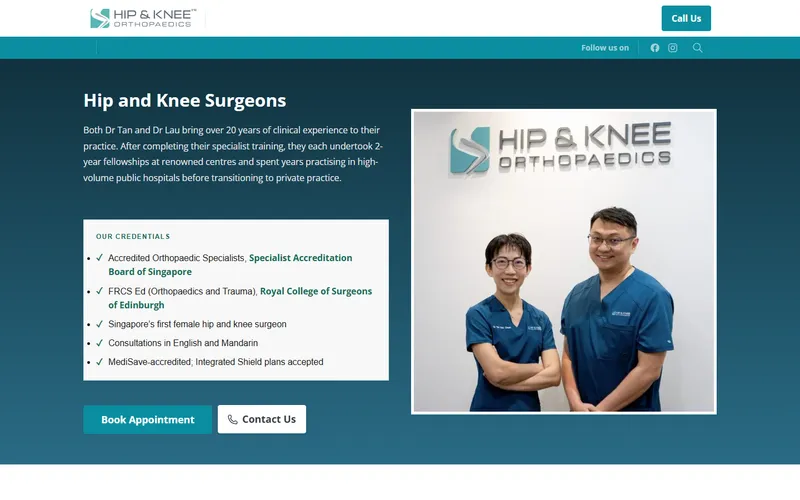
Website: hipkneeortho.com.sg
Subspecialty: Primary and complex hip and knee replacement
Ask: Whether your case is primary or complex, and their annual volume
Best for: Joint replacement, including revision work
2. Advanced Orthopaedic & Sports Centre: keeping the hip you have
Advanced Orthopaedic & Sports Centre is home to Dr Poh Seng Yew, described as Singapore's first fully fellowship-trained specialist in hip preservation surgery, and that specialty is the reason to know this practice.
Hip preservation is the field concerned with fixing a hip rather than replacing it, and it matters most for younger patients. A hip replacement has a finite lifespan, so a replacement at forty is likely to mean a revision later, and revisions are harder than first operations. Procedures that address the underlying mechanical problem, such as impingement or dysplasia, can delay or avoid that whole sequence.
If you are under about fifty with hip pain and someone has already mentioned replacement, this is the second opinion worth getting. Not because replacement is wrong, but because the alternative deserves to have been considered by someone who does that work specifically.

Website: advancedortho.com.sg
Lead surgeon: Dr Poh Seng Yew, hip preservation
Relevant when: You are younger and replacement has been raised
Best for: Preserving a hip rather than replacing it
Recommended reads
3. Oxford Orthopaedics: two fellowships, twenty years
Oxford Orthopaedics is led by Dr James Wee, Medical Director and a Senior Consultant with over twenty years of clinical experience, dual fellowship trained in hip and knee surgery and in foot and ankle surgery.
That combination is unusually practical. Lower limb problems rarely stay in one joint: a stiff ankle changes how you load the knee, a knee that has hurt for two years changes how you walk and eventually complains upstream at the hip. A surgeon trained across hip, knee, foot and ankle can look at the whole chain rather than treating the joint you happened to point at.
Twenty years of practice also means a long personal series of outcomes to draw on. When you ask how many of your procedure he does a year, you are also asking about a track record long enough to include the awkward cases.

Website: oxfordortho.sg
Lead surgeon: Dr James Wee, 20+ years, dual fellowship trained
Covers: Hip and knee, plus foot and ankle
Best for: Lower limb problems that span more than one joint
4. Ortho Kau: a knee-focused practice
Ortho Kau is the practice of Dr Kau Chung Yuan, organised around knee work specifically, from sports injuries through to degenerative knee problems.
The knee is the joint where the range of possible answers is widest. The same complaint of pain and swelling might be a meniscal tear, ligament damage, cartilage injury, patellofemoral pain or early arthritis, and each has a different treatment path running from physiotherapy through injection and arthroscopy to replacement. Getting the diagnosis right is most of the value, and that is easier for someone looking at knees all week.
Ask about the non-surgical options as part of the conversation. In knees particularly, a structured rehabilitation programme resolves a great deal of what walks into a clinic, and the surgeons worth trusting say so unprompted.
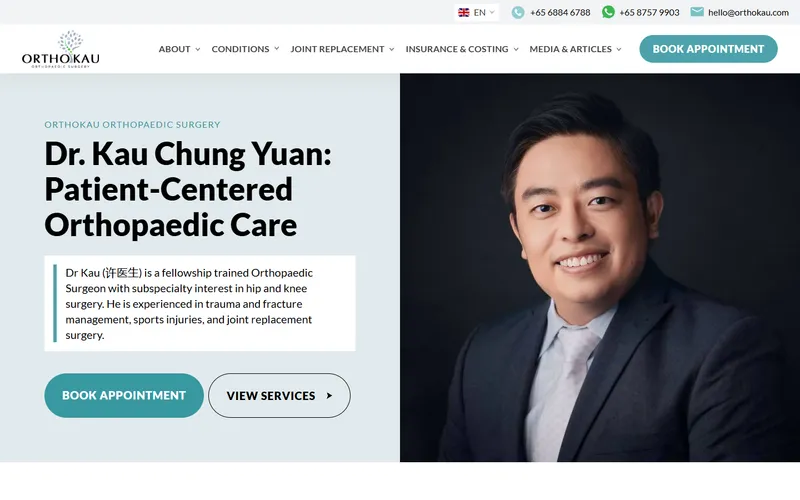
Website: orthokau.com
Focus: Knee, from sports injury to degenerative disease
Ask about: The non-surgical path before the surgical one
Best for: Knee pain where the diagnosis is the hard part
5. Liberty Orthopaedic: a focused hip and knee clinic
Liberty Orthopaedic runs as a hip and knee specialist clinic, which puts it in the same useful category as the first entry here: a practice that has chosen a lane.
For a patient, the advantage of a focused clinic shows up in the parts of care that are not the operation. The pre-operative assessment, the physiotherapy protocol afterwards, the follow-up schedule and the expectations set about recovery are all standardised around a small number of procedures done repeatedly, which tends to make the whole experience smoother than at a general practice.
Use it as a comparison consultation. Joint replacement is a large enough decision that seeing two subspecialty surgeons is entirely reasonable, and hearing two people describe the same X-ray teaches you more about your own knee than either consultation alone.

Website: libertyorthopaedic.com
Focus: Hip and knee specialist clinic
Worth doing: A second subspecialty opinion before a replacement
Best for: A focused joint consultation
Contact Liberty Orthopaedic directly
6. Dr Andrew Dutton: the surgeon writing about how to choose one
Dr Andrew Dutton publishes guidance on how to choose an orthopaedic surgeon in Singapore and on what orthopaedic care costs, which is unusual and useful whether or not you end up consulting him.
Very little of the writing in this category is by surgeons. Most of what ranks is directory content assembled by marketers, which is why so much of it is a list of names with no explanation of subspecialty, volume or cost. A practising surgeon setting out how the decision should be made is a better starting point, and it is worth reading with the obvious caveat that he also has a practice.
The material on cost is particularly worth reading alongside the MOH benchmarks, because the two together let you walk into any consultation knowing both the published reference range and how a surgeon explains the number.

Website: drandrewdutton.com
Notable: Publishes on choosing a surgeon and on treatment costs
Read alongside: The MOH fee benchmarks
Best for: Understanding the decision before you make it
Contact Dr Andrew Dutton directly
7. OrthoCare SG: costs published against the benchmarks
OrthoCare SG publishes orthopaedic surgery costs referenced against the MOH fee benchmarks, which in private healthcare is rare enough to be worth a place on this list by itself.
Price opacity is the standard experience in private specialist care. You are quoted at the consultation, after you have paid for the consultation, at a point where you are worried and have already invested time in this doctor. A practice that publishes indicative costs beforehand removes that pressure and lets you compare while you are still calm.
Read a published figure as an indication rather than a quotation. Actual cost depends on the specific procedure, implant choice, hospital tier, length of stay and any complications. But an indicative range plus the MOH benchmark gives you two reference points before you sit down, which is two more than most patients have.

Website: orthocaresg.com
Notable: Publishes costs referenced to MOH fee benchmarks
Remember: Published figures are indicative, not quotations
Best for: Knowing the shape of the bill before the consultation
How much does knee or hip replacement cost in Singapore?
A single knee replacement runs roughly S$5,000 to S$8,000 in the public sector and S$8,500 to S$13,500 in private clinics. A total hip replacement is about S$6,000 to S$9,300 public and S$8,550 to S$12,850 private. Initial consultations at private clinics start around S$218 including the 9 percent GST.
Those totals bundle several separate fees: the surgeon, the anaesthetist, the hospital or facility charge, the implant, and inpatient attendance. MOH publishes fee benchmarks for the surgeon component across common procedures on the Table of Surgical Procedures, extended in 2020 to include anaesthetist and inpatient attendance fees, so you can check the professional fees against a public reference before you commit.
Ask for an itemised estimate rather than a single number, and ask which parts can vary. Implant choice and hospital tier are usually the two largest swing factors, and they are decisions you can be involved in. Then check what your insurance covers, whether the surgeon sits on your insurer's panel, and what your co-payment is, because that frequently changes your out-of-pocket cost more than the choice between two competent surgeons does.
How do I choose an orthopaedic surgeon in Singapore?
Start with subspecialty, then volume, then cost. Orthopaedic surgery divides into hip and knee, spine, foot and ankle, hand, shoulder and sports, and these are separate fellowship trainings rather than areas of interest. Match the subspecialty to your problem, particularly for anything complex or revisional.
Then ask how many of your specific procedure they perform a year. In joint replacement, volume is among the most reliable signals a patient can actually check, and the question is entirely normal. Ask too about complication rates and what happens if something goes wrong, including who you call and where you would be readmitted.
Finally, take a non-surgical answer seriously if you get one. A great deal of knee, hip, back and shoulder pain resolves with physiotherapy, load management, weight reduction, injections or time, and a surgeon who works through those first is giving you good advice rather than avoiding work. If surgery is proposed at a first consultation for a recent problem, a second opinion is a reasonable thing to want and no good surgeon will be offended by it.
My verdict on orthopaedic surgeons in Singapore
Match the surgeon to the joint. For hip or knee replacement including revision work, Hip & Knee Orthopaedics, where the whole practice is built around those two joints. If you are younger and someone has already mentioned replacing a hip, get a hip preservation opinion from Advanced Orthopaedic & Sports Centre before you agree to anything.
For lower limb problems that cross joints, Oxford Orthopaedics and its dual hip-knee and foot-ankle training. For knees specifically, where the diagnosis is usually the hard part, Ortho Kau. For a focused second opinion before a replacement, Liberty Orthopaedic.
And before any of that, read Dr Andrew Dutton on how the decision should be made and OrthoCare SG on what it costs, then look up your procedure in the MOH fee benchmarks. Twenty minutes of preparation changes a consultation from something that happens to you into something you are participating in.
A closing note for the practices. Two clinics on this page publish costs and guidance and the rest quote at consultation, and the two that publish are the ones a worried patient can evaluate at eleven at night before deciding who to call. In private specialist care, where people feel least able to ask about money, being the practice that answered first is a real advantage. If your website is not doing that, it is fixable, and it happens to be my day job. Take a look at my web design services in Singapore, or get a quote and I will tell you honestly what would help.
Spotted something out of date in this guide?
Suggest an edit or a business to add. This guide is pre-filled for you.

Professional Opinion-haver
Terris
Chief Recommender · I do the digging so you don't have to
Terris is a Singapore-based web designer and digital strategist who has spent 8+ years building websites for local businesses. His Terris Recommends series shares personal picks for the best service providers across Singapore, informed by his experience working with businesses across industries.
Want to see these strategies in action? Browse our portfolio or get in touch to discuss your project.