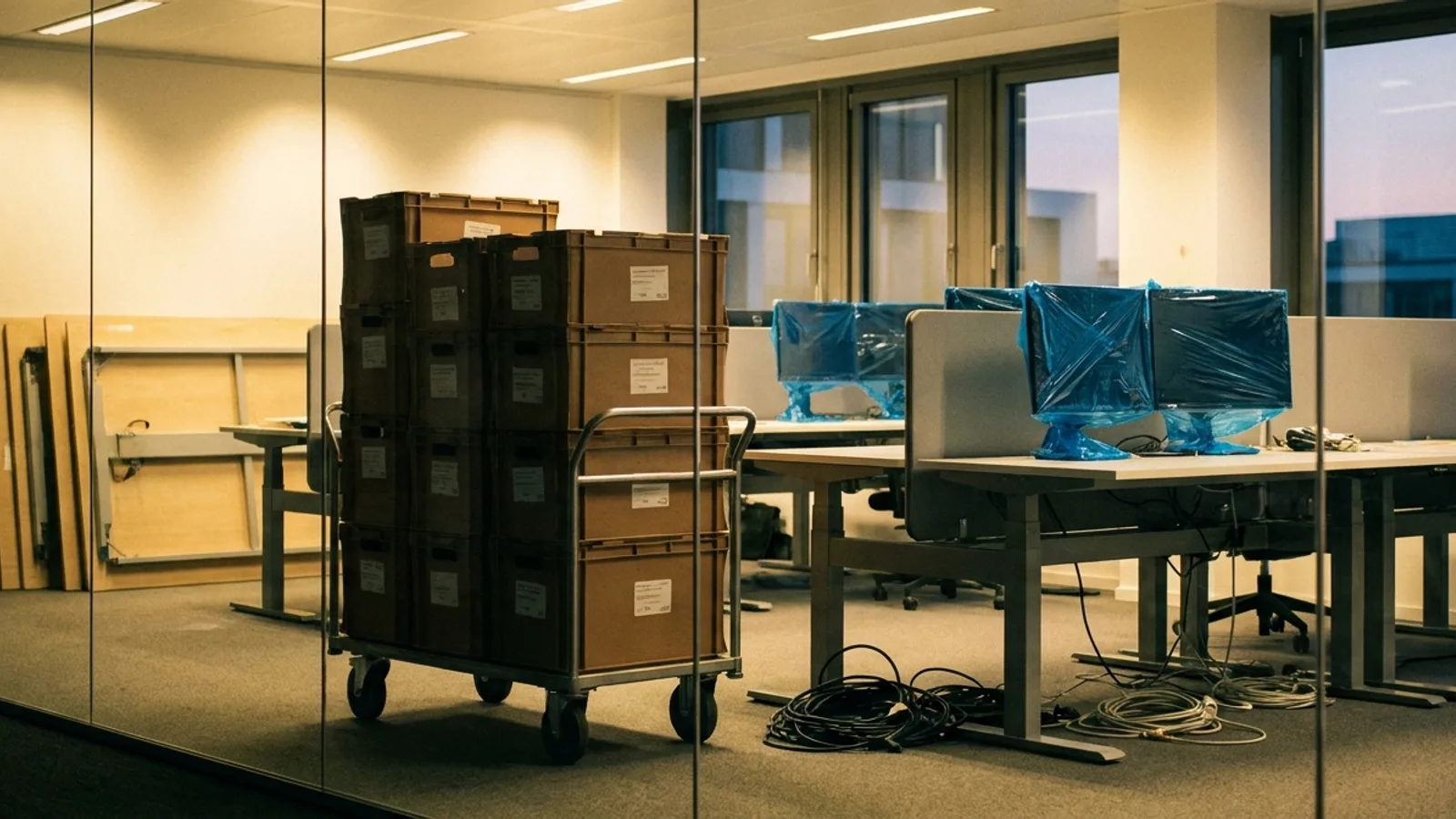
When people compare office movers Singapore has, they compare quotes. That is the wrong number to focus on.
Work out what a day of downtime costs you first. Thirty people unable to work for a day is several times any mover's fee, and once you have that figure in front of you the whole decision changes shape. It is why almost every office move here happens over a weekend or overnight, why the after-hours surcharge is worth paying, and why the cheapest quote is frequently the most expensive outcome.
The second thing worth knowing is that your mover does not control the schedule. Building management does, at both ends, through service lift bookings, insurance certificates and permitted move windows. This guide covers seven movers, the extras that turn a quote into a bill, and the sequence that keeps a move from slipping.
Key Takeaways
- 1 The mover quote is the smallest number in an office move. A day of thirty people unable to work costs several times what any mover charges, which is why almost every office move happens over a weekend or overnight, and why the after-hours surcharge is usually money well spent.
- 2 Building management sets the schedule, not the mover. Service lift bookings, insurance certificates, protection of common areas and permitted move windows all come from the building, and both buildings have to agree. Start that conversation before you agree a date with anyone.
- 3 Office moving is quote-only in Singapore. Nobody publishes rates because the job scope genuinely varies by workstation count, IT load, timing and access, so get at least three quotes and make sure they are quoting the same scope.
- 4 The extras are where quotes diverge. Ask specifically about stairs or no lift access charged per level, long push distance when the lorry cannot park near the lift, waiting time, weekend or urgent surcharges, dismantling and reassembly, packing materials, and disposal of what you are not taking.
- 5 Decide who owns the IT before moving day. Movers will transport servers and network equipment with proper labelling and protection, but transporting hardware is not the same as being responsible for uptime or data. Agree with your IT provider who unplugs, who reconnects and who tests.
What actually determines the cost and the date
Four things to settle before you collect quotes.
- Price the downtime before you price the move. Take your headcount, take an average loaded daily cost per person, and multiply. That is what a day of disruption costs, and it is almost always a larger number than the moving quote. Once you have it, choosing a weekend slot, paying for more crew, or splitting a large office into a phased move stops feeling like an indulgence and starts looking like the obvious call.
- Book the buildings before you book the mover. Commercial buildings control service lift access, require the mover's insurance certificate, ask for protection of lift cars and common corridors, and often restrict moves to evenings and weekends. You need all of that agreed at the building you are leaving and the one you are moving into. Two buildings with incompatible windows is the commonest reason a move date slips, and it has nothing to do with the mover.
- Get three quotes on the same scope. Office moving in Singapore is quote-only, because the work genuinely varies by workstation count, IT load, timing and access. That makes comparison hard unless you give every mover the same brief: number of workstations, what is being dismantled, what is being disposed of, the move window, and the access at both ends. Otherwise you are comparing three different jobs.
- Ask about the extras by name. The line items that separate a quote from a final bill are consistent across this industry: stairs or no lift access charged per level, long push distance when the lorry cannot park near the lift, waiting time, weekend or urgent surcharges, dismantling and reassembly of furniture, packing materials, and disposal of anything you are not taking. Ask about each one specifically rather than asking whether there are extras, because the answer to the general question is always no.
One boundary worth drawing early. Movers will handle computers, servers and network equipment with labelling and protection, and that is transport rather than IT responsibility. Decide explicitly who powers down, who reconnects, who tests, and who is on site on Monday morning when something does not come back up. If your IT is outsourced, that provider needs to be in the planning conversation, not informed afterward.
Two related decisions usually happen in the same quarter. My guides to the best coworking spaces in Singapore and the best commercial interior design firms in Singapore cover where you are going and who fits it out. And if the move is a home rather than an office, the best movers in Singapore is the right guide, because residential is a genuinely different job.
How the best office movers in Singapore compare
| Mover | Strength | Notable | Best for |
|---|---|---|---|
| Rodex Movers | Minimising downtime | Works evenings and weekends | A move that cannot touch a working day |
| Shalom Movers | Scale and crew capacity | Long-established, large teams | Bigger offices and phased moves |
| Move Move Movers | Commercial breadth | Offices, retail and F&B | Shops and outlets, not just offices |
| Soon Seng Transport | Track record | Long-running local operator | Straightforward moves done plainly |
| Red Sun Movers | Planning and coordination | Publishes an office relocation guide | A first office move you have to plan |
| Vimbox Movers | Packing and handling | Storage and packing services | Moves with a gap between leases |
| Office Empire | Office specialisation | Office relocation as the core service | Office fit-out and move together |
1. Rodex Movers: built around not interrupting the business
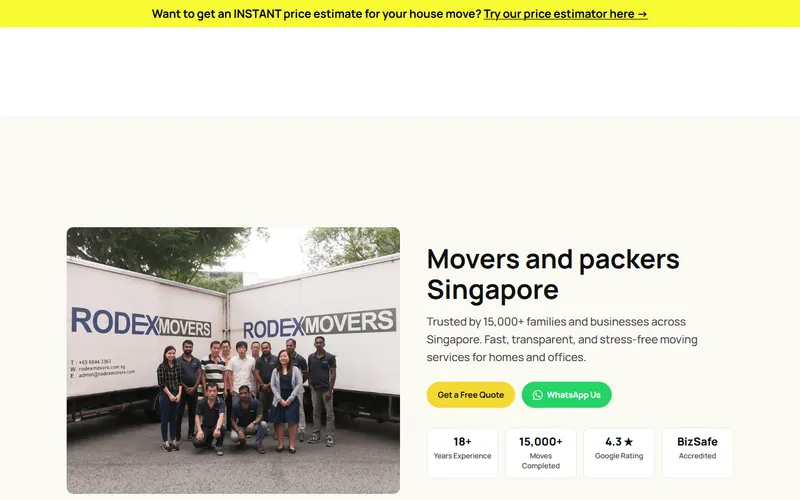
Working outside hours is not a luxury add-on for an office move, it is usually the whole plan. A Friday evening start gives a crew two full days to move, reassemble and let IT reconnect before anyone needs a desk on Monday. Compressing the same job into a Wednesday costs you a day of everyone's time, which is the expensive resource.
Ask two things when you brief them: what the after-hours surcharge is, and whether the crew size on a weekend matches the crew size on a weekday. A discounted weekend rate with half the team is not the saving it appears to be.
Contact Rodex Movers directly
- Best for
- A move that must not touch a working day
- Approach
- Built around minimising business downtime
- Hours
- Works evenings and weekends
- Covers
- Furniture dismantling and reassembly, IT equipment
- Website
- rodexmovers.com.sg
2. Shalom Movers: the scale to do a big office in one weekend
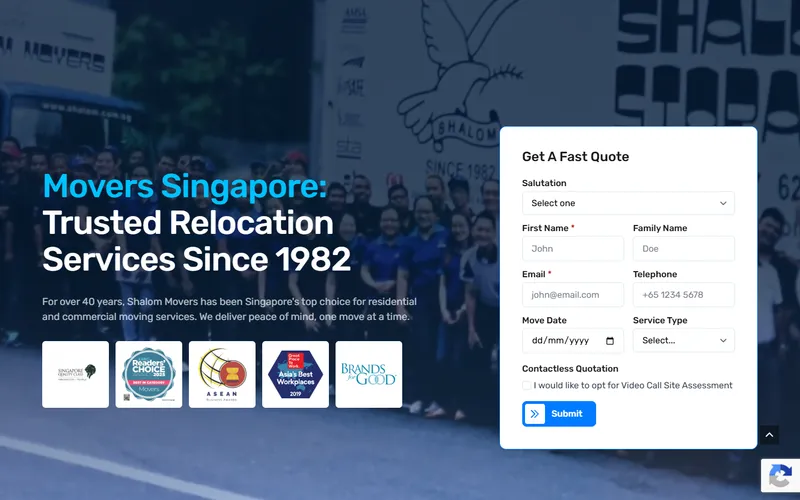
Crew size is the variable that decides whether a big move fits in a weekend. A move is a fixed quantity of lifting, and a small team simply takes more hours to do it, which is fine on a Saturday and not fine when the window closes on Sunday night. For anything above roughly fifty workstations, ask directly how many people will be on site and how many lorries are assigned, then sanity check that against the hours available.
The trade-off with a larger operator is usually flexibility on small jobs, where a smaller firm may be quicker to fit you in and slightly cheaper. Match the operator to the size of the move.
- Best for
- Larger offices and phased relocations
- Strength
- Crew capacity and a long operating history
- Ask
- How many crew and how many lorries are assigned
- Website
- shalom.com.sg
Recommended reads
3. Move Move Movers: retail and F&B, not only offices
Moving a shop or a restaurant is not an office move with different furniture. There is equipment that needs disconnecting by a licensed trade, refrigeration that cannot sit warm for long, stock that has to be counted, and a fit-out schedule at the new unit that the move has to slot into. Mall tenancies also come with their own loading bay rules and delivery windows on top of anything the landlord requires.
If you are moving a retail unit or an F&B outlet, say so at the first phone call rather than describing it as an office. The scope, the timing and the risk are all different, and a mover who does these regularly will start asking the right questions immediately.

Contact Move Move Movers directly
- Best for
- Retail units and F&B outlets
- Covers
- Offices, retail and F&B relocations
- Why it matters
- Shops and restaurants have equipment, stock and mall rules an office does not
- Website
- movemove.biz
4. Soon Seng Transport: a long-running local operator
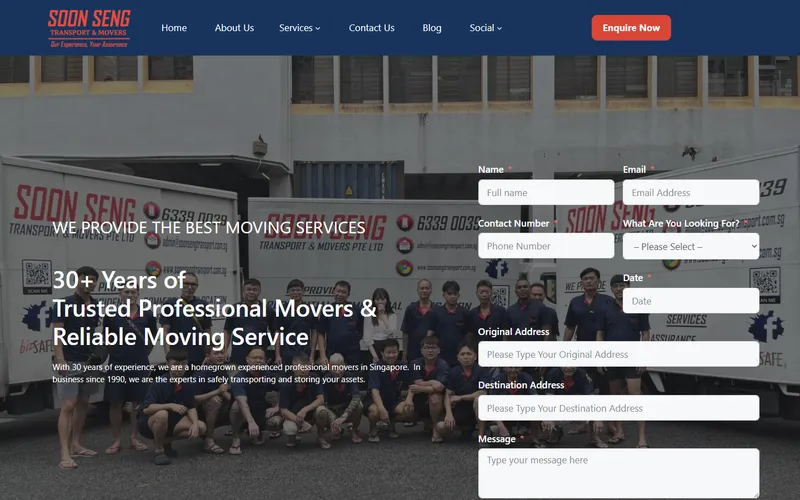
Longevity in moving means something specific. This is an industry with low barriers to entry, a lot of turnover and a fair number of operators who quote low and add on later. A firm still trading after decades has been doing repeat business, and in commercial moving repeat business is the whole model, because companies move every few years and remember who made it painless.
For a small to medium office with normal access and no unusual equipment, this tier is exactly right. Ask for the same itemised extras list you would ask anyone.
- Best for
- A straightforward small or mid-sized office move
- Strength
- A long track record in a high-turnover industry
- Website
- soonsengtransport.com.sg
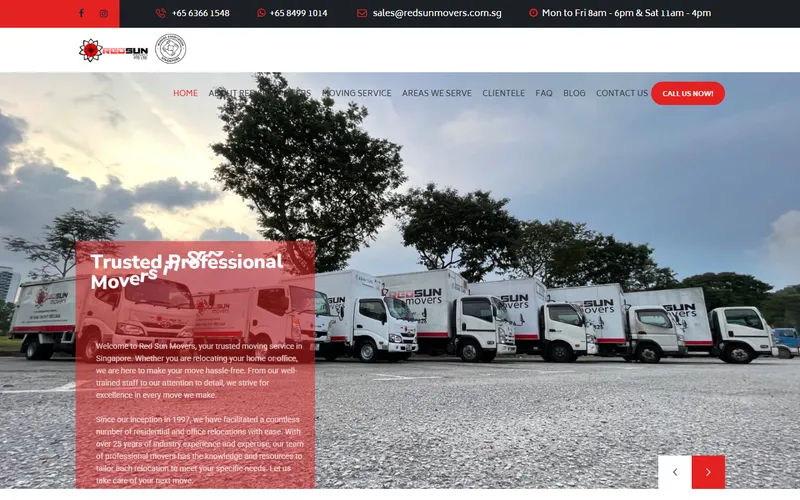
5. Red Sun Movers: the one that publishes the planning guide
A mover who has written down the process has, at minimum, been through it enough times to systematise it. More usefully for you, it means the planning conversation starts from a shared checklist rather than from scratch, which matters a great deal if this is your first office move and you do not yet know what you are supposed to be asking.
The guide is candid that office moving is quote-only because scope varies by size, equipment volume, distance, manpower and complexity. That is true across the industry, and a mover willing to say so up front is less likely to be the one whose number moves after the site survey.
- Best for
- A first office move where you need the checklist
- Notable
- Publishes a corporate relocation planning guide
- Handles
- Lift bookings and building management coordination
- Website
- redsunmovers.com.sg
6. Vimbox Movers: packing, and storage between leases
That gap is common and awkward. Commercial leases rarely line up neatly, fit-out work at the new premises regularly runs late, and you can end up needing somewhere for forty desks and a server rack for three weeks. Handling that through the mover means one party moves it out, stores it and moves it in, rather than a storage company and a mover blaming each other for a scratched credenza.
If a storage period is even possible, raise it at the quoting stage. Storage priced as an afterthought once the lorries are loaded is never the good version of that conversation.

- Best for
- A move with a gap in the middle
- Covers
- Moving, packing and storage
- Useful when
- Your leases do not line up, or the fit-out runs late
- Website
- vimboxmovers.sg
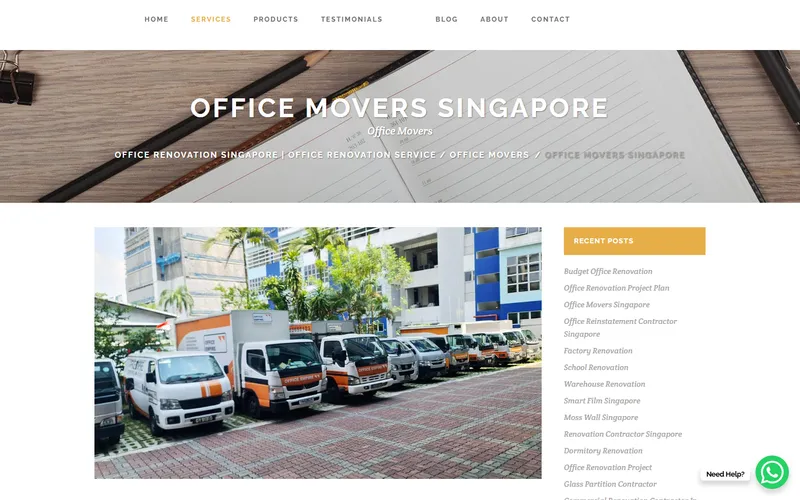
7. Office Empire: office relocation as the whole business
Specialisation is worth something here because the failure modes are specific. An office move goes wrong through mislabelled crates that leave people unable to find their monitor, through a service lift booking that was never confirmed, and through IT reconnection that nobody owned. None of those are lifting problems, and a firm that only does offices has usually built its process around exactly those risks.
It also sits close to office fit-out and furniture supply, which can be convenient if you are furnishing the new space at the same time. Keep the quotes separate and comparable even if the supplier is the same, so you can still tell what each part costs.
Contact Office Empire directly
- Best for
- Moving and furnishing the new space together
- Focus
- Office relocation as the core service
- Also covers
- Office furniture and fit-out
- Website
- office-empire.com
How much does an office move cost in Singapore?
There is no published rate, and that is not evasion. Office moving is quoted per job because the scope genuinely varies with office size, workstation count, volume of IT equipment, distance, manpower needed, whether it runs in or out of business hours, and how good the access is at both ends. Every mover here quotes after a site survey.
What you can control is comparability. Give each mover the same written brief: workstation count, what is being dismantled and reassembled, what is being disposed of, the intended move window, lift and loading access at both addresses, and who is handling IT. Three quotes against that brief are comparable. Three quotes against three phone conversations are not.
Then ask about the extras individually, because these are where final bills diverge: stairs or no-lift access charged per level, long push distance if the lorry cannot park near the lift, waiting time, weekend or urgent surcharge, dismantling and reassembly, packing materials, and disposal. And price your own downtime first, because that number is usually larger than any of the quotes and it should drive the schedule.
When should an office move happen?
Outside business hours, almost always. A Friday evening start gives the crew the weekend to move and reassemble, and leaves Sunday for IT to reconnect and test before anyone needs a desk on Monday. The after-hours surcharge is nearly always smaller than a day of lost productivity.
Frequently you will not have a choice anyway. Many commercial buildings restrict moves to evenings and weekends, require service lift bookings in advance, ask for the mover's insurance certificate, and want lift cars and common corridors protected. You need that approval at both ends, and the two buildings must offer overlapping windows.
Start the building conversation first, then fix the date, then book the mover. Doing it the other way round is the most common way an office move slips, because a mover can be rebooked in days and a service lift slot in a busy building sometimes cannot.
My verdict on office movers in Singapore
For most offices, Rodex Movers, which organises around downtime and works evenings and weekends, which is the shape almost every office move should take. For anything large enough that crew size decides whether it fits in a weekend, Shalom, and ask specifically how many people and lorries are assigned.
For a shop or a restaurant, Move Move Movers, and say it is retail or F&B at the first call. For a plain job done plainly, Soon Seng. If this is your first office move and you want the checklist, Red Sun, whose published guide is genuinely useful. If your leases do not line up, Vimbox for storage in the middle. And if you are furnishing as well as moving, Office Empire.
Whoever you pick, do it in this order: price your downtime, book both buildings, then book the mover. And ask about the extras by name, because asking whether there are any extras reliably produces the answer no.
A closing note for the movers. Not one company in this category publishes a rate, which is defensible given how much scope varies, and it means the website has to do the trust-building instead: a clear scope checklist, honest examples, and a quotation form that asks the right questions. The firm whose site makes an office manager feel organised is the one that gets the site survey. If your website is the weak link, that is fixable, and it happens to be my day job. Take a look at my web design services in Singapore, or get a quote and I will tell you honestly what I would change.
Spotted something out of date in this guide?
Suggest an edit or a business to add. This guide is pre-filled for you.
Sources & References (7)

Professional Opinion-haver
Terris
Chief Recommender · I do the digging so you don't have to
Terris is a Singapore-based web designer and digital strategist who has spent 8+ years building websites for local businesses. His Terris Recommends series shares personal picks for the best service providers across Singapore, informed by his experience working with businesses across industries.
Want to see these strategies in action? Browse our portfolio or get in touch to discuss your project.