Choosing the best serviced office Singapore has starts with a question most comparison pages skip: do you need an office, or do you only need an address? Every Singapore company must maintain a registered office address, and a great many businesses buy a serviced office when what they actually needed was a virtual one at a tenth of the cost.
There is also a third option almost nobody mentions. Under the HDB and URA Home Office Scheme you can register your company at your own home for a small fee, subject to conditions. It is the cheapest legal route by a wide margin, and the reason to reject it is usually privacy rather than price, because the ACRA register is public and that address stays on it.
So this guide sets out the three routes and what each costs, notes a 2025 rule change that has quietly made registered addresses easier, and covers six providers worth knowing. Prices are as of 2026.
Key Takeaways
- 1 Serviced office and virtual office are different products with a tenfold price gap. A virtual office is an address and mail handling from about S$30 a month. A serviced office is a furnished private room, with Servcorp starting from around S$500 per desk.
- 2 The cheapest legal option is not on any provider list. Under the HDB and URA Home Office Scheme you can register your company at your own home for a small fee, provided the business is in an approved category, no more than two non-resident employees work there, and there is no customer-facing retail.
- 3 The catch with the home route is permanent publicity. The ACRA register is public, so your home address becomes searchable on BizFile and stays there. That privacy trade-off, rather than the money, is the real reason most people pay for a virtual office.
- 4 The rules loosened in 2025. The Corporate and Accounting Laws (Amendment) Act 2025 removed the fixed minimum opening-hours requirement for a registered office, so a registered address no longer has to be staffed for a set number of hours each day.
- 5 Apply for Home Office Scheme approval before you incorporate, not after. ACRA expects the approval to be in place at the point you submit the incorporation application.
Three routes to a registered address, and what each costs
Work out which of these you need before you compare any providers, because the price difference between them is far larger than the difference between any two names on this page.
- Home Office Scheme: cheapest, and public. The Housing and Development Board and Urban Redevelopment Authority run a scheme letting you register a business at your HDB flat or private residence for a small fee. Conditions apply: the business must fall in an approved category, which covers most professional services and online businesses, no more than two non-resident employees may work there, the home cannot be physically modified for business use, and there is no customer-facing retail or showroom activity.
- Virtual office: an address and mail, from about S$30 a month. Budget packages start around S$30 and premium CBD addresses run to S$200 or more. You get a registered address, mail receipt and usually mail forwarding or scanning. You do not get a desk. For a company whose people work from home or a coworking space, this is very often the right purchase.
- Serviced office: a furnished private room, from around S$500 a desk. Servcorp private offices start from about S$500 per desk, with listings spanning roughly S$122 to S$12,002 depending on capacity and location. You get a lockable room, reception, meeting rooms and the address, on a licence rather than a lease.
The privacy trade-off is the real decision. ACRA's register is public, so a company registered at a home address puts that address on BizFile where anyone can search it, permanently. For a sole director running a consultancy that is often unwelcome, and a S$30 a month virtual office solves it. That, rather than any legal obstacle, is why most home-based businesses end up paying.
Two procedural points that catch people out. Apply for Home Office Scheme approval before submitting your incorporation application, because ACRA expects it to be in place at that point. And note that the Corporate and Accounting Laws (Amendment) Act 2025 removed the fixed minimum opening-hours requirement for a registered office, so an address no longer has to be staffed for a set number of hours each day. That makes lighter-touch virtual office arrangements straightforwardly compliant in a way they previously sat awkwardly against.
How the best serviced and virtual office providers in Singapore compare
| Provider | Type | From | Best for |
|---|---|---|---|
| Servcorp | Serviced and virtual | Private offices from about S$500 a desk | Premium addresses and a full reception service |
| Regus | Serviced and virtual | Varies by location | The largest network, and short commitments |
| The Executive Centre | Serviced | Premium banding | Corporate teams wanting a prestige address |
| Compass Offices | Serviced | Competitive CBD pricing | A CBD room without top-tier pricing |
| Sleek | Virtual office plus incorporation | Bundled with company services | Incorporating and getting an address together |
| Rikvin | Virtual office plus corporate services | Bundled | Corporate secretarial alongside the address |
1. Servcorp: the premium end, and a virtual arm worth knowing
The more interesting product for most small businesses is its virtual office arm, which gives you the same prestige address without the room. For a two-person consultancy that needs a credible address on proposals but genuinely works from home, that is the cost-effective half of what Servcorp sells.
Be clear which you are being quoted for. Serviced office enquiries default to the full room, and the sales conversation will not necessarily volunteer that the address alone is available for a fraction of it.
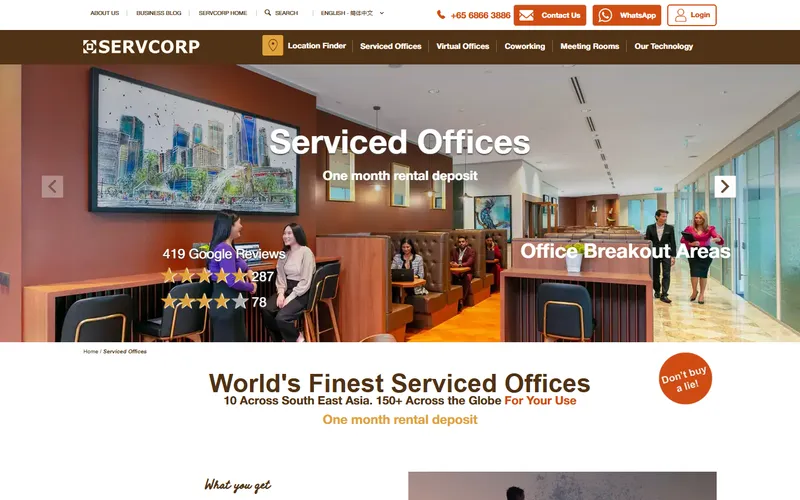
- Best for
- A prestige address, with or without the room
- Serviced offices
- Private offices from about S$500 a desk
- Also offers
- Virtual office at the same addresses
- Website
- servcorp.com.sg
2. Regus: the biggest network, and the shortest commitments
Short terms are the reason to look here first if you are uncertain. A business that might double in six months, or might not, is badly served by a twelve-month licence on a fixed room, and Regus is set up for exactly that uncertainty. The trade is that the spaces are functional rather than distinctive.
Its virtual office packages sit alongside the serviced offices at the same addresses, so you can start with an address and move into a room at the same location later without changing your registered details with ACRA, which saves a filing and a certain amount of admin.
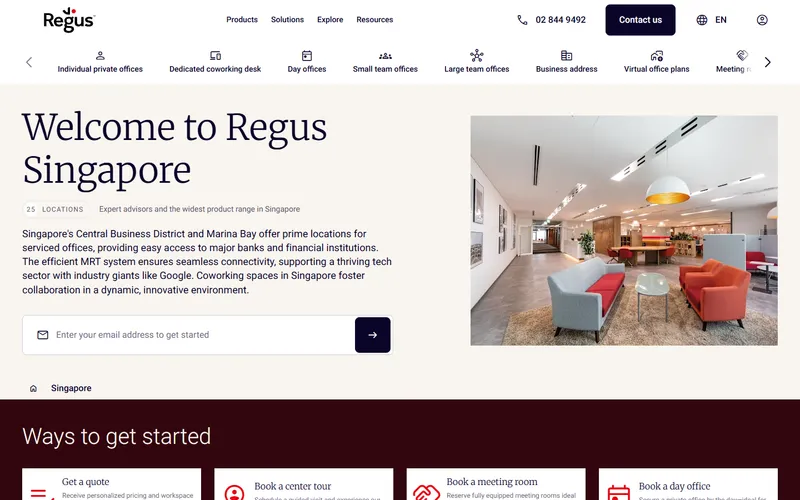
- Best for
- Businesses whose headcount is uncertain
- Network
- Part of IWG, 3,500+ locations worldwide
- Strength
- Short commitment terms and location choice
- Website
- regus.com
3. The Executive Centre: the corporate prestige option
Pricing is premium and quoted on enquiry. The honest way to think about it is that you are buying a fitted-out office in a good building without the capital cost, the lease term or the fit-out project, which for a team that needs to be operational in three weeks is a genuinely different product from a conventional lease.
Not the right call for a solo founder or an early-stage company. Very much the right call for a ten-person team that would otherwise be signing a three-year lease it may regret.
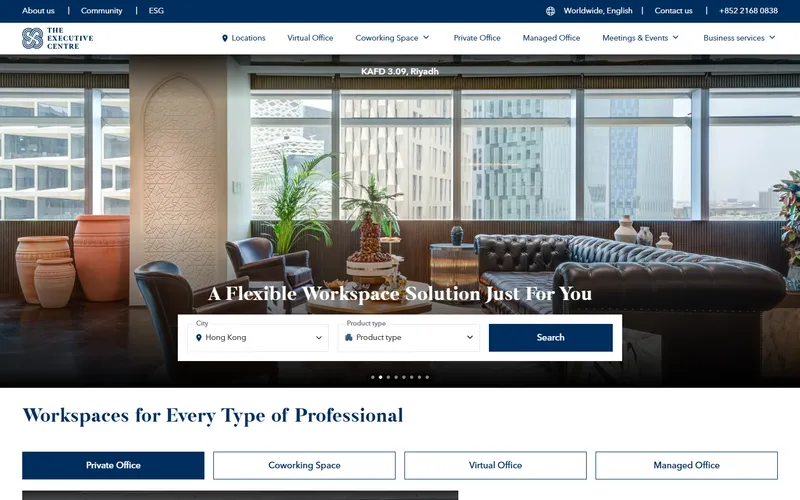
- Best for
- Teams that need a fitted office without a lease
- Positioning
- Premium, Asia Pacific wide
- Pricing
- On enquiry
- Website
- executivecentre.com
Recommended reads
4. Compass Offices: a CBD room without the top-tier price
For a small team that needs a room of its own, and where being in the CBD genuinely matters for client access rather than for appearances, this is the sensible middle. You give up some of the polish and some of the reception theatre.
Pricing is on enquiry, as with most of this sector. Ask for the all-in monthly figure including meeting room hours, internet, printing and mail handling, because serviced office quotes are frequently a room rate with the operating costs alongside rather than inside it.

- Best for
- A CBD private office at mid-market pricing
- Positioning
- Competitive CBD serviced offices
- Ask for
- An all-in monthly figure, not just the room rate
- Website
- compassoffices.com
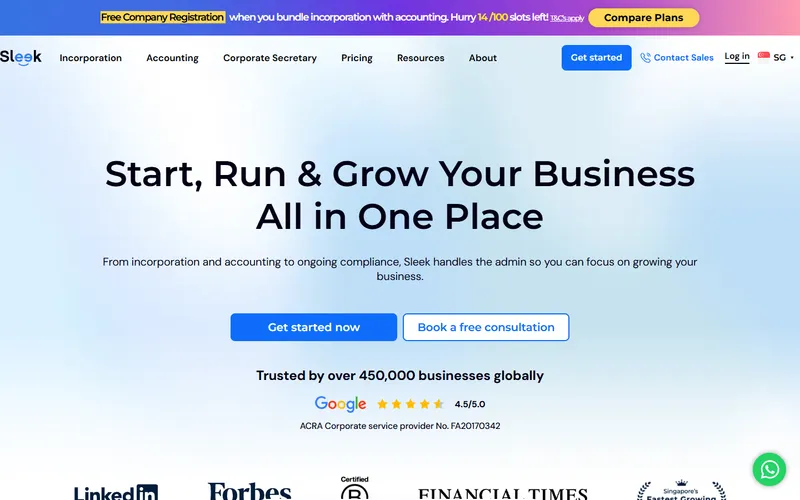
5. Sleek: the address bundled with the incorporation
The sequence matters here. You need a registered address at the point of incorporation, and if you were planning to use the Home Office Scheme you need that approval first. A provider handling both the incorporation and the address at once sidesteps the ordering question entirely.
The trade-off with bundling is that it is harder to price-compare each component, and moving your address later means untangling it from the corporate secretarial arrangement. Worth asking upfront what happens if you want to keep one and change the other. My guide to company incorporation in Singapore covers the wider field.
Contact Sleek directly
- Best for
- Incorporating and getting an address in one step
- Model
- Registered address bundled with incorporation and compliance
- Ask about
- What happens if you later change one component
- Website
- sleek.com/sg
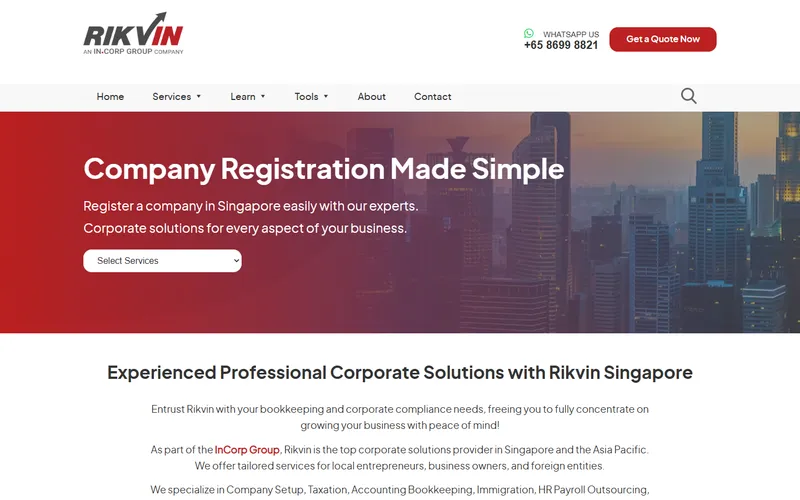
6. Rikvin: corporate services with the address attached
That suits a certain kind of business. If you expect to need actual advice, on employment passes, on a shareholder change, on whether an audit exemption applies, having the address sit with a firm that also does that work means one relationship rather than three.
As with any bundled arrangement, ask what the address costs on its own. If the answer is that it is only available as part of a package, that is fine, but you should know it before comparing against a S$30 standalone virtual office.
Contact Rikvin directly
- Best for
- Businesses that will want advice, not just an address
- Model
- Virtual office alongside incorporation, corporate secretarial and accounting
- Ask about
- The standalone address price, if there is one
- Website
- rikvin.com
How much does a virtual office cost in Singapore?
A virtual office in Singapore costs from about S$30 a month at the budget end to S$200 or more for a premium CBD address, and some providers offer basic packages below S$30. That typically covers a registered office address that satisfies ACRA, mail receipt, and mail forwarding or scanning. A serviced office, by contrast, starts from around S$500 per desk at Servcorp.
| Option | Cost | What you get |
|---|---|---|
| Home Office Scheme | A small application fee | Your own home as the registered address, subject to conditions |
| Virtual office, budget | From about S$30 a month | Registered address and mail handling |
| Virtual office, premium CBD | S$200 or more a month | A prestige address, often with meeting room credits |
| Serviced office | From about S$500 a desk | A furnished private room, reception and meeting rooms |
The most common overspend in this category is buying a serviced office for the address. If nobody on the team needs to sit in the room, a virtual office at a tenth of the price does the same regulatory job, and a coworking membership covers the desk separately if you want one.
Can I use my home address as my company address in Singapore?
Yes, under the Home Office Scheme administered by HDB for flats and URA for private residential properties. You apply for approval and pay a small fee, and the business must fall within an approved category, which covers most professional services and online businesses. No more than two non-resident employees may work at the address, the home cannot be physically modified for business use, and no customer-facing retail or showroom activity is permitted.
Apply for Home Office Scheme approval before submitting your incorporation application, since ACRA expects it to be in place at that point. The significant trade-off is privacy: the ACRA register is public, so once your company is registered at your home address, that address is searchable on BizFile and remains on the public record. For many sole directors that is the reason to pay for a virtual office instead.
What is the difference between a serviced office and a virtual office?
A virtual office provides a registered business address and mail handling with no physical workspace, from about S$30 a month. A serviced office provides a furnished, lockable private room in a managed building, with reception, meeting rooms and the address included, from around S$500 per desk. The gap between them is roughly tenfold.
Choose a virtual office when the requirement is regulatory and reputational, meaning you need a compliant registered address and something credible on your invoices, but the team works remotely or from coworking. Choose a serviced office when people actually need to sit somewhere together, and you want to avoid a conventional lease and a fit-out.
What are the ACRA rules for a registered office address?
Every Singapore company must maintain a registered office address in Singapore where official correspondence can be received. It must be a physical address rather than a post office box, and it must be an address at which mail is genuinely received. A virtual office satisfies this provided the provider actually receives and passes on mail.
The rules loosened in 2025: the Corporate and Accounting Laws (Amendment) Act 2025 removed the fixed minimum opening-hours requirement, so a registered office no longer needs to be open to the public for a set number of hours each day. Note that the registered address appears on ACRA's public register, so whichever route you choose, that address becomes publicly searchable.
My verdict on serviced and virtual offices in Singapore
Answer one question first: does anyone actually need to sit there? If not, you want a virtual office at S$30 to S$200 a month, not a serviced office at S$500 a desk, and the gap between those two numbers is the most common overspend in this category.
If price is the whole constraint and you are comfortable with your home address appearing permanently on a public register, the Home Office Scheme is legal, cheap and the option nobody selling you an office will mention. Apply before you incorporate. If that publicity is unwelcome, and for a lot of sole directors it is, a budget virtual office solves it for roughly a dollar a day.
For a room: Regus if headcount is uncertain and short terms matter, Compass for a CBD office without top-tier pricing, The Executive Centre when clients visit and the room has to signal established, and Servcorp when you want the prestige address, whether or not you take the room behind it. Sleek or Rikvin if you are incorporating at the same time and would rather buy it as one arrangement.
One last note. The 2025 removal of the minimum opening-hours rule for registered offices is a small change that makes lighter virtual arrangements cleanly compliant, and almost nothing ranking for these terms mentions it. In a category where businesses are choosing between a S$30 address and a S$500 desk on the strength of a comparison page, being the page that is actually current is worth more than being the longest. If your website is the weak link, that is fixable, and it happens to be my day job. Take a look at my web design services in Singapore, or get a quote and I will tell you honestly what would move the needle.
Spotted something out of date in this guide?
Suggest an edit or a business to add. This guide is pre-filled for you.

Professional Opinion-haver
Terris
Chief Recommender · I do the digging so you don't have to
Terris is a Singapore-based web designer and digital strategist who has spent 8+ years building websites for local businesses. His Terris Recommends series shares personal picks for the best service providers across Singapore, informed by his experience working with businesses across industries.
Want to see these strategies in action? Browse our portfolio or get in touch to discuss your project.