Most people choosing a uniform supplier Singapore businesses use compare quotes. The thing that actually goes wrong is the calendar.
Standard production is 7 to 21 working days after design approval, and embroidery specifically runs 10 to 14. Read that phrase carefully, because the weeks do not disappear in the factory, they disappear in the approval loop: artwork goes back for a colour change, the person who signs off is away, and the version everyone agreed on turns out to be the wrong logo file. A team that needs uniforms for an opening in three weeks has usually already missed it.
The prices themselves are modest. Basic polos with a one-colour print run about S$8 to S$15 a piece above fifty units, and a dri-fit polo with two embroidered logos is roughly S$15.70 at a quantity of twenty. This guide covers six suppliers, and the decision that matters most in it is print against embroidery.
Key Takeaways
- 1 Lead time is what catches people out, not price. Standard production runs 7 to 21 working days after design approval, and embroidery specifically takes 10 to 14. If you need uniforms for something three weeks away, you are already tight.
- 2 The phrase doing the damage is "after design approval". The approval loop, where artwork goes back and forth and someone senior is on leave, is where the weeks actually disappear. Lock the artwork and the decision maker before you start counting days.
- 3 Minimum orders are lower than most people assume. Twenty to thirty pieces is typical, and some suppliers accept from ten, which makes a proper uniform viable for a small team or a pilot run rather than only for a chain.
- 4 Print versus embroidery is a durability decision, not an aesthetic one. Printed logos crack and fade under repeated hot industrial washing, embroidery does not. For F&B and hospitality, where uniforms are washed daily, embroidery usually costs less over a year despite costing more per piece.
- 5 Real prices to plan against: basic polos with a one-colour print run about S$8 to S$15 a piece on orders above 50, and a dri-fit polo with two embroidered logos sits around S$15.70 a piece at a quantity of 20.
Lead times, minimums, and the print versus embroidery decision
Four things to settle before you brief a supplier.
- Count backwards from the date you need them. Production is 7 to 21 working days after approval and embroidery is 10 to 14, so working days rather than calendar days, and that is before the approval loop. If your uniforms are for a launch, an event or a new outlet opening, start four to six weeks out. If somebody is flying in for photographs, add more.
- Lock the artwork and the approver first. Have a vector logo file, agreed colours and one named person who can say yes, before you brief anyone. The most common delay in this category is not the supplier, it is three people with opinions and a logo that only exists as a low-resolution image in a slide deck.
- Minimums are lower than people expect. Twenty to thirty pieces is the common threshold, and some suppliers will accept from ten, which puts a proper uniform within reach for a small team or a trial run before committing to a full order. Ask about a pilot quantity rather than assuming you have to commit to a hundred.
- Choose print or embroidery on how it will be washed. Printed logos are cheaper per piece and look sharp on day one, and they crack and fade under repeated hot washing. Embroidery is stitched thread, costs more per piece, and survives industrial laundry more or less indefinitely. For an office polo worn occasionally, print is fine. For F&B or hospitality where staff wash uniforms daily, embroidery is normally the cheaper choice over a year, because you replace fewer shirts.
Two practical points that save reorders. Order a size run rather than guessing: get one sample of each size, have people try them on, and then place the real order, because cuts vary enormously between brands and a shirt labelled L is not a standard object. And order roughly ten percent spare, because people leave, shirts get ruined and a matching top-up order six months later may not come from the same fabric dye lot.
Uniforms usually get commissioned in the same week as other branded things, so my guides to the best corporate gift suppliers in Singapore and the best printing services in Singapore cover the neighbouring purchases, and several suppliers overlap across all three.
How the best uniform suppliers in Singapore compare
| Supplier | Strength | Minimum | Best for |
|---|---|---|---|
| MeowPrint | Custom apparel and corporate gifts | Standard | Uniforms and gifts in one order |
| ECEmbroid | Embroidery specialist | From about 10 pieces | Small teams and pilot runs |
| Uniform Hub | Uniform-focused supplier | Standard | Proper uniforms rather than branded tees |
| Asia T-shirt | Corporate uniforms and workwear | Standard | Workwear for operational teams |
| Zurlique | Polo printing and embroidery | Standard | A straightforward branded polo order |
| Sin Ming Industries | Founded 1975, promotional and corporate apparel | Standard | A long-established supplier for a large order |
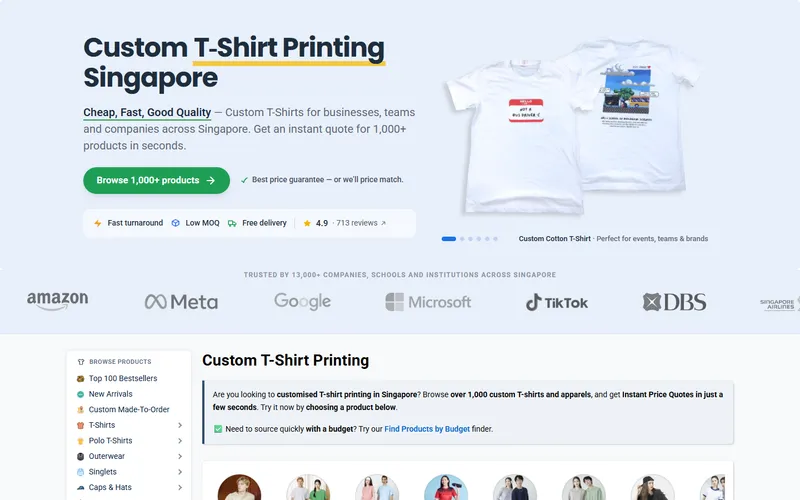
1. MeowPrint: apparel and gifts from one supplier
Uniforms are rarely commissioned alone. The same week usually involves branded lanyards, tote bags, water bottles or notebooks, all needing the same logo applied in the same colours. Getting them from one supplier means one artwork approval, one colour reference and one delivery, rather than discovering that your navy is subtly different across three vendors.
Colour consistency is a genuine issue worth managing. Ink on cotton, thread on a dri-fit polo and print on an anodised bottle will never match perfectly, but a single supplier working from one specification will get far closer than three working from three emails. Give them a Pantone reference if you have one.
- Best for
- Uniforms and gifts commissioned together
- Covers
- Custom apparel, corporate gifts and merchandise
- Useful for
- One artwork approval across everything branded
- Website
- meowprint.sg
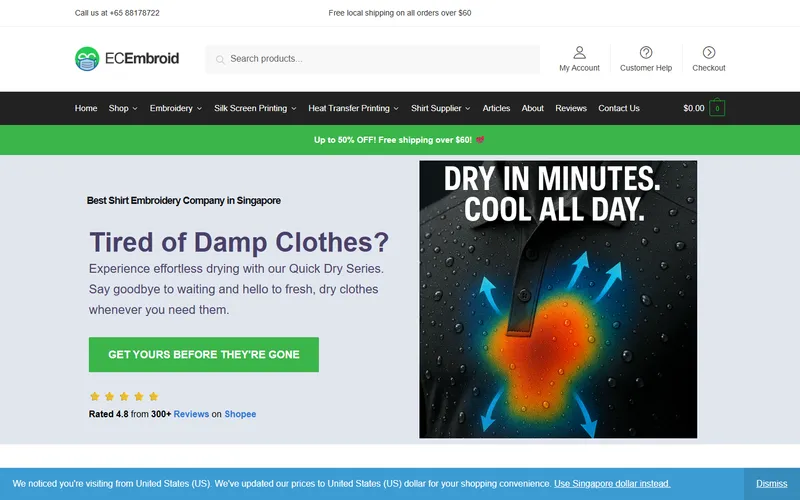
2. ECEmbroid: embroidery, and the lowest minimum here
A ten-piece minimum genuinely changes what is possible. A five-person startup, a small clinic or a team piloting a uniform before rolling it out can get properly made shirts rather than ordering fifty and storing forty. It also makes a trial run viable: order ten, wear them for a month, then commit to the full order knowing the fabric and fit work.
On embroidery specifically, ask about stitch count and digitising. Converting a logo into a stitch file is skilled work, and a badly digitised logo looks wrong on every single shirt you own. It is a one-off cost and it is worth getting right, so ask to see a stitch-out sample before the full run.
- Best for
- Small teams, and pilots before a full rollout
- Minimum
- From about 10 pieces, 20 for most styles
- Indicative price
- About S$15.70 a piece for a dri-fit polo with two embroidered logos at 20
- Ask for
- A stitch-out sample before the full run
- Website
- ecembroid.com
Recommended reads
3. Uniform Hub: actual uniforms, not branded T-shirts
A branded polo and a uniform are different products. A uniform is worn every day, washed constantly, needs to look the same on twenty different body shapes and has to still look presentable in month eight. That points to heavier fabrics, better construction and cuts designed to be worn all day rather than at a company event. A supplier who works on uniforms specifically will steer you toward those rather than the cheapest blank.
Ask about fabric weight and composition, and ask what happens with reorders. A uniform programme runs for years, so the practical question is whether the same shirt in the same colour will still be available when you hire six people next March.
Contact Uniform Hub directly
- Best for
- A uniform worn daily rather than a branded tee
- Focus
- Corporate uniforms specifically
- Ask about
- Fabric weight, and whether reorders stay available
- Website
- uniformhub.sg
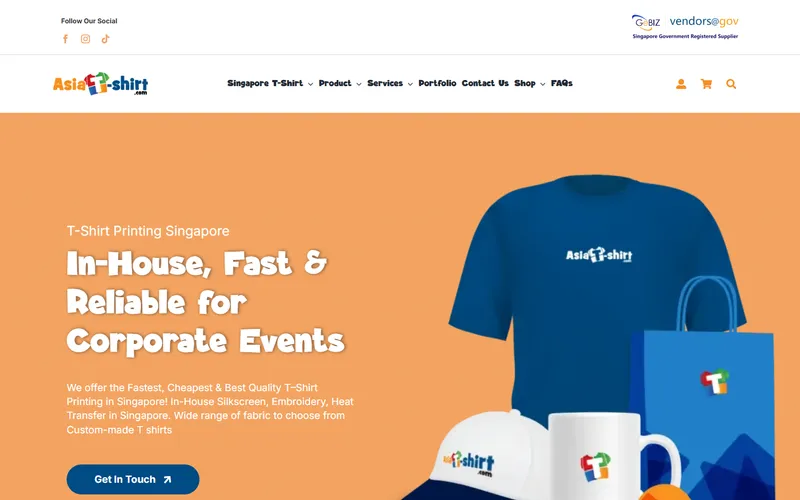
4. Asia T-shirt: workwear for operational teams
Workwear has requirements office apparel does not. Reinforced seams, fabrics that survive contact with tools and cleaning chemicals, high-visibility elements where they are needed, and cuts that allow real movement rather than looking neat while standing still. A shirt that works for a showroom is not the same garment as one for a warehouse or a site.
If any of your team works outdoors, raise the climate explicitly. Singapore heat makes fabric weight and breathability a genuine welfare issue rather than a comfort preference, and a supplier should be able to recommend a lighter technical fabric that still holds a logo well.
Contact Asia T-shirt directly
- Best for
- Operational and site-based teams
- Covers
- Corporate uniforms and custom workwear
- Raise early
- Outdoor work, and fabric weight in this heat
- Website
- asiat-shirt.com
5. Zurlique: the straightforward branded polo
Not every apparel order is a uniform programme. Plenty are a one-off run for an event, a road show, a company retreat or a client-facing team who need something matching for a fortnight. For that, the sensible choice is a straightforward supplier, a standard blank, one logo position and a short lead time.
Keep the specification simple to keep the schedule short. One logo position, one colour of print, a stock garment colour. Every additional decision, a second logo, a contrast collar, a custom dye, adds days to a timeline that is already 7 to 21 working days from approval.
Contact Zurlique directly
- Best for
- A one-off run for an event or a road show
- Covers
- Polo printing and embroidery with logo application
- Keep it fast
- One logo, one colour, a stock garment
- Website
- zurlique.com
6. Sin Ming Industries: trading since 1975
Longevity earns its place on a large or recurring order. A uniform programme is a relationship rather than a transaction: you will reorder as people join, you will need the same garment in the same colour in eighteen months, and you want the specification on file somewhere that still exists. A supplier that has been trading for five decades is a reasonable bet on all three.
It also covers promotional products alongside apparel, so it fits the same one-supplier logic as the first entry here. For a small ten-piece order you may find a keener price elsewhere, and for a company-wide rollout this is the tier to be talking to.
- Best for
- A company-wide rollout you will reorder against for years
- Founded
- 1975
- Covers
- Promotional products and corporate apparel
- Website
- sinming.com.sg
How long does a custom uniform order take in Singapore?
Standard production is 7 to 21 working days after design approval, and embroidery specifically runs about 10 to 14 working days. Those are working days, so a three-week production estimate is closer to a month of calendar time once weekends and any public holiday are counted.
The phrase that misleads people is "after design approval". The clock does not start when you first email a supplier, it starts when the artwork is finalised and signed off. In practice that stage regularly takes as long as production, because logo files turn out to be low resolution, colours get debated, and the person who has to approve it is travelling.
So work backwards from the date you need them and add a buffer. Four to six weeks is a comfortable window for a straightforward order. If uniforms are needed for an opening or a campaign with a fixed date, start earlier and get the artwork approved in week one, before you have even chosen the garment.
Should I choose printed or embroidered logos?
Decide on the laundry, not the look. Printed logos are cheaper per piece and can reproduce complex artwork and gradients well, and they degrade under repeated hot washing, cracking and fading over time. Embroidery is stitched thread, costs more per piece, and survives industrial laundry more or less indefinitely.
That makes it a straightforward calculation. For an office polo worn once a week, print is entirely sensible and the shirts will outlast the logo either way. For F&B, hospitality, clinics or any team whose uniforms are washed daily and hot, embroidery is usually the cheaper option over a year, because you replace shirts far less often.
Two caveats on embroidery. Very fine detail and small text do not stitch well, so a complex logo may need simplifying into an embroidery-friendly version, which is normal and worth doing properly. And ask to see a stitch-out sample before the full run, because a badly digitised logo will be wrong on every shirt and you only find out once they are all made.
My verdict on uniform suppliers in Singapore
For most companies, MeowPrint, because uniforms are rarely ordered alone and one supplier handling apparel and branded items keeps your colours consistent across all of it. For a small team or a pilot before a rollout, ECEmbroid, which takes orders from about ten pieces and quotes around S$15.70 for a dri-fit polo with two embroidered logos at twenty.
If this is a daily-wear uniform rather than a branded tee, Uniform Hub, and ask about fabric weight and reorder availability. For operational or site teams, Asia T-shirt. For a one-off event run kept deliberately simple, Zurlique. And for a company-wide programme you will be reordering against for years, Sin Ming Industries, trading since 1975.
Whoever you choose, do the two things that prevent almost every problem: approve the artwork before you start counting days, and order a size run for people to try on before committing to the full quantity.
A closing note for the suppliers. This is a category where the buyer is usually an office manager under time pressure who needs three things from a website: the minimum order, the lead time, and an indicative price. The supplier whose site answers all three gets the enquiry, and the one that says request a quote for everything gets skipped. If your website is the weak link, that is fixable, and it happens to be my day job. Have a look at my web design services in Singapore, or get a quote and I will tell you honestly what would help.
Spotted something out of date in this guide?
Suggest an edit or a business to add. This guide is pre-filled for you.
Sources & References (6)

Professional Opinion-haver
Terris
Chief Recommender · I do the digging so you don't have to
Terris is a Singapore-based web designer and digital strategist who has spent 8+ years building websites for local businesses. His Terris Recommends series shares personal picks for the best service providers across Singapore, informed by his experience working with businesses across industries.
Want to see these strategies in action? Browse our portfolio or get in touch to discuss your project.