
There is one question that separates a real PR agency Singapore shortlist from an expensive mistake, and you can ask it on the first call: can you guarantee coverage?
The right answer is no. Editorial placement is a journalist's decision, and nobody can promise it. An agency that guarantees placements is either buying advertorials, which are paid, must be labelled as advertising and are read very differently, or it is telling you something untrue at the start of the relationship. Either way you now know what you are dealing with.
The second thing worth knowing is the price ladder, because it is enormous. Boutique agencies aimed at SMEs start around S$4,000 to S$6,000 a month. Mid-market engagements run roughly S$8,000 to S$30,000. Global network agencies sit at S$30,000 to S$70,000 and beyond. This guide covers seven agencies across those bands and explains what changes as you move up.
Key Takeaways
- 1 If an agency guarantees coverage, it is not selling you PR. Editorial placement is a decision made by a journalist, and no agency controls that. A guaranteed placement is a paid advertorial, which is a legitimate product but has to be labelled as advertising and behaves completely differently.
- 2 The retainer range is enormous and each band buys something different. Boutique and SME-focused agencies start around S$4,000 to S$6,000 a month, mid-market engagements run roughly S$8,000 to S$30,000, and global network agencies sit at S$30,000 to S$70,000 and above.
- 3 PR is a retainer, not a project, and the first quarter is mostly groundwork. Building relationships, developing story angles and getting a spokesperson media-ready takes weeks before anything is published. Signing a three-month contract and judging it at week six is the most common way businesses waste this budget.
- 4 PR is earned media. Digital marketing is paid and owned media. They are complementary and they are not substitutes, so do not brief a PR agency expecting leads next month or a performance agency expecting a feature in The Straits Times.
- 5 Ask who is actually doing the work. Pitching is a relationship business, so the difference between a senior consultant who knows the journalists on your beat and a junior working from a media list is the difference between coverage and silence. Ask which named people are on your account and what proportion of their time you get.
What you are actually buying, and what it costs
Four things to settle before you brief anyone.
- Earned media cannot be guaranteed, and that is the point. A journalist writing about you independently carries credibility precisely because you did not pay for it. That is also why it cannot be promised, and why the honest agencies talk about story angles, relationships and probability rather than deliverable counts. Advertorials and sponsored content are perfectly legitimate, they simply are not the same product and they are not priced the same way.
- Know which band you are in. Boutique and SME-focused agencies start around S$4,000 to S$6,000 a month and typically give you basic media relations with a small senior team. Mid-market at S$8,000 to S$30,000 buys a broader programme: media relations plus content, spokesperson training, events and some digital. Global networks at S$30,000 to S$70,000 and up buy regional reach, specialist practices such as financial communications, and the bench to handle a crisis at 2am. Paying mid-market money and expecting network reach is a mismatch, not a bad agency.
- Budget three to six months before you judge it. The first weeks go on understanding your business, developing angles a journalist would actually run, preparing a spokesperson and rebuilding relationships on your beat. Coverage that arrives in month one is usually luck or a pre-existing relationship. Signing for three months and evaluating at week six is the most reliable way to conclude that PR does not work.
- Ask who is on the account, by name. Pitching runs on relationships, and a senior consultant who has known the technology or property or F&B reporters for a decade gets calls returned that a junior on a media list does not. Ask which named people work on your account, how much of their week you get, and who actually makes the pitch calls. The answer to that last one explains most of the variation in results.
One boundary worth drawing clearly, because it causes more disappointment than anything else. PR is earned media: coverage, commentary, reputation, crisis response. Digital marketing is paid and owned: ads, search, social, your own channels. They support each other and they do different jobs. If what you need is leads next quarter, my guides to the best digital marketing agencies in Singapore and the best SEO agencies in Singapore are the right place to start. If what you need is to be taken seriously by an industry, this is.
And if the underlying problem is that your brand does not yet stand for anything specific, the best branding agencies in Singapore come before PR rather than after it. Pitching a story about a company with no clear position is hard work for everyone.
How the best PR agencies in Singapore compare
| Agency | Tier | Focus | Best for |
|---|---|---|---|
| Klareco Communications | Large independent | Corporate and financial communications | Complex corporate and stakeholder work |
| Mutant Communications | Mid-market | Integrated PR, content and digital | Brands that need comms and content together |
| Tate Anzur | Mid-market | Strategic communications and storytelling | Positioning before publicity |
| Mileage Communications | Mid-market | Consumer and lifestyle PR | Consumer brands and launches |
| Saltine Communications | Boutique | Startups and SMEs | A first PR programme on a real budget |
| Grow PR | Boutique | SME-focused public relations | Smaller businesses wanting senior attention |
| WhiteLabel PR | Boutique | Retail, F&B, lifestyle, property | Consumer sectors on a boutique budget |
1. Klareco Communications: the largest independent here
The practical difference is conflict and continuity. Global network agencies sometimes cannot act for you because a sister office acts for a competitor, and their senior people move between markets on network timelines. A large independent has fewer of those constraints and its senior team tends to stay put, which matters in a market as small as Singapore where the same handful of people know the same journalists for years.
Corporate and financial communications is also a genuinely different discipline from consumer PR. Regulatory announcements, investor audiences, transactions and stakeholder management have rules and rhythms that a lifestyle agency does not work in daily. If your communications touch a listed entity, a fundraise or a restructuring, start at this end of the market.
Contact Klareco Communications directly
- Best for
- Listed companies, transactions and stakeholder-heavy work
- Tier
- Among the largest independents in Singapore
- Focus
- Corporate and financial communications
- Website
- klareco.com
2. Mutant Communications: PR and content in one place
Integration matters more than it used to. A media placement now lives mostly as a link shared on social, quoted in a newsletter and eventually found in search. An agency that can write the piece, place the story and then make sure the coverage is used afterward gets considerably more out of the same result than one that emails you a clipping and moves on.
Read their in-house versus agency material before you commit, including the parts that argue for hiring internally. An agency willing to publish the case against using an agency is telling you something about how the conversation will go.
Contact Mutant Communications directly
- Best for
- Companies that need the coverage and the content around it
- Tier
- Mid-market
- Focus
- Integrated PR, content and digital
- Notable
- Publishes an honest agency versus in-house comparison
- Website
- thisismutant.com
3. Tate Anzur: positioning before publicity
A great many PR briefs are really positioning briefs in disguise. A company that cannot say in one sentence why it exists and who it is for will not get coverage no matter how good the pitching is, because there is nothing for a journalist to write. Agencies that start with the narrative rather than the media list are addressing the actual constraint.
That work is slower and it feels less like PR, because the first deliverables are messaging and narrative rather than clippings. It is also the reason some companies get coverage easily and others spend two years failing to. If you have already run a PR programme that produced little, this is usually the reason.
Contact Tate Anzur directly
- Best for
- Companies whose story is the bottleneck, not their pitching
- Tier
- Mid-market
- Focus
- Strategic communications and narrative
- Website
- tateanzur.com
Recommended reads
4. Mileage Communications: consumer and lifestyle
Consumer PR lives on launches, product news, seasonal hooks, influencer and media previews, and the timing is unforgiving: a restaurant opening or a product launch has a window of a few weeks and then the story is stale. Agencies that work this way run to a different rhythm from corporate teams, and they know which lifestyle editors are planning what, months ahead.
If you are launching something consumer-facing, brief an agency that does this constantly rather than a generalist. And brief it early, because the lead times on print and long-lead lifestyle titles are considerably longer than most founders expect.
- Best for
- Product launches and consumer brands
- Tier
- Mid-market
- Focus
- Consumer and lifestyle communications
- Brief early
- Long-lead titles plan months ahead
- Website
- mileageco.com
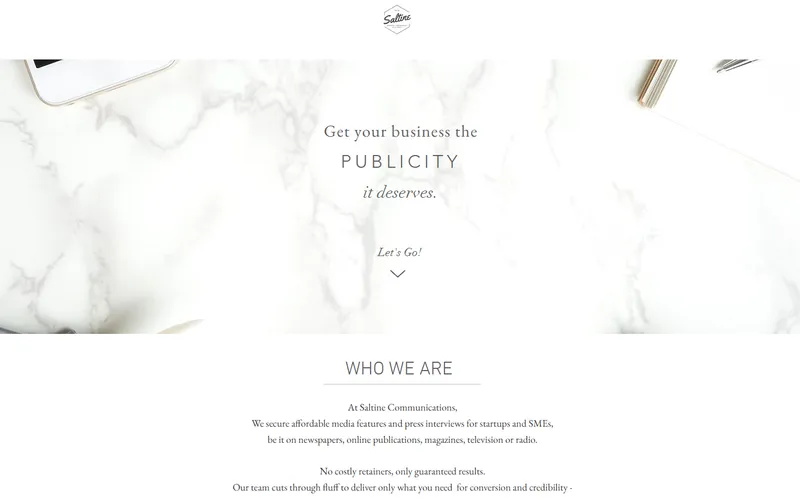
5. Saltine Communications: startups, and honest pricing
Founders are the group most often mis-sold PR, usually because nobody set expectations. They are told a retainer will produce coverage, they sign for three months, and they cancel at week eight having concluded the whole discipline is a con. An agency that publishes the price bands and explains the timeline before you engage is removing exactly that failure.
At the boutique end, roughly S$4,000 to S$6,000 a month, the work is focused: a defined set of stories, a target media list and a spokesperson prepared properly. Expect fewer moving parts than a mid-market programme, and expect more of the senior person's actual time.
- Best for
- A first PR programme with expectations set properly
- Tier
- Boutique
- Focus
- Startups and SMEs
- Notable
- Publishes what PR actually costs here
- Website
- saltinecomms.com
6. Grow PR: SME work with senior attention
The genuine advantage of a small agency is who does the work. In a large agency the senior people win the business and a junior team runs the account, which is normal and not sinister, but it means the person pitching your story may be six months into their career. In a boutique the person who pitched you is frequently the person picking up the phone to a journalist. For a smaller company with one or two stories to tell, that trade is usually worth making.
The corresponding limitation is bench depth. A boutique cannot surge a team overnight for a crisis or run a simultaneous six-market campaign, so if either of those is a real possibility for you, price that in.

- Best for
- Smaller companies that want the senior person on the phone
- Tier
- Boutique
- Focus
- SME public relations
- Trade-off
- Senior attention, less bench depth for a crisis
- Website
- growpublicrelations.com
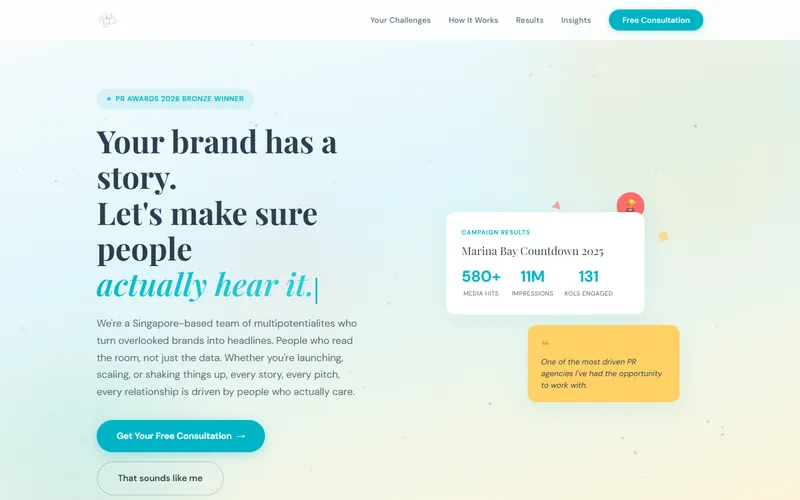
7. WhiteLabel PR: consumer sectors at a boutique price
Sector range matters at this size because a boutique lives or dies on relevant relationships. An agency that has placed stories across beauty and F&B and property has media contacts across several desks, which gives a smaller client more angles than a single-sector specialist could offer at the same fee.
As with any boutique, ask for recent examples in your specific sector rather than the general client list. A broad portfolio is a strength when the relationships are current and a weakness when the last F&B campaign was in 2021, and only asking will tell you which it is.
- Best for
- Consumer brands on a boutique budget
- Tier
- Boutique
- Sectors
- Retail, F&B, lifestyle, beauty, property, non-profit, entertainment, technology
- Ask for
- Recent work in your sector, not the overall client list
- Website
- whitelabelpr.com.sg
How much does a PR agency cost in Singapore?
It is a monthly retainer, and the bands are wide. Boutique and SME-focused agencies typically start around S$4,000 to S$6,000 a month. Mid-market engagements run roughly S$8,000 to S$30,000. Global network agencies and specialist practices such as financial communications or crisis sit at S$30,000 to S$70,000 and above.
What changes as you move up is seniority, breadth and bench. At the bottom you get a small senior team doing focused media relations. In the middle you add content, spokesperson training, events and digital support. At the top you add regional coordination, specialist practices and the capacity to put a large team on a crisis at short notice.
Two things to clarify in any quote. Whether the retainer covers a defined scope or a number of hours, since those behave very differently when a month gets busy. And what is excluded: media monitoring tools, event costs, photography, video, influencer fees and paid amplification are commonly billed on top and can be a substantial addition to the headline figure.
Can a PR agency guarantee media coverage?
No, and an agency that says otherwise is describing a different product. Editorial coverage is a decision made by a journalist or an editor based on whether your story is interesting to their readers. No agency, at any price, controls that decision, which is precisely why earned coverage carries credibility that advertising does not.
What can be guaranteed is paid placement: advertorials, sponsored content and native advertising. Those are legitimate and sometimes the right tool, and they must be labelled as advertising, which changes how readers weigh them. If an agency promises a specific number of placements, ask directly whether those are paid, and price them as advertising, because that is what they are.
What a good agency will commit to is effort and process: a defined number of story angles developed, a target media list, pitching activity, spokesperson preparation and reporting. Judge on that plus results over a quarter, not on a promised clipping count.
What is the difference between PR and digital marketing?
PR earns attention from third parties. Digital marketing buys and owns it. That distinction explains nearly every mismatched expectation in this category.
A PR agency works on media relations, commentary, thought leadership, reputation and crisis response, and its output is coverage in outlets you do not control. A digital agency works on search, paid media, social and your own channels, and its output is traffic, leads and measurable conversion. PR is generally slower to show results and harder to attribute, and it builds something advertising cannot buy, which is the credibility of somebody else saying it.
The two work well together and neither substitutes for the other. If you need leads this quarter, start with digital. If you need an industry, a regulator or a hiring market to take you seriously, start with PR. If you need both, say so at the briefing, because plenty of agencies here now offer integrated services and can sequence the two properly.
My verdict on PR agencies in Singapore
For corporate, financial or stakeholder-heavy communications, Klareco, one of the largest independents here, which means fewer network conflicts and more stable senior people. For coverage plus the content that makes it work afterward, Mutant. If your story is the bottleneck rather than your pitching, Tate Anzur before anyone else.
For a consumer launch, Mileage, and brief them earlier than feels necessary. For a first PR programme with the expectations set honestly, Saltine, which publishes what this actually costs. For an SME that wants the senior person making the calls, Grow PR. And for consumer sectors on a boutique budget, WhiteLabel PR, asking for recent work in your specific sector.
Two questions worth asking every one of them. Can you guarantee coverage, where the right answer is no. And who by name is on my account and how much of their week do I get, where the right answer is specific.
A closing note for the agencies. Two firms on this page publish what PR costs in Singapore and the rest quote on enquiry, and the two that publish are the ones a founder can actually evaluate at eleven at night before deciding whether to email anyone. In a category people find opaque and slightly intimidating, transparency is the whole differentiator. If your website is not doing that work, it is fixable, and it happens to be my day job. Take a look at my web design services in Singapore, or get a quote and I will tell you honestly what I would change.
Spotted something out of date in this guide?
Suggest an edit or a business to add. This guide is pre-filled for you.
Sources & References (7)

Professional Opinion-haver
Terris
Chief Recommender · I do the digging so you don't have to
Terris is a Singapore-based web designer and digital strategist who has spent 8+ years building websites for local businesses. His Terris Recommends series shares personal picks for the best service providers across Singapore, informed by his experience working with businesses across industries.
Want to see these strategies in action? Browse our portfolio or get in touch to discuss your project.