


Terris Recommends 16,400+ monthly visitors Home Services
9 Best Termite Control Services in Singapore (October 2026)
My picks for termite control in Singapore: 9 NEA-registered firms compared on baiting, soil treatment, warranties and real prices for HDB, condo and landed.
This guide is part of Terris Recommends, my researched, hands-on picks of the best local businesses and services in Singapore. Every recommendation is researched and ranked by me.
See all recommendationsTermites are the one pest where hiring the wrong company costs you twice: once for the treatment, then again for the kitchen cabinets. So for this guide to termite control in Singapore I kept asking one question. Who actually finds the colony and kills it? I read every firm's termite pages, checked each against NEA's register of vector control operators, counted Google reviews, and noted who publishes warranties and prices. Nine companies made the cut.
This is a spoke of my guide to the best pest control companies in Singapore. Termites get their own page because the job is so different. A cockroach treatment is usually one visit. A termite treatment is an inspection, a plan and anywhere from four weeks to six months of follow-ups.
I'm Terris, a web designer in Singapore, and Terris Recommends is where I publish my research on local services. I haven't hired these firms myself. Everything below comes from their published methods, NEA's records and their customers' reviews.
Most termite damage here comes from subterranean termites. They nest in soil or a hidden void and reach timber through mud tubes about the width of a pencil. Drywood termites are the other common type. They live inside the wood they eat, need no soil, and often arrive in a door or cabinet that was already infested.
The signs worth knowing:
- Mud tubes running up a wall, a skirting board, a pipe or the back of a cabinet. That's subterranean termites.
- Hollow-sounding timber. Tap a door frame. If it sounds papery, or a screwdriver sinks in, the inside has been eaten.
- Swarmers after rain. Winged termites (alates) fly out around dusk after a downpour and shed their wings, so a pile of wings on a windowsill means a mature colony is close. If they turn out to be flying ants, my ant control guide is the one you want.
- Frass. Tiny hard pellets, like coarse sand, under a door or shelf. That's drywood termites clearing out their galleries.
Spraying what you can see fails because those termites are just workers out foraging, and the colony behind them can run to hundreds of thousands. Spray the mud tube and you break one trail. The colony opens another somewhere harder to find, and stays away from the exact spot where a bait station should go. Termite Specialist's site puts it bluntly: please don't spray.
What does work:
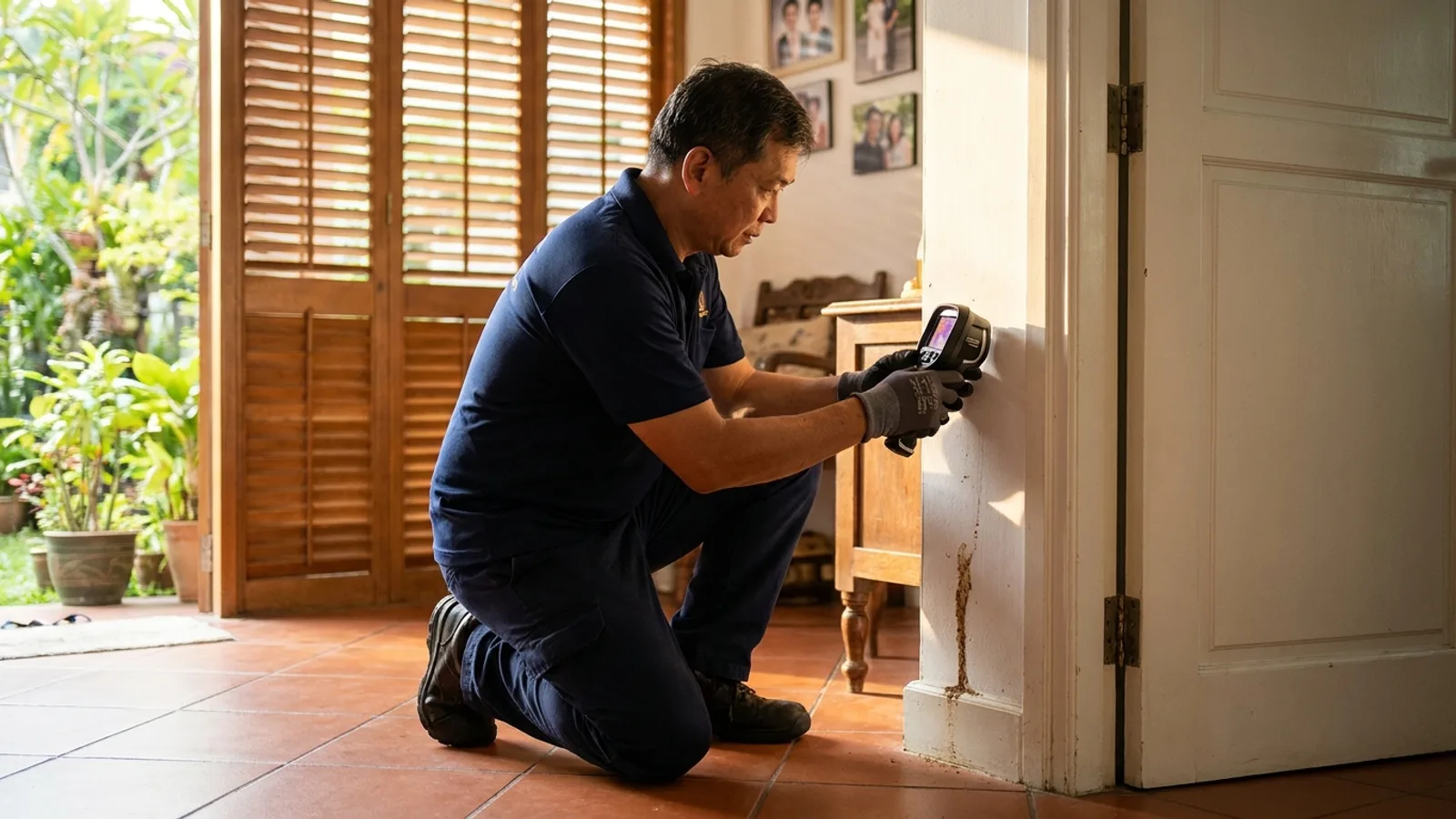
- Inspection first. A thermal camera or radar device such as Termatrac finds activity behind walls and built-ins without hacking them open, and identifies the species. That decides everything else.
- Baiting. A slow-acting bait that stops termites moulting, carried home by workers until the colony collapses. It takes weeks to months, targets the colony itself, and works only on subterranean termites.
- Direct or corrective treatment. Dust or foam pushed into active galleries and mud tubes. For drywood termites, this, heat treatment or replacing the infested piece is the answer.
- Soil treatment. A chemical barrier: termiticide injected into the soil around and under the building through holes drilled along the perimeter. Firms here quote about five years of protection.
- Pre-construction treatment. On a new build or landed rebuild, the soil is treated before the slab is poured, sometimes with stainless steel mesh around pipe penetrations. It's the cheapest moment to protect a house.
There's now a Singapore Standard behind this way of working. SS 721:2025, the code of practice for pest management services, was drawn up by a working group co-led by NEA and the Singapore Pest Management Association, and termites are among the pests it covers. Its principles are prevention first, a risk assessment before treatment, chemicals only where needed, and continuous monitoring.
HDB flats. Height doesn't protect you. Subterranean termites travel up inside walls, service ducts and pipe sleeves, and drywood termites come in with infested furniture or carpentry. Kitchen cabinets, door frames and built-in wardrobes are the usual spots. With no soil to treat, the job is normally above-ground baiting plus dust or foam, with a technician back every week or two. If the activity comes from common property such as a corridor planter or roof garden, tell your town council too.
Condos. Inside your unit it's the same job. The difference is the grounds: the soil, planters and trees around the block are common property, so if termites come up from below, the MCST's contractor has to treat the source.
Landed homes. Every method is on the table here, and most of the money goes here. You have a whole perimeter, often timber roof trusses, and garden trees or stumps that can host colonies. Expect a choice between in-ground bait stations around the perimeter, a corrective soil treatment drilled along the walls, or both. If you're rebuilding, put pre-construction soil treatment in the builder's scope. My renovation contractors guide can help you find someone to coordinate it.
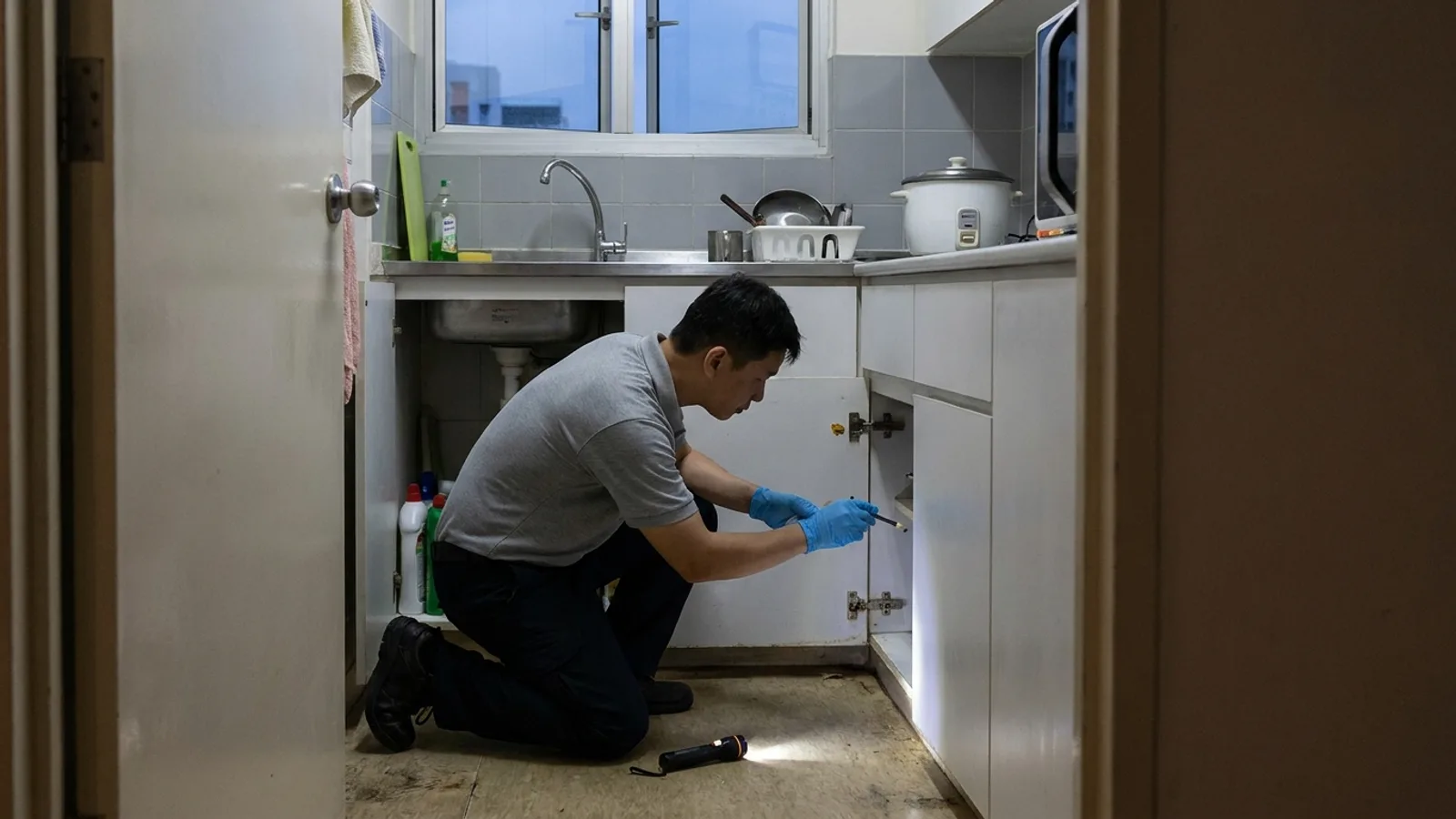
Roy Jenpire, who has 14 years in termite control, founded it in 2019, and it says it has served more than 3,500 clients. It offers above-ground and in-ground baiting, soil and corrective treatment, a wood protectant and monitoring, and says it's the only Singapore pest control company connected to the Pacific Rim Termite Research Group. A typical job takes 4 to 12 weeks.
The reviews sold me. One from August 2026 describes a technician who found drywood termites in a recently fitted door and told the owner to have the contractor replace it under warranty, without charging for the inspection. Another says the warranty covered the whole house for a year. Get that in writing.

- Best known for
- Termite-only focus with fortnightly follow-ups
- Location
- Midview Building, Bukit Batok Street 23
- Google Rating
- 5.0 (222 reviews)
- Website
- termitespecialist.sg
Incorporated in 1997 and based in Jurong, it covers baiting, in-ground stations, corrective and soil treatment, spot treatment for small outbreaks and drywood work, and says its team has over ten years of termite experience. Reviewers mention infrared scanning and baiting jobs that cleared the problem. One notes prices can sit a little above the market average.

- Best known for
- Thermal-imaging termite inspections
- Location
- 26 Third Lok Yang Road, Jurong
- Google Rating
- 4.9 (541 reviews)
- Website
- aardwolfpestkare.com
Running since 1991, it lists TRITHOR barrier protection applied at the foundation and slab stage, a marine-grade stainless steel mesh for pipe penetrations and joints, soil treatment before and after construction, and dusting and foaming for active galleries. For existing buildings there's soil injection, slab injection and reticulation piping, and inspections use Termatrac radar.
It holds ISO 9001, 14001 and 45001 and bizSAFE Star. Its Google rating is 4.3 from 78 reviews, lower than the specialists above, so ask for references from termite jobs in particular.

- Best known for
- Sentricon baiting and construction-stage barriers
- Location
- YSY Building, 139 Cecil Street
- Google Rating
- 4.3 (78 reviews)
- Website
- pestbusters.com.sg
Inspections use the Termatrac iTraker Pro (radar, moisture, thermal and temperature readings) to find termites behind walls without drilling. Bait stations go in only once live termites are confirmed, soil treatments are built to protect for at least five years, and an Altriset option stretches the usual five-year warranty to seven. Bigger jobs can be paid in 0% instalments.
Rentokil says it has more than 65 years of local experience and holds 4.8 stars from 2,487 Google reviews. It also bought Killem Pest from 1 January 2026, so two quotes from those names are now one group.

- Best known for
- Published termite prices and up to 10-year warranties
- Location
- Jalan Mesin, islandwide coverage
- Google Rating
- 4.8 (2,487 reviews)
- Website
- rentokil.com/sg
The Swedish group entered Singapore in 2016 by buying SITA Pest Control, a local firm founded in 1988. Its termite page is one of the clearest I read: pre-construction soil treatment, corrective soil treatment priced per linear metre, dusting for mud tubes, and in-ground and above-ground baiting with Requiem bait, with monitoring every one to three months.
The weak spot is the Google rating, 4.2 from 183 reviews, the lowest here. Read the recent ones and ask who will service your stations.

- Best known for
- Remote-monitored termite baiting
- Location
- ICON@IBP, International Business Park
- Google Rating
- 4.2 (183 reviews)
- Website
- anticimex.com.sg
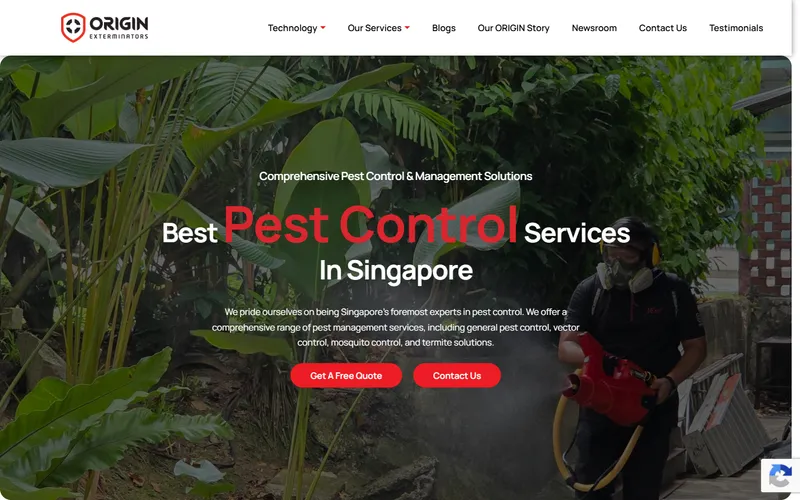
Inspections use a thermal camera that Origin says reads differences of 0.1 degrees Celsius, followed by a written report. It also drenches soil in a trench around infested trees and injects foam into drywood galleries. Origin says it has been in pest control since 1974 and was the first pest management company in the world certified to ISO 14001, in 2000.
It plans on three to six months for baiting to wipe out a colony, a realistic timeline to budget around. Google rating: 4.7 from 92 reviews.
- Best known for
- In-ground baiting for gardens and driveways
- Location
- Techplace 1, Ang Mo Kio Avenue 10
- Google Rating
- 4.7 (92 reviews)
- Website
- origin.com.sg
The inspection is free, and the written report covers the areas checked, the evidence, the damage, the treatment and the warranty terms, which Innovative pitches as useful when buying a property. Its InnoTermite programme uses Xterm bait stations made by Sumitomo Chemical. It holds 4.9 stars from 225 Google reviews and is based in Yishun. Pin down which warranty length your quote includes, because an option on a website and a line on an invoice can differ.
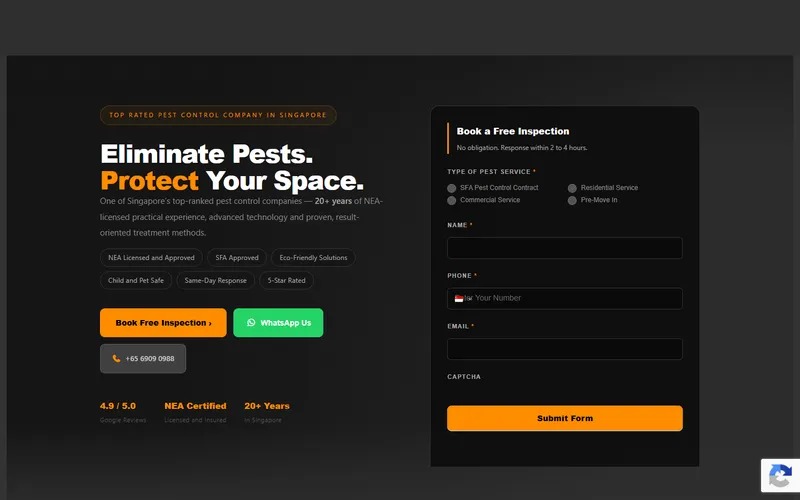
- Best known for
- Long warranties with annual inspections
- Location
- Northpoint Bizhub, Yishun
- Google Rating
- 4.9 (225 reviews)
- Website
- innovativepest.sg
It names its products, too. Xterm baiting comes with four follow-up visits, Ceptiva dust with a follow-up two weeks later, and it fits reticulation systems for ongoing subterranean protection. For new slabs there's a non-chemical physical barrier laid under the concrete. Founded in 2008, ProServ says it has over 30 NEA-certified staff, offers a free on-site inspection, and holds a 5.0 rating from a smaller base of 49 Google reviews.
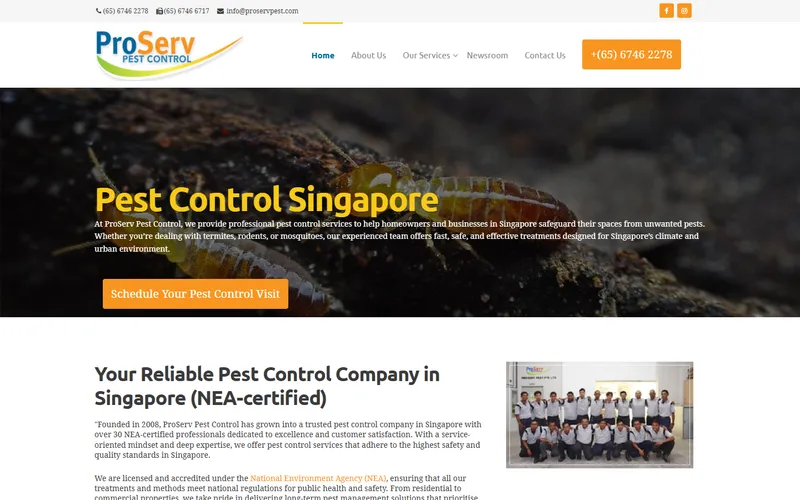
- Best known for
- Heat treatment and named bait products
- Location
- The Spire, Bukit Batok Crescent
- Google Rating
- 5.0 (49 reviews)
- Website
- proservpest.com
For landed homes it adds rodding termiticide into garden and perimeter soil and a full soil treatment barrier, which it says lasts up to five years, plus wood treatment to proof new timber. The logos on its site include BCA registered contractor, bizSAFE Star and ISO 9001 and 45001. It's based at Stellar@Tampines and holds 4.7 stars from 45 Google reviews.
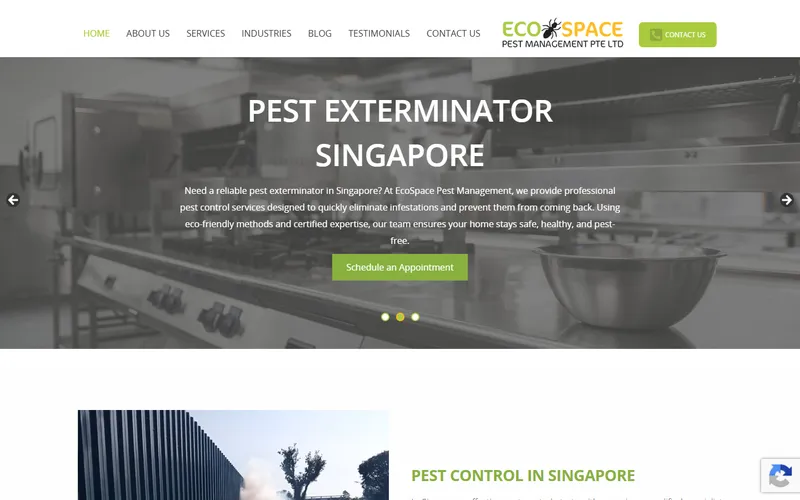
- Best known for
- Thermal scans before any hacking
- Location
- Stellar@Tampines, Tampines North Drive 4
- Google Rating
- 4.7 (45 reviews)
- Website
- ecospacepest.com.sg
| Company | Main termite methods | Published warranty | Google rating | Best for |
|---|---|---|---|---|
| Termite Specialist | Baiting, soil and corrective treatment, wood protectant | Included, length set in the quote | 5.0 (222) | Any home, termites only |
| Aardwolf Pestkare | Baiting, in-ground stations, soil, spot, drywood | Not published | 4.9 (541) | Hidden activity in built-ins |
| PestBusters | Sentricon, TRITHOR, steel mesh, soil treatment | Not published | 4.3 (78) | Landed homes and new builds |
| Rentokil | Baiting, soil treatment, Altriset | Up to 10 years with retreatment | 4.8 (2,487) | Published prices |
| Anticimex | Requiem baiting with iTAS alerts, corrective soil | Not published | 4.2 (183) | Condos and remote monitoring |
| Origin Exterminators | In-ground and above-ground baiting, soil drench, foam | Not published | 4.7 (92) | Landed homes with gardens |
| Innovative Pest Management | Xterm baiting, soil treatment, wood treatment | Extended, 10-year option | 4.9 (225) | Long warranty cover |
| ProServ Pest Control | Xterm, Ceptiva dust, heat, fumigation | Not published | 5.0 (49) | Drywood in furniture |
| EcoSpace Pest Management | Baiting, dusting, rodding, soil treatment | Not published | 4.7 (45) | Flats in the east |
Few firms publish termite prices, because the quote depends on the species, the spread and the property. These are typical ranges, built from published prices (Rentokil's list, October 2026) and reported quotes. Use them to sanity-check a quote.
| Job | Typical price (S$) | What moves the price |
|---|---|---|
| Termite inspection | Free at several firms | Innovative and ProServ advertise free inspections; most firms quote after one |
| Spot or corrective treatment in a flat (dusting, foam, a few bait stations) | S$500 to S$1,500 | Number of spots, species, follow-up visits |
| Baiting programme | S$700 a year to S$3,000+ | Rentokil starts from S$700 a year; house size and number of stations |
| Post-construction soil treatment, landed | S$1,600 to S$4,500+ | Rentokil starts from S$1,600; perimeter length, often priced per metre |
| Pre-construction soil treatment or physical barrier | Quoted per project | Slab area; belongs in the builder's scope |
Species and warranty move a quote more than floor area. Drywood work is local to one piece of timber; subterranean work is about the whole colony. And a five- to seven-year soil warranty costs more than a one-off spot job, and covers far more. For a sense of where a full landed job sits, Rentokil's anti-termite promotion this year applied only to jobs of S$4,500 and up.
If you're looking to hire a termite company in Singapore, this is how I'd narrow the field.
- On NEA's register. NEA's rules for the vector control industry say only companies registered as vector control operators can be engaged for vector control work, with licensed technicians. Termites fall outside the legal definition of a vector, but any firm that also does general pest work has to be registered, so this is the best licence check you have. Look the company up on NEA's list of registered vector control operators. All nine here are on the edition dated 30 September 2026.
- An inspection before a price. A termite quote over the phone is a guess. I want someone to come out, identify the species and find the source.
- A method that matches the species. Baiting for subterranean termites. Local treatment, heat or new timber for drywood. A firm offering to bait drywood termites doesn't know which ones you have.
- The follow-up schedule in writing. Baiting needs a visit every one to two weeks while the colony feeds. Ask how many visits the price covers.
- A warranty with the terms spelled out. How long, whole house or treated spots only, and whether retreatment is free. Warranties on this list run from about a year to ten.
- Reviews from termite jobs. A 4.9 might be built on cockroach jobs. Search the reviews for the word termite.
A red flag for me is a technician who sprays the mud tubes on the first visit and calls it done.
I started with the companies that keep coming up for termite work in Singapore, then read each one's termite pages: which baiting system, whether it treats soil, how it inspects, how often it returns and what warranty it publishes. I checked every company against NEA's register and took Google ratings and review counts from their Google Business listings in October 2026. Termite-focused firms, and firms that publish their methods in detail, ranked higher. A few with very thin reviews, or with claims I couldn't square with their company records, didn't make it.
Ratings move and prices change, so check the latest before you book.
Termite treatment in Singapore typically costs S$500 to S$1,500 for a localised job in an HDB flat or condo, from S$700 a year for a baiting programme, and from S$1,600 for soil treatment around a landed house, going by Rentokil's published starting prices. Several firms inspect for free and quote after.
A termite baiting system is better for killing an active subterranean colony, because workers carry the bait home and the whole colony dies, usually within 4 to 12 weeks, longer for a big colony. Soil treatment is better as a barrier, protecting a landed house for about five years. Many landed homes use both: bait first, then a barrier.
The Control of Vectors and Pesticides Act defines a vector as an insect or rodent that can carry or cause disease in people, which termites don't. But almost every termite firm also does general pest control, and for that it must be registered with NEA as a vector control operator. Check NEA's register before you book.
Rentokil's own HDB and condo guidance says upper floors aren't safe, because subterranean termites travel up through mud tubes inside walls, service ducts and pipe sleeves. Drywood termites arrive in infested furniture, doors or carpentry on any floor. In a flat, treatment is usually above-ground baiting and dusting, since there's no soil to treat.
Termite baiting usually takes 4 to 12 weeks with visits every 7 to 14 days, according to Termite Specialist, and Origin plans for three to six months on a big colony. Spot treatment for drywood termites takes a visit or two. Soil treatment is drilled and injected in about a day, then protects for around five years.
No. Termite Specialist, for one, tells customers outright not to spray or touch them. Spraying kills the termites in view, scatters the colony to new spots and stops them feeding where a bait station would go, which makes the job longer and dearer. Take photos, leave the mud tubes intact and book an inspection.
Good termite control in Singapore comes down to three things: a firm that inspects before it quotes, a method that matches your species, and a warranty you've actually read. Get two or three quotes from the companies above and compare what each one found before you compare prices.
Once the colony is gone, the damage stays. For swollen cabinet doors and eaten skirting, my best carpenters in Singapore guide lists firms that rebuild built-ins, and my main pest control guide covers everything else that crawls. Every home trade I've researched sits in my handyman services hub.
Need a website for your pest control business? Good termite firms lose jobs to sites that bury the phone number. I design websites for Singapore service businesses that turn searches into enquiries. See my web design services or get a quote.
Sources and references (14)
- termitespecialist.sg
- aardwolfpestkare.com
- pestbusters.com.sg
- rentokil.com › sg
- rentokil.com › pest control prices
- anticimex.com.sg
- origin.com.sg
- innovativepest.sg
- proservpest.com
- ecospacepest.com.sg
- nea.gov.sg › background on singapore standard 721 2025
- nea.gov.sg › pest control operators
- file.go.gov.sg › q9fbqn
- sso.agc.gov.sg › CVPA1998