

Terris Recommends 16,400+ monthly visitors Home Services
7 Best Ant Control Services in Singapore (October 2026)
Ant control Singapore guide: 7 companies that bait ghost and pharaoh ants properly, with Google ratings, published S$ prices and what to do before they come.
This guide is part of Terris Recommends, my researched, hands-on picks of the best local businesses and services in Singapore. Every recommendation is researched and ranked by me.
See all recommendationsAnts are the pest most Singapore homes put up with for too long. A trail along the counter, a few in the sugar jar, a thin line running out of a plug point, and a spray that works for about a week. If you're searching for ant control Singapore companies, you've probably noticed that. There's a reason for it, and it changes who you should hire.
For this guide I read the ant pages of the pest control companies that come up most for ant treatment here, and kept the seven that describe a real ant method: which species, what bait, where it goes and what happens on the follow-up. Then I checked each one's Google rating on Google Maps, what it says about NEA licensing, and any prices it publishes.
This is a spoke of my guide to the best pest control services in Singapore, which covers the all-round companies for every pest. If ants are your only problem, start here.
Ants look like the easy pest. They rarely bite, they don't spread dengue, and a spray kills every one you can see. That's the trap. The ants on your counter are foragers from a colony living in a wall gap, a cabinet or a socket, and killing them does nothing to the queens behind the tiles.
The ants Singapore homes actually get.
- Ghost ants. About 1.3 to 1.5mm, with a dark head and an almost see-through body. They like sugar and damp (kitchen cabinets, under the sink, behind the fridge) and spread many queens across several nests.
- Pharaoh ants. About 2mm, golden to yellow-brown, keen on grease and protein. The hardest common indoor ant to clear.
- Crazy ants. Long legs, black or dark red, and they scatter in every direction when disturbed.
- The Singapore ant. Small, light brown, darker at the rear. Pest trade guides describe it nesting in plug sockets and electrical items, and it's often mistaken for the pharaoh ant.
- Carpenter ants and fire ants. Carpenter ants are much bigger and tunnel into damp wood, leaving sawdust. Fire ants nest in soil outdoors and sting. Winged ants are easy to mistake for flying termites, so if you're finding wings by a window, read my termite control guide too.
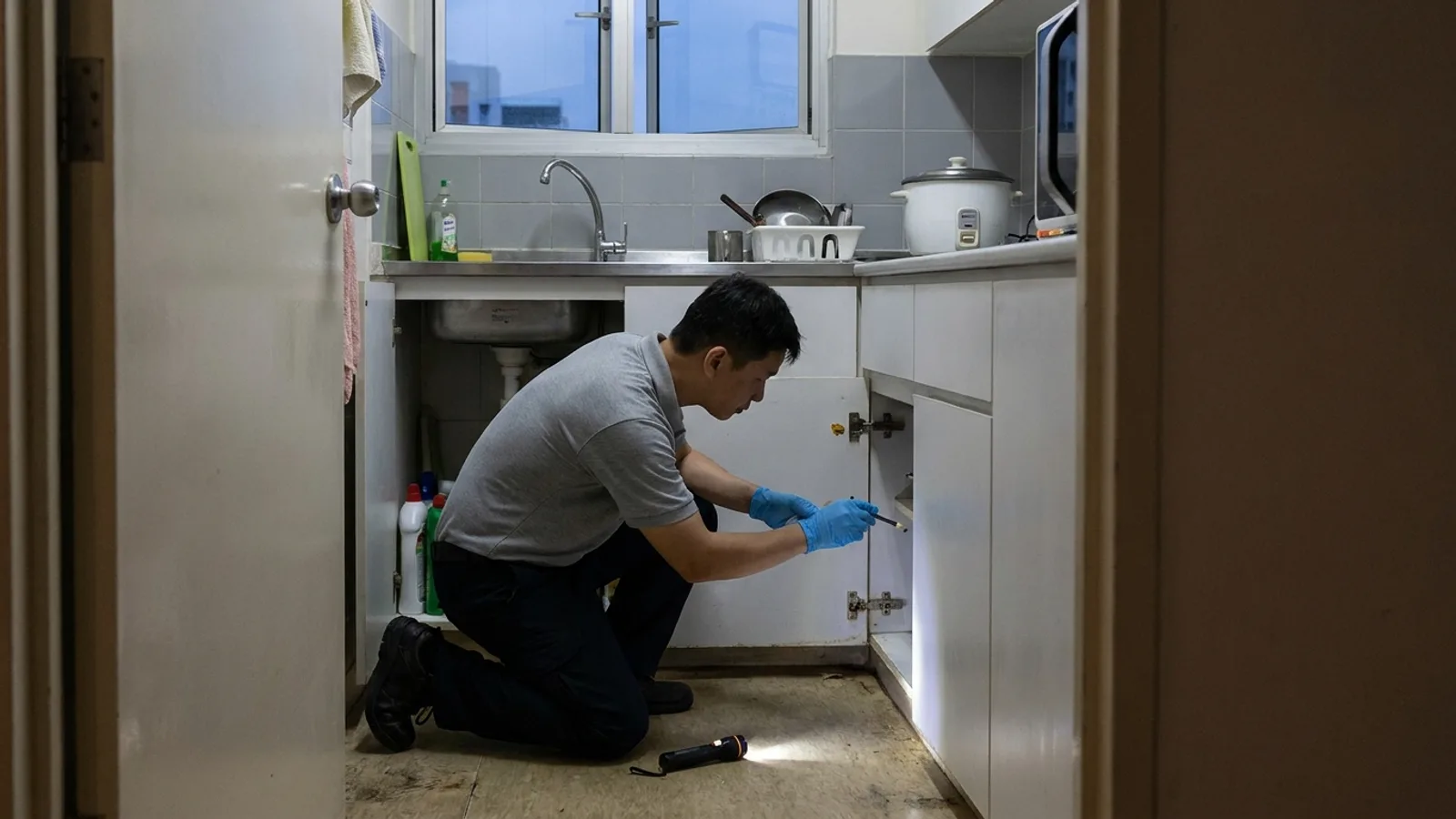
Where to look. Kitchen cabinets, under the sink, the bathroom, sockets near the counter and skirting along shared walls. Ghost and pharaoh ants travel along the wiring inside walls, so a socket is often where people first see them.
Why spraying a trail can make it worse. Pharaoh and ghost ants keep many queens. Hit the colony with a repellent spray and workers carry brood off with a queen to start new nests, which pest controllers call budding. Rentokil, Killem, Protect Pest Control and PestBusters all warn about it. One trail becomes three, in three rooms.
Why slow bait works better. Ant bait is food laced with a slow, non-repellent insecticide. The ant eats it, walks home and shares it with the brood and the queens. Kill the queens and the colony stops. So a good technician lays small dots of bait on the trail and then asks you to leave the ants alone.
Gel or granular? Gel goes indoors: cracks, cabinet hinges, socket edges, skirting boards. Granular bait, scattered or in stations, goes outdoors in garden beds and along walls, and suits fire ants and crazy ants. Ghost ants lean sweet and pharaoh ants lean greasy, so a careful technician may use two baits.
Landed homes need a perimeter. In a terrace or semi-D the colony often lives outside, in soil, planters or a tree touching the wall, so the job adds a residual spray along perimeter walls, manholes and floor traps. In an HDB flat ants more often come in through wall gaps, pipe openings and sockets, sometimes from next door.
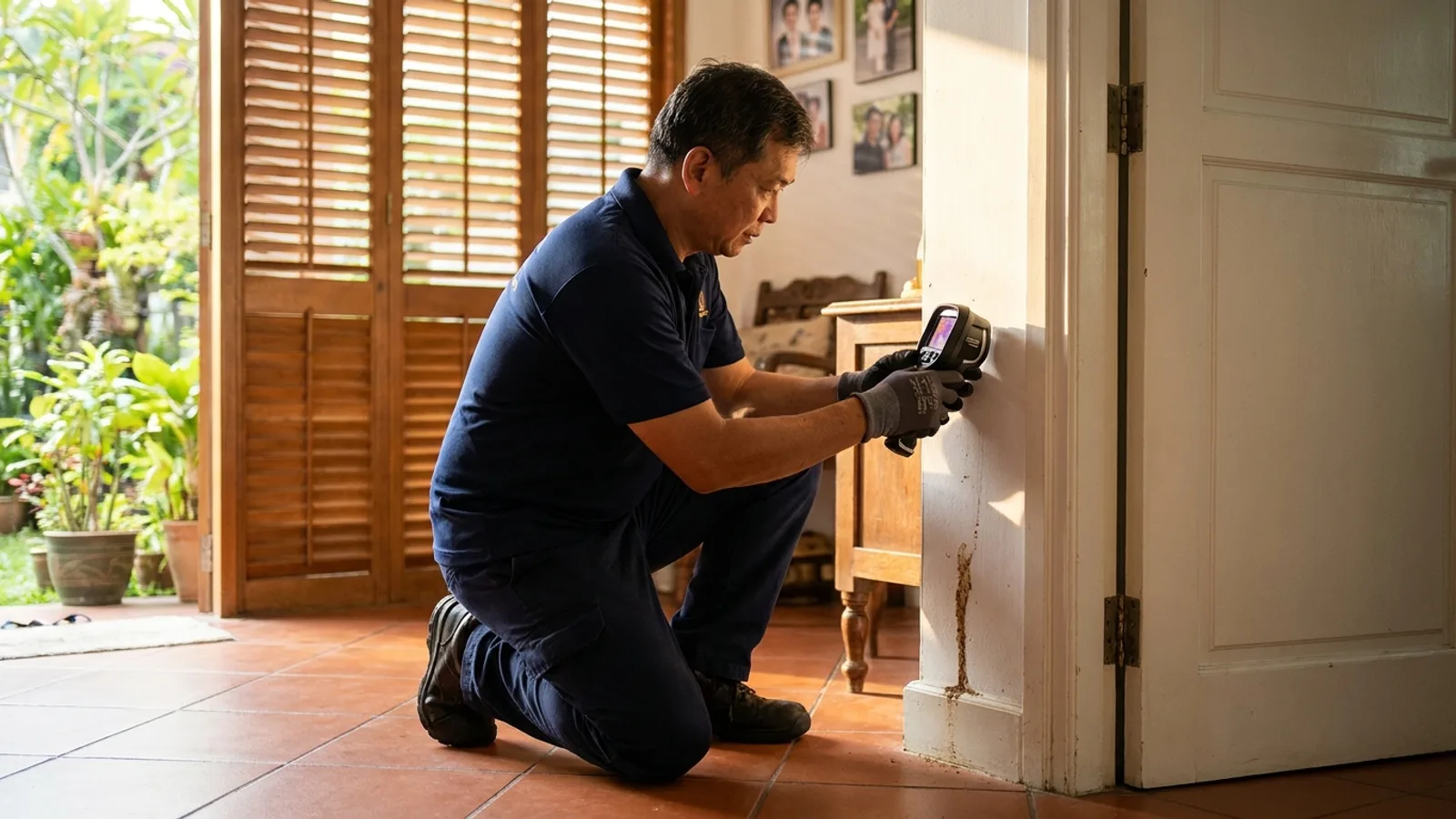
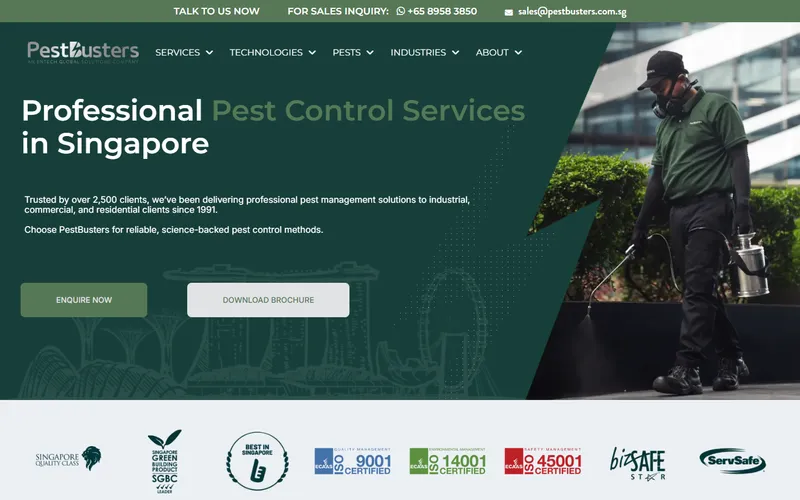
The rest of the toolkit is what sets it apart. Granular bait and bait stations go outdoors for fire ants and black crazy ants, insecticide dust goes into wall voids, and a residual spray covers perimeters and outside entry points. It then seals gaps around pipes and conduits and comes back to confirm the colony is gone. PestBusters has operated since 1991, is NEA accredited and leaves a written service report.
One thing to weigh: its Google rating, 4.3 across 78 reviews, is lower than most names here, and its client list leans commercial. For a pharaoh ant problem that has survived a few rounds of supermarket spray, I'd still start here.
- Best known for
- Gel, granular and dust baiting for budding ant species
- Location
- 139 Cecil Street (YSY Building), CBD
- Google Rating
- 4.3 (78 reviews)
- Website
- pestbusters.com.sg
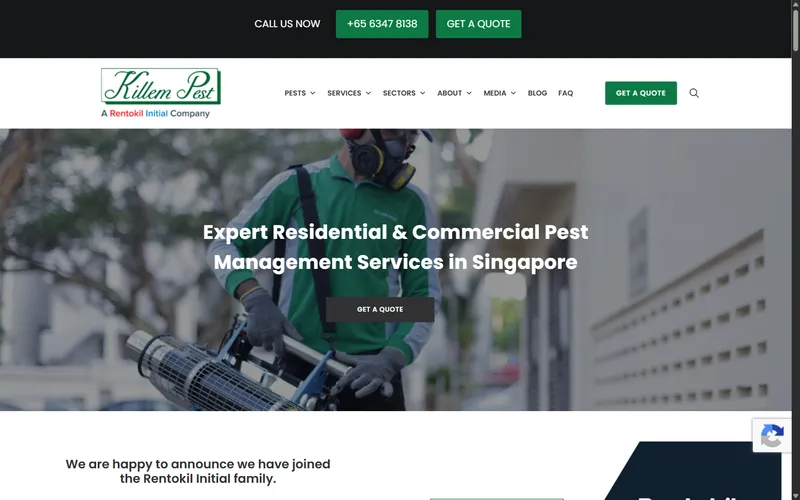
It's also straight about spraying. Killem calls residual spraying the most common ant treatment, then says it doesn't work on every species and can make things worse when the ants are disturbed. Its technicians are NEA licensed, and the company has served Singapore homes and businesses since 1993.
Worth knowing: Killem joined Rentokil Initial on 1 January 2026, and its announcement says the same local team carries on with Rentokil's research and training behind it. Its 4.7 rating across 341 Google reviews is one of the strongest records here.
- Best known for
- Slow-acting, non-repellent baiting aimed at the queen
- Location
- 48 Toh Guan Road East (Enterprise Hub), Jurong East
- Google Rating
- 4.7 (341 reviews)
- Website
- killem.com.sg
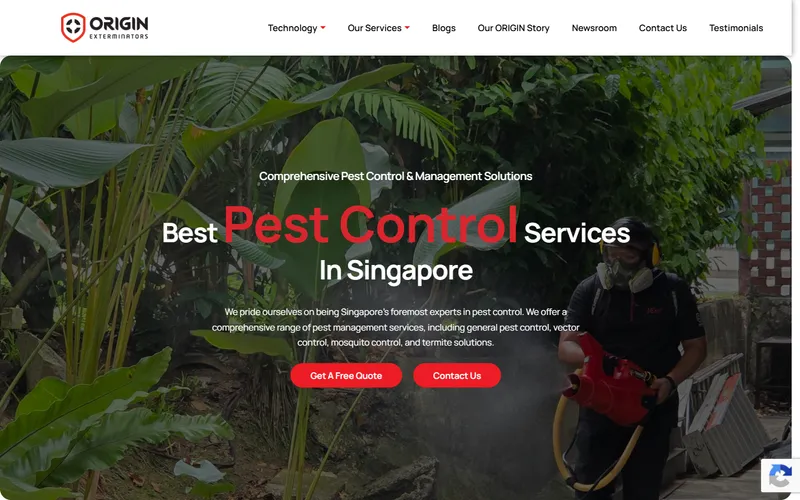
Two details won me over. After each visit you get a digital service report with photos of the problem spots, so you can see where the bait went. And its advice before a visit is the right advice: don't disturb the ants, so the technician can follow their movements, and don't use other sprays or cleaners on treated areas afterwards.
Origin quotes after an inspection rather than publishing a price list, so allow for that first visit. It holds a 4.7 rating across 92 Google reviews.
- Best known for
- Species-by-species plans and photo service reports
- Location
- 4008 Ang Mo Kio Avenue 10 (Techplace 1)
- Google Rating
- 4.7 (92 reviews)
- Website
- origin.com.sg
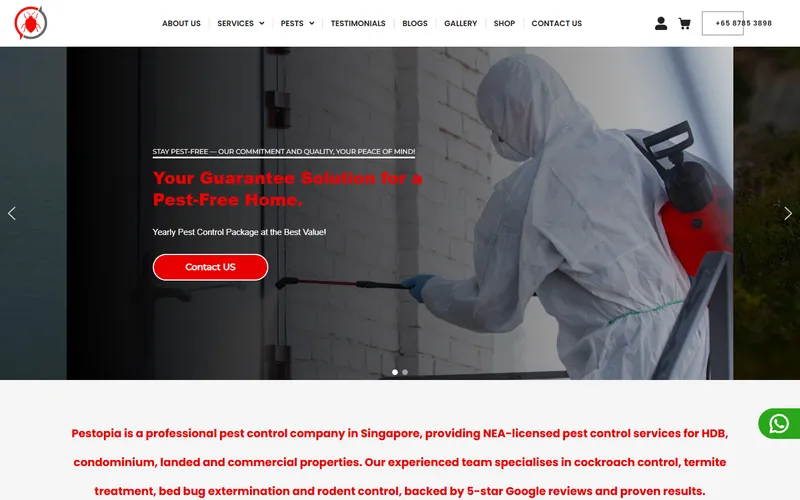
The guarantee is the other draw: Pestopia says it will treat again for free if pests return. Its ant page names sugar, pharaoh, ghost and carpenter ants and says the technician identifies the species and traces entry points before treating. Technicians are NEA licensed, weekday same-day slots run from 9am to 5pm, and its 4.9 rating across 413 Google reviews is the biggest review base on this list.
- Best known for
- Affordable one-time ant treatment with a free re-treat promise
- Location
- 30 Kallang Pudding Road (Valiant Industrial Building), MacPherson
- Google Rating
- 4.9 (413 reviews)
- Website
- pestopia-sg.com
Its ant species page explains budding plainly (disturbed pharaoh ants move off and start several new colonies) and tells homeowners to check the electrical outlets in the kitchen and bathroom, since ghost ants trail along wiring in wall voids to reach sinks and showers.
Protect holds a 4.8 rating across 29 Google reviews, a smaller base than the bigger firms, and says its listed prices are indicative until someone has inspected the place.

- Best known for
- Published ant prices from HDB flat to bungalow
- Location
- 21 Woodlands Close, Woodlands
- Google Rating
- 4.8 (29 reviews)
- Website
- protectpestcontrol.sg
It's NEA certified and BCA registered, runs a 24-hour emergency line, and the review on its ant page is from a condo resident whose ants were sorted after a Sunday-night call. At 4.8 across 24 Google reviews it's a smaller outfit, so ask who does the follow-ups and how long the warranty runs before you book.
- Best known for
- Bait stations, monitoring and follow-up visits
- Location
- 31 Woodlands Close (Woodlands Horizon)
- Google Rating
- 4.8 (24 reviews)
- Website
- pentapest.com.sg
Anticimex is the Singapore arm of a Swedish pest control group, with separate 24/7 sales and service hotlines and a garden pest control service. The trade-off is reviews: 4.2 across 183, the lowest average here. I'd still shortlist it for a big compound where one company should handle the drains, the garden and the house on a schedule.
- Best known for
- Perimeter, drain and floor-trap treatment for landed homes
- Location
- 3A International Business Park (ICON@IBP), Jurong East
- Google Rating
- 4.2 (183 reviews)
- Website
- anticimex.com.sg
| Company | Ant method on its site | Best for | Google rating |
|---|---|---|---|
| PestBusters | Gel, granular, dust, perimeter spray, proofing, follow-ups | Pharaoh and ghost ants that keep budding | 4.3 (78) |
| Killem Pest | Slow-acting, non-repellent bait | Bait-first treatment from a large operator | 4.7 (341) |
| Origin Exterminators | Gel bait, residual spray, photo report | Knowing which ant you have | 4.7 (92) |
| Pestopia | Gel bait on trails, 30-day residual | Budget one-off treatment in a flat | 4.9 (413) |
| Protect Pest Control | Published prices by home type | A price upfront, landed homes | 4.8 (29) |
| Pentapest | Bait stations, monitoring, follow-up, warranty | Ants that keep coming back | 4.8 (24) |
| Anticimex | Gel bait, perimeter walls, manholes, floor traps | Large landed homes and gardens | 4.2 (183) |
These are typical ranges from the prices companies publish and from published price guides, checked in October 2026. Where a company on this list publishes its own number, it's in the last column. The final price follows an inspection, and a heavy pharaoh ant problem sits at the top of each band.
| Ant treatment | Typical range (S$) | Published example |
|---|---|---|
| One-off, HDB flat | S$80 to S$200 | Pestopia from S$80; Protect S$140 |
| One-off, condo | S$140 to S$200 | Protect S$150 |
| One-off, terrace or semi-D | S$150 to S$220 | Protect S$150 to S$200 |
| One-off, bungalow | S$200 to S$280 | Protect S$200 to S$250 |
| Bi-monthly plan, 12 months, HDB flat | S$480 to S$600 a year | Protect S$520 |
| Bi-monthly plan, 12 months, landed | S$480 to S$800 a year | Protect S$480 to S$750 |
| Monthly plan, 12 months, condo or landed | S$1,080 to S$1,700 a year | Protect S$1,080 to S$1,680 |
If you're looking to hire someone for ant treatment in Singapore, these are the checks I'd run, roughly in this order.
- NEA registration. The Control of Vectors and Pesticides Act treats any insect capable of carrying or causing disease as a vector, and NEA's vector control operator page says only NEA-registered operators, with licensed or certified technicians, can be engaged for vector control work. The page also links a downloadable list of registered companies.
- Species before treatment. The company should tell you which ant you have before it treats. If the plan for pharaoh ants is the same spray it would use on cockroaches, keep looking.
- Bait indoors, spray outdoors. For ants inside a flat I want gel bait on the trails and in the cracks. Residual spray belongs on the perimeter, in drains and at outside entry points.
- A service report and registered products. NEA expects operators to leave a comprehensive service report with recommendations, and any pesticide used for vector control must be registered and carry the NEA Registration Mark. Ask for both.
- Prevention in the plan. NEA's page on integrated pest management sets out Singapore Standard SS 721:2025, which puts prevention first and pesticides last. It doesn't name ants, but the logic fits: sealing a wall gap or fixing a leak under the sink beats another round of spray.
- A re-treat promise and real review numbers. Colonies with several nests sometimes need a second visit, so I want that written into the quote. And I trust a 4.7 across a few hundred Google reviews more than a 5.0 across ten.
I started from the companies that come up for ant pest control in Singapore and read each one's ant page, not its homepage. Plenty of firms list "ants" between "bed bugs" and "booklice" and say nothing more. Companies whose ant page was thin, written around another country's species, or wouldn't load didn't make it.
I checked each Google rating and review count on Google Maps in October 2026, read published prices where they exist, and noted recent changes like Killem joining Rentokil Initial. Three of these companies also appear in my main pest control guide; the other four are here for their ant work. Ratings and prices move, so get your own quote.
Ant pest control in Singapore costs about S$80 to S$200 for a one-off treatment in an HDB flat, going by published prices. Protect Pest Control lists S$140 for an HDB flat and S$150 for a condo, and Pestopia starts from S$80. Landed homes run about S$150 to S$250.
A bi-monthly annual plan for a flat is around S$520. That makes sense when the ants come from somewhere you can't fix, like a neighbour's unit or a garden full of soil nests.
Tiny ants in a Singapore home are usually ghost ants or pharaoh ants, both around 1.5 to 2mm. Ghost ants have pale bodies and dark heads; pharaoh ants are golden. Both nest inside walls, cabinets and sockets and come out for food and water, so you see the foragers and never the nest.
Leaks under the sink, sweet spills, pet food and gaps around pipes pull them in, and in a flat they can come through shared walls from next door. That's why a spotless kitchen can still have a trail.
No. Don't spray ants before the technician arrives. Repellent spray can make pharaoh and ghost ant colonies split into new nests, and it wipes out the trails the technician follows home. Origin Exterminators asks clients not to disturb the ants before a visit, and not to use their own sprays on treated areas afterwards.
What you can do: seal food away, wipe up spills, fix any drip under the sink and photograph where the trails run. Then leave the trail alone, and after treatment don't wipe off the bait dots.
An ant treatment visit in Singapore usually takes a few hours or less, and most homes need one or two sessions. With slow-acting bait you'll still see ants feeding for the first few days. Activity normally drops over the next week or two; a multi-nest pharaoh ant colony may need a follow-up visit.
If the trail looks exactly the same after two weeks, call the company back. That's what a re-treat promise is for, and it often means there's a second nest the first round didn't reach.
Yes. The National Environment Agency says only companies registered with it as vector control operators can be engaged for vector control work, and their technicians must hold NEA licences or certificates. NEA posts a downloadable list of registered operators on its vector control operator page, so you can check a company before booking.
Ask to see the technician's licence when they arrive too. Every company on this list says its technicians are NEA licensed or certified.
The short version of good ant control in Singapore: find out which ant you have, put bait where the ants will carry it home, keep the spray for the outside of the house, and give it a week or two. PestBusters and Killem Pest are the strongest on method, Pestopia and Protect Pest Control are the easiest on the wallet, and Anticimex is the one I'd look at for a big landed property.
Ants and cockroaches share kitchens and the same gel-bait logic, so if you're seeing both, read my cockroach control guide next. My home cleaning services guide covers the deep clean after. For everything else there's my best pest control services in Singapore guide and the best handyman services in Singapore hub.
Need a website for your pest control business? Most of the ant pages I read for this guide buried a good method under stock photos. I design websites that put that know-how up front and turn searches into bookings. See my web design services in Singapore or get a quote.