
Terris Recommends 16,400+ monthly visitors Home Services
6 Best Bee & Wasp Nest Removal in Singapore (October 2026)
Bee removal in Singapore: 6 beekeepers and pest control firms I recommend for beehives, wasp and hornet nests, with real prices and who handles HDB hives.
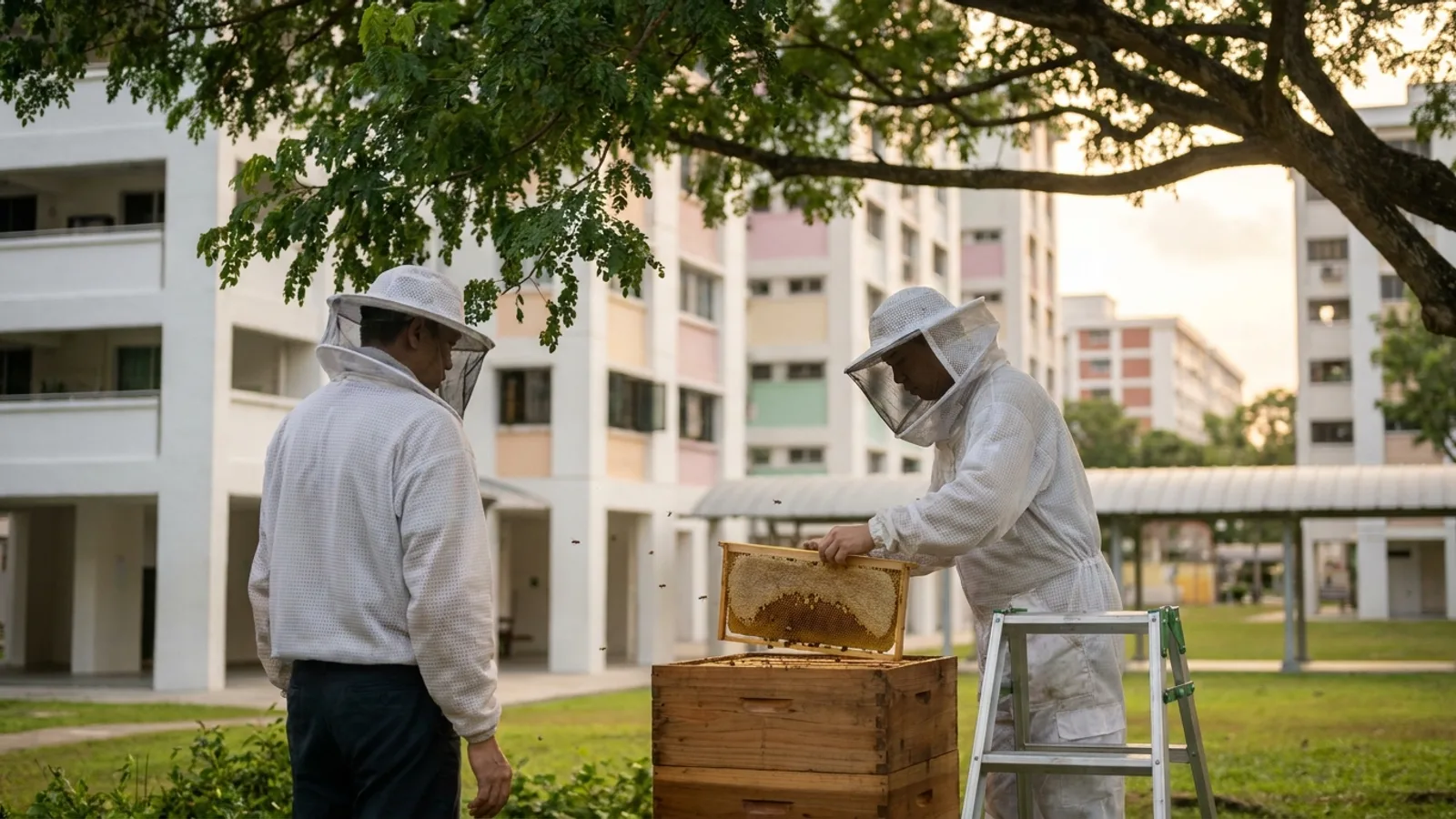
This guide is part of Terris Recommends, my researched, hands-on picks of the best local businesses and services in Singapore. Every recommendation is researched and ranked by me.
See all recommendationsA beehive on the aircon ledge or a paper wasp nest under the eaves is one of those problems where the first call matters more than the price. Call the right person and the bees end up in an apiary. Call the wrong one and you've paid someone to spray a colony that's now angrier, still there, and leaving honey to rot inside your wall. So I spent a good while working out who does bee removal in Singapore properly, reading every vendor's bee, wasp and hornet pages, their published prices and their Google reviews, and checking the species advice against NParks.
This guide is narrower than my guide to the best pest control companies in Singapore, which covers termites, cockroaches and the rest. Stinging insects get their own list because the people worth calling are different. Two of my six picks are beekeepers who move honey bee colonies alive. The other four are pest control firms that also take on wasp and hornet nests, which neither beekeeper advertises.
I'm Terris. I run a web design studio in Singapore, and Terris Recommends is where I share the local services I've researched closely enough to point a friend to.
Start by working out what you've got. NParks counts more than 130 bee species in Singapore, four of them honey bees. The Asian honey bee is the one most homes meet. It builds several parallel wax combs in sheltered spots like tree holes, upturned pots and building eaves, which is how it ends up in roof spaces, false ceilings and wall cavities. The giant honey bee hangs one big comb under a branch of a tall tree. Dwarf honey bees build a single small comb in a bush and often leave within months. Stingless bees nest in crevices and even lamp posts, and can't sting you at all.
Wasps and hornets are a different job. The lesser-banded hornet is the most common hornet here, and paper wasps such as the Sumatran paper wasp build on trees, fences, roof eaves and even at ground level. NParks describes both as aggressive when defending a nest and quick to sting.
Why the species changes the answer. Honey bees can usually be moved alive. A beekeeper finds the queen, cuts out the comb and takes the whole colony to an apiary. Nobody on this list relocates hornets or wasps; a pest control firm knocks the adults down and takes the nest away. And a clump of bees with no comb under it is usually a swarm passing through, which I cover in the FAQ.
Why you shouldn't spray it or knock it down yourself. A can of insect spray kills the bees it hits and sets off the rest, and NParks warns that an injured insect can release alarm pheromones that bring more of them. With honey bees in a wall, the comb stays behind too. Killem Pest points out that unless the comb comes out and the entry is sealed, robber bees come back for the honey.
Height and access set the price. A nest at head height in a shrub is a quick job. The same colony inside a roof or outside a ninth-floor window needs tall ladders, a lift or opening up the structure. Rentokil recommends arranging repairs after a concealed hive comes out, and The Sundowner's price list leaves reinstatement out. If the hive is inside a wall, budget for a handyman; my handyman guide has the ones I'd call.
Who's responsible depends on where it is. Your home is yours to arrange; HDB common areas, parks and condo grounds aren't. The contacts are in the FAQ.
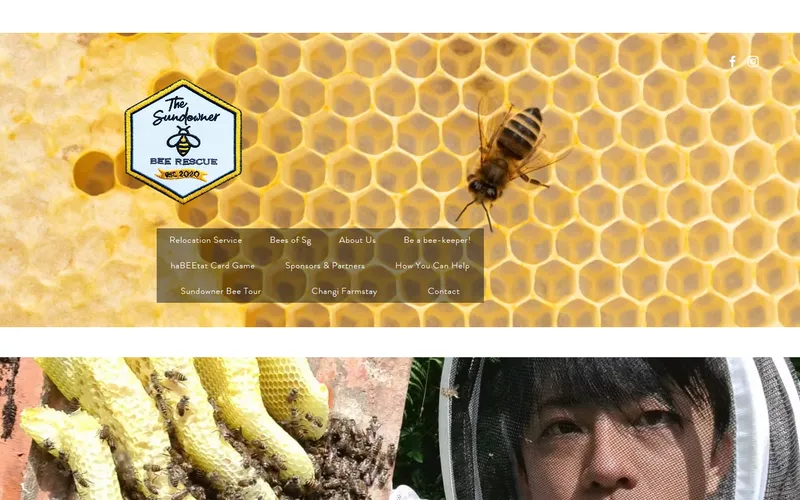
The beekeeper behind it is Clarence Chua, whom Reuters profiled in July 2026 after six years of relocating around 100 nests a year. The site says a proper relocation can take up to three hours: find the queen, take the colony out alive, settle it at an apiary. Send a photo or video showing how the nest is reached, because access sets the price. Condo jobs add S$25, attics and outside-window nests add S$50 to S$100, and making good afterwards isn't included.
The Sundowner itself is a farm and nature experience centre rated 5.0 across 929 Google reviews, though most of those are for its workshops. What tells me more is who leans on it: Rentokil, Anticimex and Killem Pest all name The Sundowner as their bee relocation partner.
- Best known for
- Live honey bee relocation with published prices
- Location
- 272 Upper Bukit Timah Road (The Sundowner), with apiaries around Singapore
- Google Rating
- 5.0 (929 reviews, on The Sundowner Nature Experience Centre listing)
- Website
- beerescue.com.sg
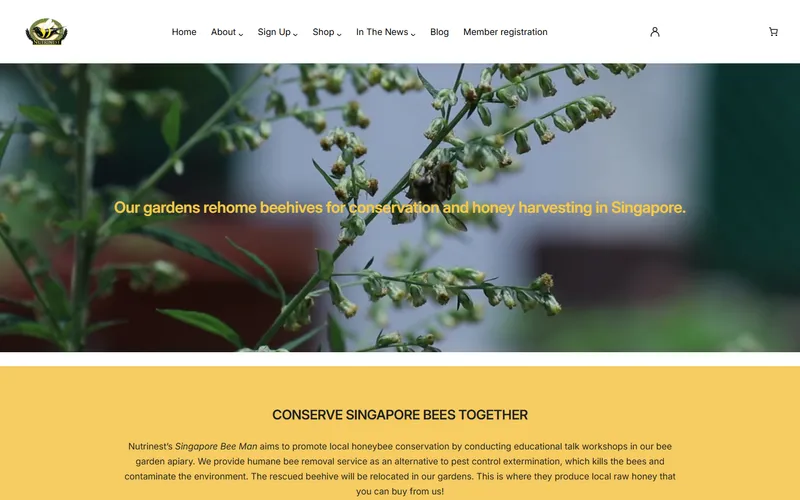
It's run by Xavier Tan, who calls the project Singapore Bee Man. JTC's own feature on him says Nutrinest rehomes hives displaced by industrial work across JTC estates as an alternative to extermination, and that he tends a bee garden at Jurong Town Hall. Nutrinest also runs beekeeping courses and sells the raw honey its colonies make. There's no published price list, so message a photo of the nest for a quote, and expect the job to take longer than a spray.
- Best known for
- Humane beehive removal and rehoming
- Location
- 340B Sembawang Close, with a bee garden at 60 Mandai Lake Road
- Google Rating
- 5.0 (546 reviews, Nutrinest Bee Rescue listing)
- Website
- nutrinests.com
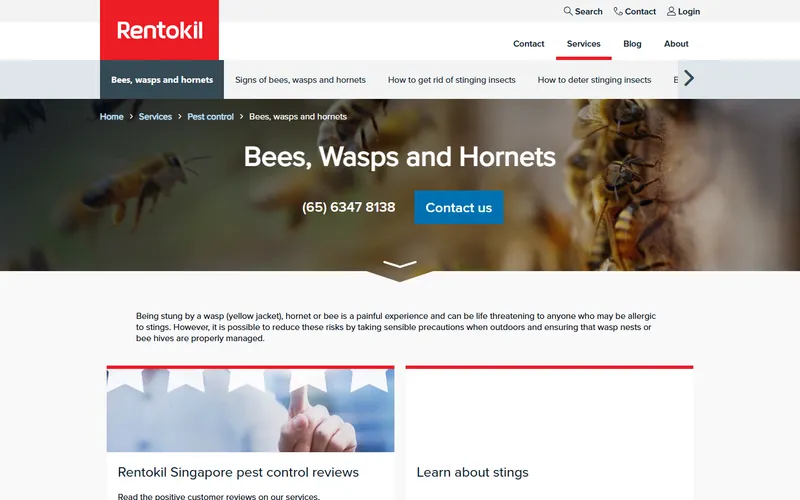
Its bee jobs go through The Sundowner, and the relocation page lists apiaries in Siglap, Bukit Timah and Thomson where colonies are rehomed. Rentokil is upfront that a concealed hive may mean working from a rooftop, with repairs to arrange afterwards. That's the honest answer for a nest inside a roof. With a 4.8 Google rating across nearly 2,500 reviews and islandwide coverage, it's also the easy choice for a condo MCST or an office that wants a large contractor.
- Best known for
- One call for bees, wasps and hornets
- Location
- Jalan Mesin, islandwide coverage
- Google Rating
- 4.8 (2,487 reviews)
- Website
- rentokil.com/sg
The firm has been going since 1991, says its technicians are NEA-accredited and trained in bee-suit safety, and recommends relocation to a bee farm for Asian honey bees and stingless bees in particular. Its Google listing sits at 4.3 across 78 reviews, lower than some here, so I'd ask where the bees go and get the plan in writing. For a property manager who answers to a committee, that written process is the reason to pick it.

- Best known for
- Relocation-first bee control for managed properties
- Location
- YSY Building, 139 Cecil Street
- Google Rating
- 4.3 (78 reviews)
- Website
- pestbusters.com.sg
For honey bees, ORIGIN relocates hives to bee farms and says its team was trained by John Chong, the former teacher who runs Bee Amazed Garden. Technicians identify the species, barricade public spaces and move the hive in a custom box. It's honest that relocation isn't always right, weighing how precarious the hive is and whether the bees are native. Its Ang Mo Kio office holds a 4.7 Google rating across 92 reviews.

- Best known for
- Wasp and hornet nest removal, plus bee relocation
- Location
- Techplace 1, 4008 Ang Mo Kio Avenue 10
- Google Rating
- 4.7 (92 reviews)
- Website
- origin.com.sg
Bee relocation runs through The Sundowner here too, and Anticimex says some rescues take up to five hours before the colony goes to a garden full of native flowers. Its Singapore office holds 4.2 stars from 183 Google reviews, the lowest on my list, so I treat Anticimex as the call for speed rather than my first choice for a calm, low hive.

- Best known for
- 24/7 hotlines and wasp and hornet treatment
- Location
- ICON@IBP, 3A International Business Park
- Google Rating
- 4.2 (183 reviews)
- Website
- anticimex.com.sg
| Company | Type | Honey bees | Wasps and hornets | Published price |
|---|---|---|---|---|
| The Sundowner Bee Rescue | Beekeeper | Relocates alive | Not offered on its site | S$150 to S$550 |
| Nutrinest | Beekeeper | Rehomes in its gardens | Not offered on its site | Quote |
| Rentokil | Pest control | Relocates via The Sundowner | Treats and removes | Relocation from S$300 |
| PestBusters | Pest control | Relocation first | Separate hornet and wasp services | Quote |
| ORIGIN Exterminators | Pest control | Relocates to bee farms | Knockdown and nest removal | Quote |
| Anticimex | Pest control | Relocates via The Sundowner | Exterminates | Quote |
Only two businesses on this list publish bee prices, so the table leans on them, plus the extermination figure Reuters quoted in July 2026. These are typical ranges from published prices, not a quote. Height, access and colony size move the number most.
| Job | Typical price (S$) |
|---|---|
| Pest control exterminating a bee nest (Reuters, July 2026) | S$80 to S$150 |
| Beekeeper relocation, small dwarf bee colony at head height (The Sundowner) | S$150 |
| Beekeeper relocation, mature Asian honey bee nest at head height (The Sundowner) | S$250 |
| Mature Asian honey bee nest on a tall ladder, 3.1m to 4m (The Sundowner) | S$500 |
| Nest above 4.1m needing a lift or scaffold (The Sundowner) | S$250 to S$550, plus access rental |
| Bee relocation by a pest control firm (Rentokil) | From S$300 |
| Condo or remote location / attic or outside-window nest (The Sundowner) | +S$25 / +S$50 to S$100 |
| Wasp or hornet nest removal | Quoted after inspection |
| Repairs after a hive is cut out of a wall or ceiling | Not included, quoted separately |
Nobody here publishes a wasp or hornet figure, but Rentokil's pricing page says a wasp nest removal costs less than a rat treatment, because it's usually one visit.
If you're looking to hire someone for a beehive or a wasp nest, these are the things I'd check before anyone climbs a ladder.
- They identify the insect first. Honey bee, stingless bee, paper wasp or hornet changes the whole job. The NParks guide to bees and wasps in Singapore helps you describe what you're seeing. Anyone who quotes without asking for a photo hasn't looked.
- Relocation is on offer for honey bees. Ask straight out: will you move the colony alive, and where to? A good answer names the apiary or the beekeeper.
- A licensed operator if anything gets sprayed. Firms that use insecticide come under NEA's rules for vector control operators, technicians and workers, who must comply with the Control of Vectors and Pesticides Act. Ask whether the technician coming out is licensed. A beekeeper moving a live colony isn't spraying, so there the question is experience.
- A clear plan for height and access. Nests beyond a ladder's reach need a lift or scaffold, and hives inside walls need opening up. I want to hear who arranges access, who pays for it and who closes the hole.
- Comb out, entry sealed. For honey bees in a cavity, the comb has to come out and the gap has to be closed, or new bees follow the smell of honey back in.
- Reviews that mention bees. A few reviews describing a calm hive removal tell me more than a high rating earned on cockroach jobs.
I read the bee, wasp and hornet pages of every Singapore pest control firm I could find, plus the sites of the beekeepers who do relocations, and kept the ones that say plainly what they do with honey bees and with wasps. I checked each Google rating on the business's own listing, looked for published prices, and cross-checked the species advice against NParks. A firm that mentioned bees only in passing, or a beekeeper whose site doesn't offer removal, didn't make it.
Six is fewer than most of my guides. Bee relocation is a small field here (The Sundowner's own site counts three dedicated relocators), and I'd rather give you six I'd actually call than pad the list. Ratings and prices move, so check them and send a photo of the nest before you book.
Beehive removal in Singapore costs about S$80 to S$150 when a pest control firm exterminates the nest, according to a July 2026 Reuters report, and S$150 to S$550 when a beekeeper relocates the colony alive, going by The Sundowner Bee Rescue's published table. Height, colony size and access decide where in that range you land.
Rentokil's bee relocation starts from S$300. Lifts, scaffolding and wall repairs are usually extra.
In an HDB estate, a hive in a common area such as a corridor, void deck, rooftop or estate tree is your town council's to remove, and you can also report it through the LifeSG app. NParks' contact page sends greenery issues in HDB estates to the town council, and condo ones to the MCST.
A hive in a public park goes to NParks, whose advice is to keep away and call its helpline on 1800-471-7300. Inside your own flat, the job is yours. According to a 2021 written answer from the Ministry of National Development, NParks received around 8,400 requests to remove bee, wasp and hornet hives from 2016 to 2020. If you'd like the colony saved, say so when you report it; Reuters reported that some town councils have begun engaging bee rescuers.
No. NParks advises everyone to keep their distance from a bee or wasp hive and not to touch or provoke it, because the insects attack when they see the nest as threatened. Spraying kills only the insects it reaches, and honey bee comb left inside a wall draws robber bees back for the honey.
A hornet or paper wasp nest near a door or a play area is worth a same-day call to a pest control firm. If a honey bee stings you, NParks says to scrape the stinger out with the edge of a card rather than pinch it, then wash the area and watch for an allergic reaction.
A bee swarm in Singapore often moves on within a few days without any help. ORIGIN Exterminators and Anticimex both describe a swarm as a calm clump of bees on its way to a new home. If there's no wax comb under the cluster, give it a day or two and keep people away.
If comb starts to appear, they've settled and you'll need a beekeeper or a pest control firm. Call early, while the nest is still small and easy to reach.
NParks lists four honey bee species in Singapore and names the lesser-banded hornet as the most common hornet. A honey bee nest is made of wax comb, often covered in a mass of bees. A wasp or hornet nest looks like grey or brown paper, and the insects are slimmer, shinier and more sharply banded.
It matters because only honey bees can usually be relocated. Take a photo from a safe distance and send it with your enquiry, so whoever you call knows which job it is.
Most bee problems end well if you work out whether it's bees or wasps and call someone before you reach for the spray. For live honey bees, start with a beekeeper. For wasps, hornets or one call for everything, use a pest control firm. That's my shortlist for bee removal in Singapore.
For everything else that crawls, my pest control guide covers the general firms. If the nest was in a garden tree that needs cutting back, my landscaping guide lists who I'd call. Leafy landed homes usually fight mosquitoes too (see my mosquito control picks), and if a contractor opens up your roof space, it's a good moment to check for termites with my termite control guide.
Need a website for your pest control or beekeeping business? Plenty of good operators lose jobs to a site that hides the phone number and never says whether they relocate bees. Take a look at my web design services in Singapore or get a quote.
Sources and references (10)
- beerescue.com.sg
- nutrinests.com
- rentokil.com › sg
- pestbusters.com.sg
- origin.com.sg
- anticimex.com.sg
- avs.nparks.gov.sg › bees and wasps
- nea.gov.sg › vector control operator
- nparks.gov.sg › contact us
- mnd.gov.sg › written answer by ministry of national development on removal of bee hives and conservation of key pollinators