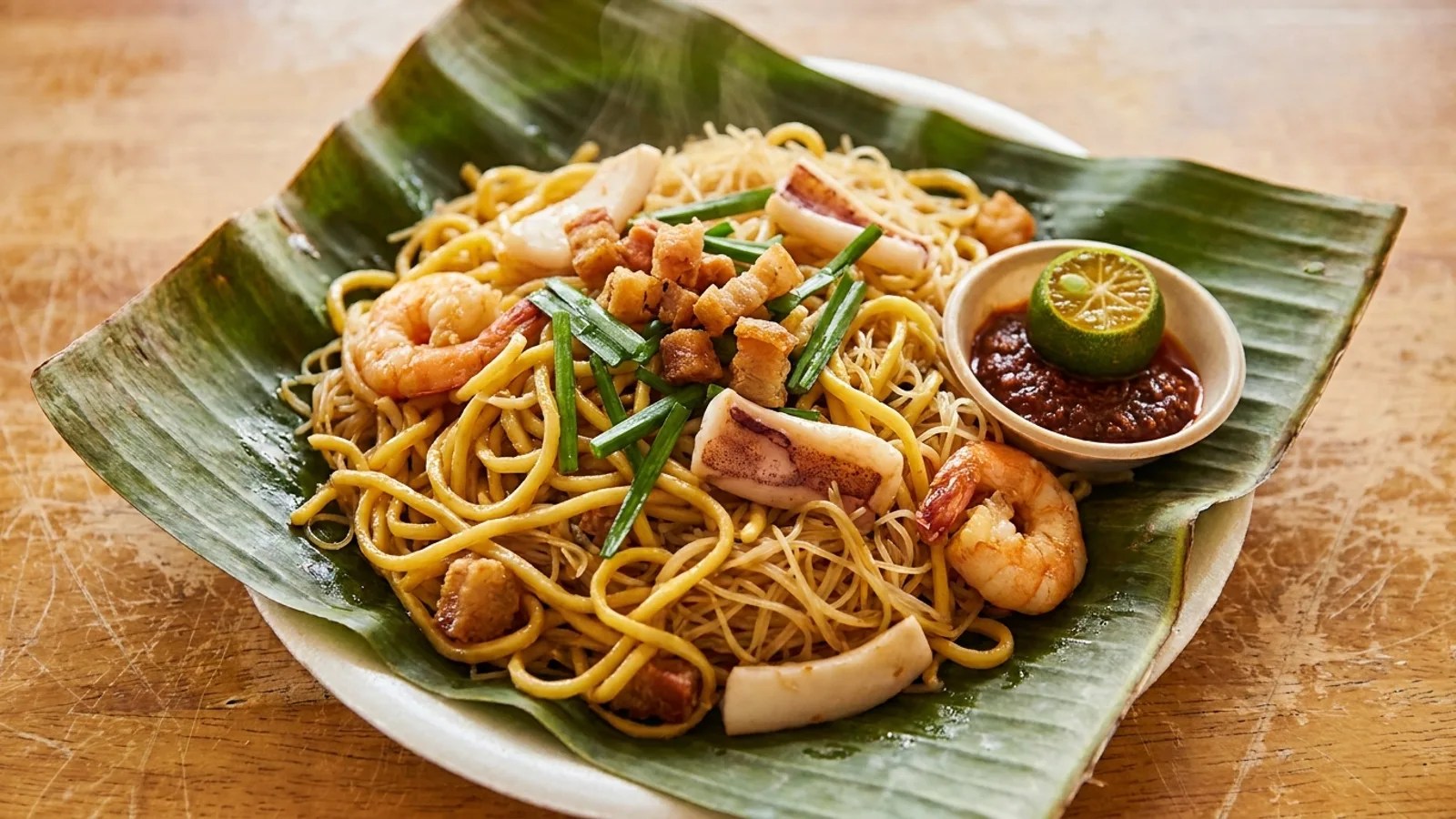
The best Hokkien mee Singapore has depends on an argument you should settle before you queue, because ordering wrong is the most common way people end up disappointed by a stall everyone else rates. Some stalls braise the noodles in prawn stock until the plate is glossy and slightly soupy. Others cook the liquid right off for wok hei and a drier, charred finish. Both are traditional, both have devotees, and they are not the same dish.
Under that, the thing that actually separates good from great is the stock. A serious stall reduces prawn heads and pork bones for hours and the noodles are just the way it reaches you. It is why a flat plate cannot be rescued with sambal, and why the stalls below have queues at 11am on a Tuesday.
Here are six I would wait for, from a S$4 plate with a Michelin Bib Gourmand to one still fried over charcoal after 41 years. Prices are 2026.
Key Takeaways
- 1 Wet or dry is the whole argument, and both are traditional. Wet stalls braise the noodles in prawn stock until they go glossy and you eat it with a fork. Dry stalls cook the liquid off for wok hei and a texture closer to char kway teow. Nam Sing is the reference for dry, Hong Heng for wet. Jump to Nam Sing Hokkien Fried Mee: the reference dry plate
- 2 A plate is S$4 to S$8 in 2026. Hong Heng, which holds a Michelin Bib Gourmand, sells at S$4, S$5 and S$6, which is among the cheapest starred-guide food anywhere. Jump to Hong Heng Fried Sotong Prawn Mee: a Bib Gourmand plate for S$4
- 3 Geylang Lorong 29 still fries over a charcoal fire after 41 years, and that is the flavour difference people describe as smoky and cannot get from a gas wok. Plates from S$6. Jump to Geylang Lorong 29 Fried Hokkien Mee: still cooked over charcoal
- 4 The stock is the dish, not the noodles. A good stall reduces prawn heads and pork bones for hours, and the noodles are the delivery mechanism. If a plate tastes flat, it is the stock, and nothing on the table will fix it.
- 5 Small batches are why you wait. Hong Heng fries a few plates at a time because a loaded wok drops in temperature and steams instead of frying. A queue at a Hokkien mee stall is usually a good sign rather than a bad one. Jump to Hong Heng Fried Sotong Prawn Mee: a Bib Gourmand plate for S$4
Wet or dry, and what actually makes a plate good
Four things. Decide the first one before you order.
- Wet style braises, dry style fries. Wet stalls simmer yellow noodles and bee hoon in prawn stock until the noodles drink it and a little pools at the bottom of the plate. It is richer, softer and easier with a fork. Dry stalls cook most of that liquid off, so you get wok hei and a texture closer to char kway teow, better suited to chopsticks. Ask which a stall does, and where both are offered, ask for one by name.
- The stock is the dish. Prawn heads and pork bones reduced for hours is what you are actually paying for. Noodles are the delivery mechanism. This is why a mediocre plate stays mediocre no matter how much sambal you add, and why the good stalls are the ones that run out rather than the ones that stay open longest.
- Small batches are the reason for the queue. A wok loaded with eight portions loses heat and starts steaming the noodles rather than frying them. The best stalls fry three or four plates at a time and accept the slower service. When you see a hawker refusing to scale up at peak, that is craft rather than obstinacy.
- Sambal and lime are part of the recipe. The chilli is made in-house and squeezing the calamansi over the plate is not optional garnish, it cuts the richness of the stock and lifts the whole thing. Stalls plate them together because the dish is designed to be finished at the table.
Charcoal is the last variable and it has nearly gone. Geylang Lorong 29 still fries over a charcoal fire after 41 years, which produces a smokiness a gas wok cannot match. The reason it is rare is regulatory as much as economic: NEA hawker management sets the stall licensing and ventilation requirements, and charcoal is difficult to accommodate in modern premises. Worth eating while it is still there. The A, B or C hygiene grade at the stall also changed meaning on 19 January 2026, when SFA replaced the annual grade with the Safety Assurance for Food Establishments framework.
How the best Hokkien mee stalls in Singapore compare
| Stall | Where | Style | Price | Best for |
|---|---|---|---|---|
| Hong Heng Fried Sotong Prawn Mee | Tiong Bahru Market | Wet | S$4, S$5, S$6 | The best plate here, and the cheapest Bib Gourmand food in town |
| Nam Sing Hokkien Fried Mee | Old Airport Road Food Centre | Dry | S$5 to S$8 | The reference dry plate, since 1960 |
| Geylang Lorong 29 Fried Hokkien Mee | Geylang Lorong 29 | Wet | From S$6 | Charcoal, and the smokiness that comes with it |
| Geylang Ah Hock | Geylang | Wet | S$6 to S$10 | A rich, heavily reduced stock |
| Tian Tian Lai | Berseh Food Centre | Dry | S$5 to S$8 | Wok hei, if Nam Sing is too far |
| Xiao Di Fried Prawn Noodle | Golden Mile Food Centre | Wet | S$6 to S$10 | Generous seafood, and a younger hawker |
1. Hong Heng Fried Sotong Prawn Mee: a Bib Gourmand plate for S$4
It is wet style, and the stock is the reason to come: deeply savoury, properly reduced, and it soaks all the way into the noodles rather than sitting under them. The squid is cooked to the right side of tender, which is harder than the prawns and is where a lot of stalls give themselves away.
He fries in small batches, so expect to wait, and that is the trade you want. Go for the S$5 unless you are very hungry, and use the chilli, which is made in-house and is better than most.
- Where
- Tiong Bahru Market, 30 Seng Poh Road
- Price
- S$4, S$5 and S$6
- Style
- Wet
- Recognition
- Michelin Bib Gourmand since 2016
- Expect
- A queue, because he fries in small batches
2. Nam Sing Hokkien Fried Mee: the reference dry plate
Whether you love it depends entirely on which camp you are in. People who want the glossy, stock-pooled version find it austere. People who want wok hei and defined noodles think it is the best Hokkien mee in Singapore, and they have a case. The wok work is genuinely exceptional, which after six decades it ought to be.
The uncle is famously unhurried and the queue moves at the speed it moves. Old Airport Road is worth a morning anyway, so build the trip around it rather than dropping in.
- Best for
- Wok hei and defined noodles rather than a rich pool of stock
- Where
- Old Airport Road Food Centre, 51 Old Airport Road
- Price
- About S$5 to S$8
- Style
- Dry, the reference version
- Since
- 1960
3. Geylang Lorong 29 Fried Hokkien Mee: still cooked over charcoal
It is wet style, generous, and plates start around S$6. The prawns are decent and the squid is fine, but the reason to make the trip is the smoke, so order it plain rather than loading it with extra seafood that will only get in the way.
Charcoal cooking is slowly disappearing from Singapore hawker centres, partly on economics and partly on ventilation requirements in newer premises. This is one of a small handful of stalls where it survives, alongside Sungei Road Laksa, and both are worth eating on those grounds alone.
- Where
- Geylang Lorong 29
- Price
- From about S$6
- Style
- Wet, cooked over charcoal
- Frying over charcoal
- 41 years and counting
- Order it
- Plain, so the smoke is the thing you taste
Recommended reads
4. Geylang Ah Hock: the richest stock on this list
Plates run about S$6 to S$10 depending on size and how much seafood you add. It is worth going up a size here, because the ratio of stock to noodle is the point and a small plate short-changes it.
If you have eaten Nam Sing and thought it was too dry, this is the corrective, and the two together are the clearest possible demonstration of the divide. Eating both in a week is the fastest way to work out which style you actually prefer.
- Best for
- Anyone who found Nam Sing too austere
- Where
- Geylang
- Price
- About S$6 to S$10
- Style
- Wet, heavily reduced
- Order this
- A larger plate, because the stock ratio is the point
5. Tian Tian Lai: the dry version, closer to town
It is a notch below Nam Sing on consistency, which is a high bar rather than a criticism, and plates run about S$5 to S$8. The prawns are shelled properly, which sounds trivial and is the difference between eating and doing admin.
Berseh Food Centre is also where Sungei Road Laksa trades, so a single trip covers the best dry Hokkien mee in the centre of town and the last charcoal laksa in the country. That is a good hour.
- Best for
- Dry-style Hokkien mee without the trek east
- Where
- Berseh Food Centre, 166 Jalan Besar
- Price
- About S$5 to S$8
- Style
- Dry
- Nearby
- Sungei Road Laksa, in the same food centre
6. Xiao Di Fried Prawn Noodle: the generous one
It is the pick when you want the dish to feel like a meal rather than a snack, and when you are eating with someone who judges a plate by what is on top of it. The stock is good rather than exceptional, and the seafood is what you are really buying.
Golden Mile Food Centre is easy to get to and open late compared with most of this list, which makes this the most convenient plate here even if it is not the best one.
- Best known for
- A generous amount of prawn and squid
- Best for
- Convenience, later hours, and a plate that eats like a meal
- Where
- Golden Mile Food Centre, 505 Beach Road
- Price
- About S$6 to S$10
- Style
- Wet
How much does Hokkien mee cost in Singapore?
Hokkien mee in Singapore costs S$4 to S$10 a plate in 2026. Hong Heng at Tiong Bahru, which holds a Michelin Bib Gourmand, sells at S$4, S$5 and S$6. Most well-known stalls sit between S$5 and S$8 for a standard plate, and S$10 or so for a large one or with extra prawn and squid. Geylang Lorong 29 starts around S$6.
| Plate | Price | Note |
|---|---|---|
| Small, at a value stall | S$4 to S$5 | Hong Heng starts at S$4 |
| Standard plate | S$5 to S$8 | The normal order at most stalls here |
| Large, or extra seafood | S$8 to S$10 | Worth it at the wet stalls, less so at the dry ones |
Ordering advice that saves money: at a wet stall go one size up, because the stock-to-noodle ratio is what you came for. At a dry stall the standard plate is plenty, since the flavour is in the char rather than the volume.
What is the difference between wet and dry Hokkien mee?
Wet Hokkien mee braises the yellow noodles and bee hoon in prawn stock until the noodles absorb it and a little liquid pools on the plate, giving a glossy, rich and softer result usually eaten with a fork. Dry Hokkien mee cooks most of that liquid off in the wok, producing a drier plate with pronounced wok hei and a texture closer to char kway teow, eaten with chopsticks.
Both are traditional Singapore styles and the preference is genuinely personal rather than a question of authenticity. Hong Heng and Geylang Ah Hock are reference points for wet, Nam Sing and Tian Tian Lai for dry. Where a stall offers both, say which you want when ordering, because the default varies stall to stall.
Which Hokkien mee in Singapore has a Michelin listing?
Hong Heng Fried Sotong Prawn Mee at Tiong Bahru Market has held a Michelin Bib Gourmand since 2016 and sells its plates at S$4, S$5 and S$6, which makes it among the cheapest Michelin-listed food anywhere. It is a third-generation stall serving wet-style Hokkien mee, fried in small batches, so a queue is normal.
The Bib Gourmand recognises good food at modest prices rather than fine dining, which is why hawker stalls feature so heavily in the Singapore guide. Listings are reassessed annually, so check the current guide before travelling specifically for a starred or Bib listing.
Is there still charcoal-fried Hokkien mee in Singapore?
Geylang Lorong 29 Fried Hokkien Mee still cooks over a charcoal fire and has done for 41 years, with plates from about S$6. It is one of very few hawker stalls in Singapore still using charcoal rather than gas, and the difference shows as a smokiness running through the whole plate that a gas wok cannot reproduce.
Charcoal has been disappearing from Singapore hawker centres for both economic and regulatory reasons, since NEA hawker management sets stall licensing and ventilation requirements that are hard to meet with an open charcoal fire in newer premises. Sungei Road Laksa is the other well-known holdout, and both are worth eating while they last.
My verdict on the best Hokkien mee in Singapore
Hong Heng at Tiong Bahru, and order the S$5. It is the best plate on this list, the stock is properly reduced, the squid is handled with more care than most stalls manage, and it holds a Michelin Bib Gourmand while charging four dollars for the small. Wait for it.
If you know you prefer dry, Nam Sing at Old Airport Road is the reference and has been since 1960, with Tian Tian Lai at Berseh as the closer-to-town version. If you want the smoke, Geylang Lorong 29, and order it plain so the charcoal is what you taste. And if Nam Sing struck you as too dry, Geylang Ah Hock is the opposite end of the same dish.
Two habits. Say wet or dry when you order rather than accepting the house default, because that single word decides whether you enjoy the plate. And squeeze the lime. It is on the plate for a reason and the dish is designed to be finished at the table, not served complete. For the wider picture, my guide to the best restaurants in Singapore is the hub for this whole cluster.
One last note for the trade. Every stall on this page except one has no website at all, so their names online belong to food blogs and aggregators, complete with opening hours that are frequently wrong for stalls that close when the stock runs out. For a business that has been perfecting one plate since 1960, that is a real cost. If your listing is the one going stale, that is fixable, and it happens to be my day job. Take a look at my web design for restaurants, or get a quote and I will tell you honestly what would move the needle.
Spotted something out of date in this guide?
Suggest an edit or a business to add. This guide is pre-filled for you.

Professional Opinion-haver
Terris
Chief Recommender · I do the digging so you don't have to
Terris is a Singapore-based web designer and digital strategist who has spent 8+ years building websites for local businesses. His Terris Recommends series shares personal picks for the best service providers across Singapore, informed by his experience working with businesses across industries.
Want to see these strategies in action? Browse our portfolio or get in touch to discuss your project.