The best laksa Singapore has is a S$3 bowl heated over charcoal at a hawker centre in Jalan Berseh, and that is not a contrarian pick. Sungei Road Laksa is the only stall left in the country still cooking its gravy over charcoal rather than gas, and the difference is the kind of thing you notice immediately and cannot un-notice afterwards.
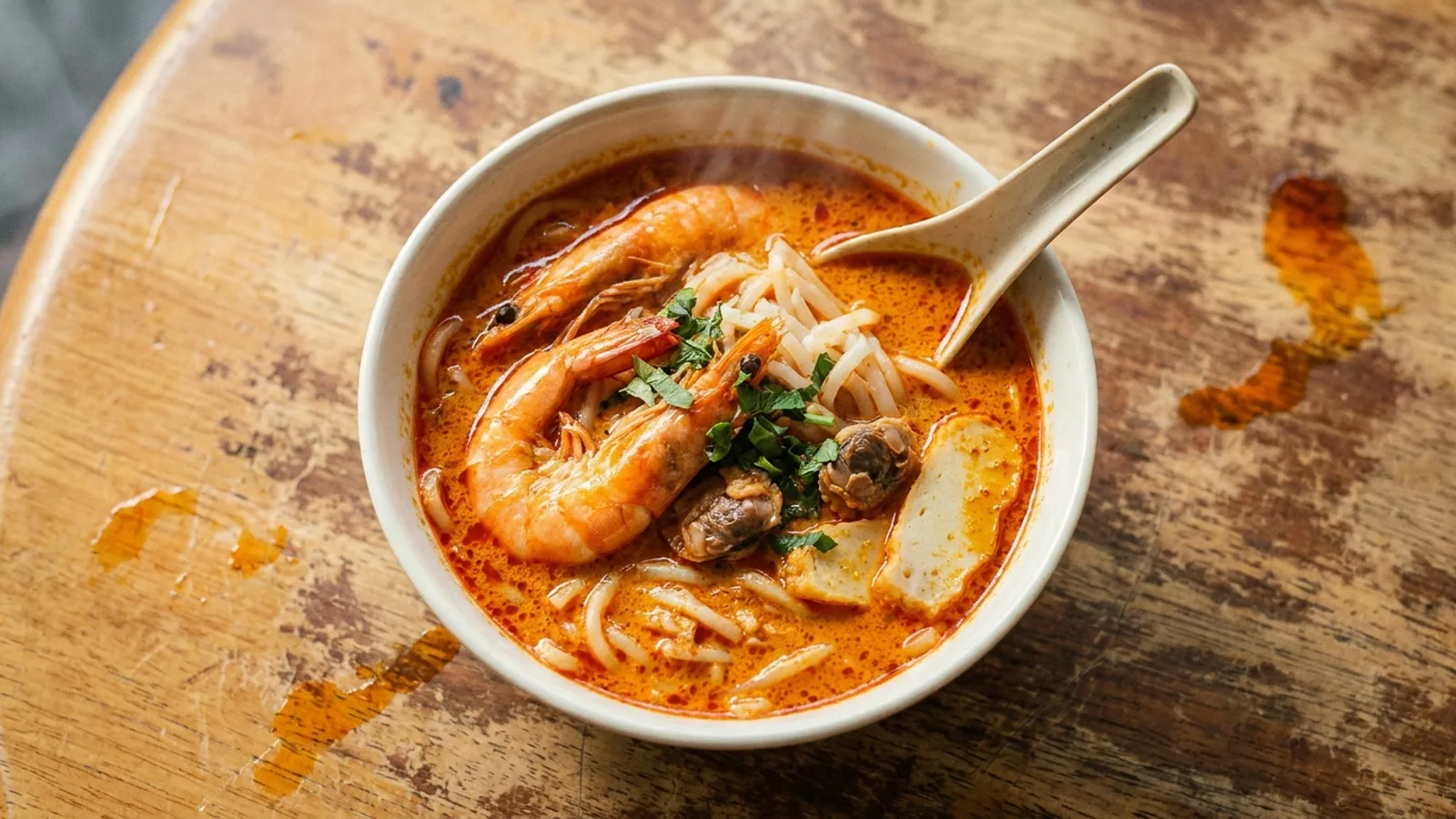
The other thing worth knowing before you order is the spoon. Katong laksa is served with the noodles cut short so the whole bowl can be eaten with a spoon alone, scooping broth, noodles and cockles together in one mouthful. Visitors reach for chopsticks and find nothing to lift. It is not a mistake in the kitchen, it is the defining feature of the dish.
So here are six bowls I would go out of my way for, from S$3 to S$9.80, including the two shops that both claim to have invented Katong laksa and one that is a completely different dish wearing the same name. Prices are 2026.
Key Takeaways
- 1 Katong laksa is served with the noodles cut short so it can be eaten with a spoon alone, no chopsticks. The story behind it is that cutting them let the dish be eaten fast, which mattered when hawkers needed to move quickly.
- 2 Sungei Road Laksa is the only stall in Singapore still heating its gravy over charcoal, and a bowl is around S$3. That is both the cheapest and the most distinctive laksa on this list. Jump to Sungei Road Laksa: the last charcoal laksa, and about S$3
- 3 Two shops claim the original Katong laksa. Janggut, founded in the 1950s by Ng Juat Swee, and 328 Katong Laksa, which is the famous one and holds a Michelin Bib Gourmand. Both are worth eating and the dispute is genuinely unsettled. Jump to 328 Katong Laksa: the famous one, and it holds up
- 4 A bowl runs S$3 to S$9.80 in 2026. Sungei Road is about S$3, Depot Road is S$4.50 to S$6.50, Janggut is S$5.50 to S$6.50, and a large bowl at 328 is S$9.80. Jump to Sungei Road Laksa: the last charcoal laksa, and about S$3
- 5 Singapore laksa, Sarawak laksa and Penang assam laksa are three different dishes. Ours is coconut curry with cockles; Sarawak laksa is sambal and coconut over bee hoon with no cockles; assam laksa is sour and tamarind-based with no coconut at all.
Why the noodles are cut, and other things worth knowing
Four things, and the first explains the cutlery.
- The noodles are cut short on purpose. Katong laksa is eaten with a spoon and nothing else. The rice noodles are chopped so that broth, noodle and topping arrive together in one scoop, and the origin story is that cutting them let the dish be eaten fast, which suited hawkers who needed customers to finish and move on. Whatever the history, it changes the eating: every mouthful is the complete dish rather than noodles first and soup after.
- Charcoal is the real differentiator and there is one stall left. Sungei Road Laksa still heats its gravy over charcoal, which keeps a low, even heat under the pot and gives the coconut a rounder, less sharp edge than a gas flame does. Every other stall on this list uses gas. This is the same squeeze that has been quietly killing charcoal satay, and it is worth eating while it exists.
- Two shops claim the original. Janggut Laksa was founded in the 1950s by Ng Juat Swee, nicknamed Janggut, and trades as The Original Katong Laksa. 328 Katong Laksa is the one with international fame and a Michelin Bib Gourmand. The dispute has run for decades, both bowls are good, and anyone telling you it is settled is picking a side.
- Cockles are standard and negotiable. Hum go in by default at most stalls. If you do not want them, say so when ordering rather than picking them out, and if you do want them, most stalls will add extra for a dollar or two. They are the topping people most often wish they had asked about.
One clarification that saves confusion when travelling: laksa is not one dish. Singapore and Katong laksa is a coconut curry broth with cockles and cut noodles. Sarawak laksa is sambal-based with coconut, served over bee hoon with shredded chicken and omelette, and contains no cockles. Penang assam laksa is sour, tamarind-driven and has no coconut at all. Ordering "laksa" in three cities gets you three unrelated bowls.
Worth knowing about the setting as well as the bowl. Singapore hawker culture was inscribed on the UNESCO Representative List of the Intangible Cultural Heritage of Humanity in December 2020, and the National Heritage Board documents the trade and its stalls on Roots. The practical side is run by NEA hawker management, which sets the stall licensing and the ventilation rules that make charcoal cooking so hard to keep, and is a large part of why only one laksa stall still does it. The A, B or C hygiene grade near the stall also changed meaning on 19 January 2026, when SFA replaced the annual grade with the Safety Assurance for Food Establishments framework.
How the best laksa stalls in Singapore compare
| Stall | Where | Price | Best for |
|---|---|---|---|
| Sungei Road Laksa | Jalan Berseh Food Centre | About S$3 | Charcoal, and the best bowl per dollar in Singapore |
| Janggut Laksa | Roxy Square, Marine Parade | S$5.50 to S$6.50 | The origin claim, and a heavy dried-shrimp broth |
| 328 Katong Laksa | 51 East Coast Road | To S$9.80 for a large | The famous one, and a Bib Gourmand |
| Depot Road Zhen Shan Mei | Alexandra Village Food Centre | S$4.50 to S$6.50 | Claypot service, and four Bib Gourmands |
| Roxy Laksa | East Coast Lagoon Food Village | Hawker pricing | Laksa by the sea, with satay two stalls away |
| Lin Yu Mei Sarawak Laksa | Sarawak-style, not Katong | S$7 to S$8.50 | A completely different laksa tradition |
1. Sungei Road Laksa: the last charcoal laksa, and about S$3
Sungei Road Laksa at Jalan Berseh Food Centre is the best laksa in Singapore and it costs around three dollars, which is an annoying sentence to write but is what the eating supports. It is the only stall in the country that still heats its gravy over charcoal, and that is not nostalgia dressing. Charcoal holds a low, even heat under the pot in a way a gas ring does not, and the coconut comes out rounder and less sharp.
The bowl itself is deliberately plain. Cut noodles, a good amount of cockles, a modest amount of everything else, and a gravy that is thinner than 328's and considerably more fragrant. There is no chicken, no giant prawn, no attempt to justify a higher price by loading the bowl.
Go early. It is a small stall with a real queue and it is the sort of place that closes when the pot is finished rather than when the clock says so. Bring cash.
Where: Jalan Berseh Food Centre, 27 Jalan Berseh
Price: Around S$3 a bowl
The difference: The only laksa stall in Singapore still cooking over charcoal
The bowl: Deliberately plain, thinner and more fragrant gravy, generous cockles
Go: Early, with cash
Also here: Tian Tian Lai, in my best Hokkien mee in Singapore picks
2. Janggut Laksa: the other claim to the original
Janggut Laksa trades as The Original Katong Laksa and has the older paper trail: it was founded in the 1950s by Ng Juat Swee, whose nickname Janggut, meaning beard, became the name. Whether that settles the Katong laksa argument depends on who you ask, and it has been asked a lot.
What is not in dispute is the broth, which is the most assertive on this list. There is a heavy hae bee, dried shrimp, aroma running through it that hits before the coconut does, and the whole thing is more savoury and less sweet than the famous version down the road. If you have eaten 328 and found it a bit rounded off, this is the corrective.
It sits in Roxy Square in Marine Parade, small at S$5.50 and around S$6.50 for the larger bowl. Between this and 328 you are about a ten-minute walk apart, which makes doing both in one afternoon entirely reasonable and much the best way to have an opinion.
Where: Roxy Square, Marine Parade
Price: About S$5.50 small, S$6.50 large
Since: The 1950s, founded by Ng Juat Swee
The broth: Heavy on dried shrimp, more savoury and less sweet than 328
Best for: Anyone who finds the famous version too smooth
3. 328 Katong Laksa: the famous one, and it holds up
328 is the laksa everyone has heard of, largely because it beat Gordon Ramsay in the 2013 Hawker Heroes challenge, and it has held a Michelin Bib Gourmand since. Fame of that kind usually outruns the food. Here it mostly does not.
The gravy is the richest and most coconut-forward on this list, thick enough to coat the spoon, and it is engineered to be immediately likeable. That is a real skill and it is also the criticism: next to Sungei Road's charcoal fragrance or Janggut's dried-shrimp punch, it can read as a little smooth. It is still an excellent bowl.
Prices have climbed with the profile and a large bowl now runs S$9.80, which is roughly three times Sungei Road. Come here first if you are visiting and want the reference version, and come to the other two afterwards if you want to know what else laksa can do.
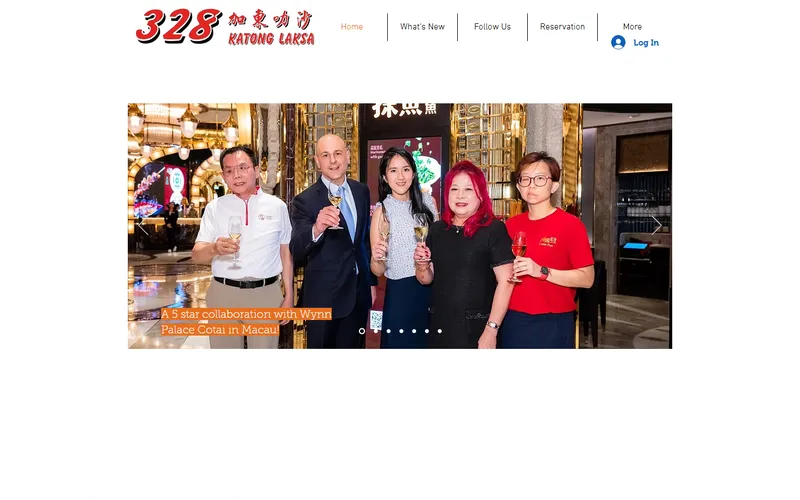
Website: 328katonglaksa.sg
Where: 51 East Coast Road, plus other outlets
Price: Up to S$9.80 for a large bowl
Recognition: Michelin Bib Gourmand, and the 2013 Hawker Heroes win
The gravy: The richest and most coconut-forward here
Recommended reads
4. Depot Road Zhen Shan Mei: laksa in a claypot
Depot Road Zhen Shan Mei serves its laksa in a claypot, which sounds like presentation and is not. The pot holds heat, so the gravy stays properly hot to the last spoonful instead of going lukewarm halfway through, and it keeps reducing very slightly as you eat, which concentrates it.
It has won the Michelin Bib Gourmand four times since 2016, and the gravy sits between Sungei Road and 328: richer than the first, less sweet than the second. Sizes are S$4.50, S$5.50 and S$6.50, which is fair for a bowl at this level.
The catch is the hours. It trades Monday to Thursday, roughly 9am to 4pm, from Alexandra Village Food Centre, which rules out most weekends and every evening. Alexandra Village is also where Keng Eng Kee is, so a Thursday lunch out there can cover two of Singapore's better hawker reputations in one trip.
Where: #01-75, Alexandra Village Food Centre, 120 Bukit Merah Lane 1
Price: S$4.50, S$5.50 and S$6.50
Hours: Monday to Thursday, about 9am to 4pm
Recognition: Michelin Bib Gourmand, four times since 2016
The difference: Claypot service, so it stays hot and keeps concentrating
5. Roxy Laksa: laksa by the sea, next to the satay
Roxy Laksa sits in East Coast Lagoon Food Village and is on this list as much for where it is as for what it is. It is a solid, unfussy Katong-style bowl at hawker prices, and it happens to be a two-minute walk from Haron Satay and Soon Huat's satay bee hoon.
That combination is the argument. East Coast Lagoon lets you eat a proper laksa, a plate of the best satay in Singapore and a bowl of satay bee hoon in one sitting, outdoors, by the water. No other hawker centre on this list gives you that.
Judged purely on the laksa it is behind the four above, and it is not close on the charcoal question. Judged as an evening, it beats all of them. Go at dusk, split everything, and do not order one bowl each.
Where: East Coast Lagoon Food Village, 1220 East Coast Parkway
Price: Hawker pricing
Best for: Eating laksa, satay and satay bee hoon in one outdoor sitting
Nearby: Haron Satay at Stall 55 and Soon Huat at Stall 15
Go: At dusk, and share everything
6. Lin Yu Mei Sarawak Laksa: the laksa that is not Katong laksa
Sarawak laksa is a genuinely different dish and Singapore has quietly acquired a handful of stalls doing it properly. The broth is built on sambal and coconut with a heavy note of galangal and lemongrass, poured over bee hoon rather than cut rice noodles, and topped with shredded chicken, omelette strips and prawns. No cockles, no curry sweetness, and you eat it with chopsticks.
Lin Yu Mei serves it alongside kolo mee, the other Sarawak staple, at S$7 for a small bowl and S$8.50 for a large. It is more aromatic and less rich than Katong laksa, and people who find Singapore laksa heavy tend to prefer it immediately.
It is on this list because ordering laksa in Kuching, Penang and Singapore gets you three unrelated bowls, and knowing that in advance saves a small disappointment. If you have only ever had the coconut curry version, this is the one to try next.
Where: Sarawak-style stall, served with kolo mee
Price: S$7 small, S$8.50 large
The broth: Sambal and coconut with galangal and lemongrass, over bee hoon
Not included: Cockles, and the curry sweetness of Katong laksa
Best for: Anyone who finds Singapore laksa too rich
How much does laksa cost in Singapore?
Laksa in Singapore costs about S$3 to S$9.80 a bowl in 2026. Sungei Road Laksa is the cheapest at around S$3, Depot Road Zhen Shan Mei runs S$4.50 to S$6.50 by size, Janggut is S$5.50 to S$6.50, and a large bowl at 328 Katong Laksa is S$9.80. Sarawak laksa sits around S$7 to S$8.50.
| Stall | Price | Note |
|---|---|---|
| Sungei Road Laksa | About S$3 | Charcoal-cooked, and the best value here |
| Depot Road Zhen Shan Mei | S$4.50 to S$6.50 | Three sizes, claypot |
| Janggut Laksa | S$5.50 to S$6.50 | Small and large |
| Sarawak laksa | S$7 to S$8.50 | Different dish, priced above Katong laksa |
| 328 Katong Laksa | Up to S$9.80 | Large bowl, prices have risen with the fame |
The spread on this page is more than 3x for what is nominally the same dish, and the cheapest bowl is the one I would send you to. That is unusual in Singapore food and it is worth taking advantage of.
Why is Katong laksa eaten with a spoon?
Katong laksa is eaten with a spoon because the rice noodles are cut short before serving, so there is nothing long enough to lift with chopsticks. Each spoonful carries broth, noodles, cockles and fish cake together, which is the intended way to eat the dish. The commonly told origin is that cutting the noodles let customers eat quickly, which suited the hawkers selling it.
This is specific to the Katong style rather than to laksa generally. Sarawak laksa is served over uncut bee hoon and eaten with chopsticks, and Penang assam laksa uses thick uncut rice noodles. If a bowl of Singapore laksa arrives with full-length noodles, it is not being served Katong-style.
What is the difference between Katong laksa, Sarawak laksa and assam laksa?
Katong laksa is a Singapore coconut curry broth with cut rice noodles, cockles, fish cake and prawns, eaten with a spoon. Sarawak laksa is built on sambal with coconut, galangal and lemongrass, served over uncut bee hoon with shredded chicken and omelette, and has no cockles. Penang assam laksa contains no coconut at all: it is a sour tamarind and mackerel broth with thick rice noodles.
They share a name and very little else, and the differences matter when ordering abroad. Singapore laksa is the richest of the three, Sarawak laksa the most aromatic, and assam laksa the most polarising because the sourness catches people who expected coconut.
Which laksa in Singapore is the original Katong laksa?
Two stalls claim it and the dispute is genuinely unsettled. Janggut Laksa, founded in the 1950s by Ng Juat Swee, whose nickname gave the shop its name, trades as The Original Katong Laksa from Roxy Square. 328 Katong Laksa on East Coast Road is the internationally famous one, holds a Michelin Bib Gourmand, and won the 2013 Hawker Heroes challenge against Gordon Ramsay.
They are about a ten-minute walk apart, and the practical answer is to eat both in one afternoon. Janggut leads with dried shrimp and is more savoury; 328 is richer and more coconut-forward. Anyone who tells you the question is settled has chosen a side rather than found evidence.
My verdict on the best laksa in Singapore
Sungei Road Laksa, and it is not close. It is the last stall in Singapore heating its gravy over charcoal, the bowl is about three dollars, and the fragrance you get from that pot is something no other stall on this list can produce. Go early and bring cash, because it closes when the pot is done.
After that it depends what you want. Janggut if you like a savoury, dried-shrimp-heavy broth and want the older origin claim. 328 if you are visiting and want the reference bowl, accepting that S$9.80 buys fame as well as laksa. Depot Road on a weekday lunchtime for the claypot. And Roxy Laksa when the evening matters more than the bowl, because eating it outdoors two stalls from the best satay in Singapore is a better hour than any single dish on this page.
One habit: taste the gravy on its own before you stir. Laksa gravies separate, and the top inch is where the chilli oil and the fragrance sit. Stall to stall, that first unstirred spoonful tells you more than the whole bowl afterwards. For the wider picture, my guide to the best restaurants in Singapore is the hub for this whole cluster.
One last note for the trade. Not one of the six stalls here beyond 328 runs a website, so the search results for their own names belong to aggregators and food blogs, with hours and prices that are frequently out of date. For a stall that closes when the pot finishes, that is a genuinely costly gap. If it is your business the internet keeps describing incorrectly, that is fixable, and it happens to be my day job. Take a look at my web design for restaurants, or get a quote and I will tell you honestly what would move the needle.
Spotted something out of date in this guide?
Suggest an edit or a business to add. This guide is pre-filled for you.

Professional Opinion-haver
Terris
Chief Recommender · I do the digging so you don't have to
Terris is a Singapore-based web designer and digital strategist who has spent 8+ years building websites for local businesses. His Terris Recommends series shares personal picks for the best service providers across Singapore, informed by his experience working with businesses across industries.
Want to see these strategies in action? Browse our portfolio or get in touch to discuss your project.