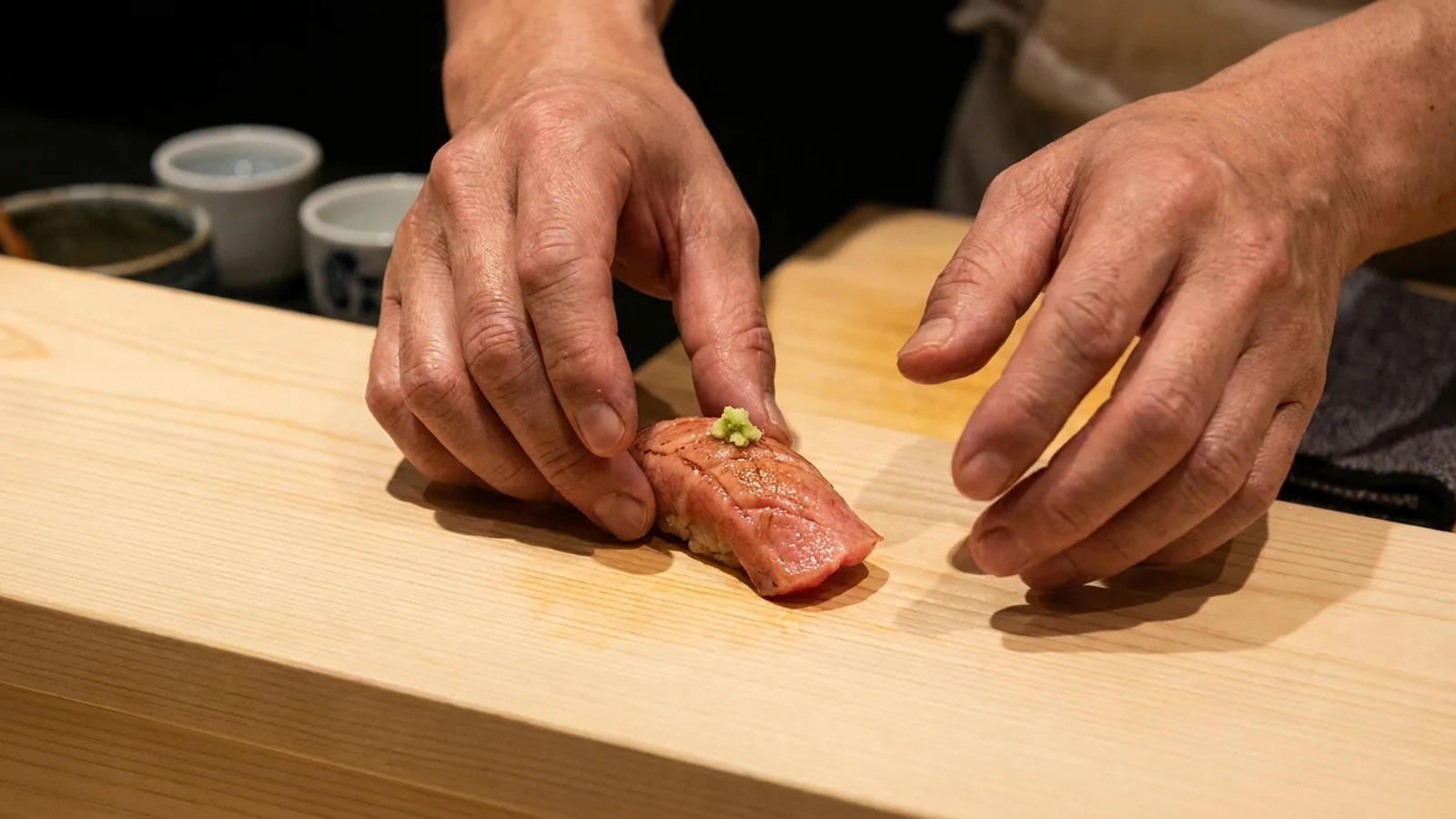
The best omakase Singapore has is a harder question than it looks, because the price range is so wide that the entries are barely the same product. You can sit down to omakase here for about S$80, or for close to S$700, and both are legitimately called omakase. Nothing on the menu explains the gap, mostly because there is no menu.
That is the whole idea. Omakase means something close to I leave it up to you, and you are handing the chef the decision about what you eat. It does not mean sushi, though most people use it that way. One of my picks below is a shabu shabu and sukiyaki omakase, and it is no less the real thing for it.
What actually drives the price is not glamour, it is logistics. How often the fish arrives from Toyosu, how many seats the counter has to spread that cost across, whether the chef whose name is on the door is the one standing in front of you, and whether the kitchen ages its fish rather than serving it straight. Those four things explain nearly every price on this list, so I have written them into each entry rather than leaving you to guess. Ten picks, from S$80 to S$680.
Key Takeaways
- 1 Omakase in Singapore spans S$80 to S$680 per seat in 2026. Kagami runs a 16-course shabu shabu omakase at about S$80, and Shoukouwa charges around S$380++ for lunch and S$680++ for dinner.
- 2 Lunch is the single biggest lever on price. Sushi Kimura starts around S$120 at lunch against S$280 at dinner, and Hashida runs about S$120 lunch against S$250 dinner, usually with the same chef behind the counter.
- 3 Omakase means "I leave it to you", not "sushi". Kagami is a shabu shabu and sukiyaki omakase, and plenty of non-sushi restaurants run the format.
- 4 What you are really paying for is fish sourcing and counter size. A daily Toyosu shipment and an eight-seat counter is a completely different cost base from a weekly order and twenty seats.
- 5 Shoukouwa and Sushi Sakuta both hold two Michelin stars, the highest for sushi in Singapore. Sakuta was promoted to two in the 2025 guide.
What actually drives the price of omakase in Singapore
Before the list, here is where the money goes, because a S$400 counter is not simply a S$150 counter with better fish.
- How often the fish lands. The top counters take deliveries from Toyosu market in Tokyo several times a week, sometimes daily. That is airfreight on small quantities of perishable, high-value produce, and it is the single largest cost difference between tiers. A restaurant ordering weekly can charge much less and is not being dishonest about it.
- How many seats there are. Shoukouwa seats eight. A mid-tier counter might seat twenty. Every fixed cost, the chef, the rent, the fish that did not sell, is divided across those seats. Small counters are expensive because the arithmetic demands it.
- Whether the named chef is there. At the top end the chef-owner is at the counter most services. As a group expands, the founder becomes a name and a trained team runs the counters. Both can be excellent. Only one justifies the top price.
- Ageing, or jukusei. Some chefs age fish deliberately for days or weeks to concentrate flavour and change texture, which takes storage, judgement and a tolerance for loss. It is the sushi equivalent of dry-ageing beef, and it is a genuine specialisation rather than a marketing line.
- Lunch versus dinner. Often the same chef, same counter, fewer courses, roughly half the price. This is the most underused piece of knowledge in Singapore dining.
If a counter is not the format you want, my best steakhouses in Singapore guide covers the other end of the special-occasion spend, and date night restaurants covers the wider field. For the wider picture, my guide to the best restaurants in Singapore is the hub for this whole cluster.
How the best omakase in Singapore compares
| Restaurant | Style | Price | Best for |
|---|---|---|---|
| Shoukouwa | Edomae sushi | S$380++ lunch, S$680++ dinner | The top of the market |
| Sushi Sakuta | Edomae sushi | Premium | Two stars, quieter reputation |
| Sushi Kimura | Aged fish, jukusei | From S$120 lunch, S$280 dinner | Tasting what ageing does |
| Ginza Sushi Ichi | Edomae sushi | Dinner from S$220++ | One star, Orchard location |
| Hashida Sushi | Contemporary sushi | From S$120 lunch, S$250 dinner | A well-known counter at lunch |
| Sushi Masa by Ki-setsu | Edomae sushi | About S$230 to S$320 | A disciplined mid-premium counter |
| Wakuda | Modern Japanese | Counter from S$128 | A famous name at an accessible price |
| Teppei | Casual omakase | Value pricing | The original budget omakase |
| Jun Omakase | Nigiri-focused | S$88 nigiri, S$128++ premium | A first omakase |
| Kagami | Shabu shabu, sukiyaki | About S$80 for 16 courses | Omakase that is not sushi |
Counters change their pricing seasonally with the fish, so treat every figure here as the current starting point rather than a quote.
1. Shoukouwa: best omakase in Singapore, and priced like it
What you get is Edomae sushi at the level Singapore is capable of, in a room small enough that the meal is unavoidably personal. There is nowhere to hide at an eight-seat counter, for the chef or for you, and that intensity is either the appeal or the reason to book somewhere else.
The honest advice: if this is your first omakase, do not start here. Not because it is not worth it, but because you will not yet have the reference points to know what you are tasting, and that is an expensive way to find out. Start further down this list and work up.
- Location
- One Fullerton
- Price
- About S$380++ lunch, S$680++ dinner
- Recognition
- Two Michelin stars
- Counter
- Eight seats, daily Toyosu sourcing
- Website
- shoukouwa.com.sg
2. Sushi Sakuta: the other two-star counter
Sushi Sakuta was promoted to two Michelin stars in the 2025 Michelin Guide Singapore, putting it level with Shoukouwa at the top of the sushi ranking here. It has a noticeably quieter public profile than its rating would suggest, which for a certain kind of diner is a feature.
Chef-owner Yoshio Sakuta is central to the restaurant's reputation, and that is worth taking literally rather than as a marketing line. This is a chef-driven counter where the person whose name is on the door does the work, which is one of the four price drivers I listed above and the one most often quietly absent elsewhere.
If you have already done Shoukouwa and want to understand how two kitchens at the same rating can differ, this is the comparison to make.
Style: Edomae sushi, chef-driven counter
Recognition: Two Michelin stars, promoted in the 2025 guide
Price: Premium, check current seasonal pricing
Best for: A second top-tier counter after Shoukouwa
3. Sushi Kimura: best for tasting what ageing does to fish
Aged fish is firmer, deeper and less clean-tasting than fresh, in the same way dry-aged beef differs from wet-aged. Some people love it immediately. Some decidedly do not. Either reaction is worth having, and it tells you something useful about what to book next.
Pricing is tiered and the range is wide: lunch menus start around S$120 and run up through S$180 to S$450, with dinner from about S$280 and typically S$330 to S$450. That lunch entry point is one of the better value doors into a serious counter in Singapore.
- Best for
- Understanding ageing, at a lunch price
- Style
- Edomae sushi with jukusei aged fish
- Price
- Lunch from about S$120, dinner from about S$280
- Website
- sushikimura.com.sg
4. Ginza Sushi Ichi: best one-star counter in town
Ginza Sushi Ichi sits inside Singapore Marriott Tang Plaza on Orchard Road and holds one Michelin star. Dinner omakase starts from S$220++, which places it in the gap between the mid-tier counters and the two-star rooms, and that gap is a useful place to be.
It is an outpost of a Tokyo group, so the style is orthodox Ginza-school Edomae rather than anything reinterpreted for a local audience. If you want to know what the classical version tastes like before exploring chefs who deviate from it, this is a good reference point.
The Orchard location also makes it one of the easier top-tier counters to build an evening around, which matters more than it should when you are coordinating four people.
Location: Singapore Marriott Tang Plaza Hotel, 320 Orchard Road
Style: Orthodox Ginza-school Edomae sushi
Price: Dinner omakase from S$220++
Recognition: One Michelin star
5. Hashida Sushi: best-known counter, best value at lunch
Hashida is one of the more recognised sushi names in Singapore, and the reason it earns a place here is the lunch price. Lunch starts around S$120 against dinner from about S$250, which is the clearest example on this list of the lunch lever being worth using.
The style is contemporary rather than strictly traditional, with more willingness to depart from Edomae orthodoxy than Ginza Sushi Ichi shows. Whether that is a plus depends entirely on what you are after, and it is worth deciding before you book rather than being surprised at the counter.
For a first serious omakase, the lunch sitting here is one of the safest recommendations I can give. Recognisable name, real counter experience, half the evening price.
Style: Contemporary sushi counter
Price: Lunch from about S$120, dinner from about S$250
Best for: A first serious omakase, booked at lunch
Recommended reads
6. Sushi Masa by Ki-setsu: best disciplined mid-premium counter
This bracket is a good place to be once you know you enjoy omakase but are not ready to spend S$680. You get a small-counter experience and serious sourcing without the very top of the market's pricing.
Worth noting the naming, since it causes confusion: this is Sushi Masa operating under the Ki-setsu group, and searching for either name separately can lead you to a different restaurant.
- Best for
- Serious sushi below top-tier pricing
- Style
- Edomae sushi, small counter
- Price
- About S$230 to S$320 and up
- Website
- kisetsu.com.sg
7. Wakuda: best famous name at an accessible price
Wakuda at Marina Bay Sands was founded by Tetsuya Wakuda, a chef with Michelin-starred pedigree, and its sushi counter starts from about S$128 per person. That combination of a genuinely significant name and a three-figure entry price is unusual.
Be clear about what that buys. This is a large, design-led restaurant in an integrated resort, not an eight-seat room where the founder is in front of you. It is Michelin Guide recommended rather than starred, and the experience is modern Japanese with a counter rather than a purist Edomae meal.
For a group that wants somewhere impressive without S$400 a head, or for someone curious about omakase who would find a silent eight-seat counter uncomfortable, this is the sensible pick.
Location: Marina Bay Sands
Style: Modern Japanese with a sushi counter
Price: Counter from about S$128
Recognition: Michelin Guide recommended, founded by Tetsuya Wakuda
8. Teppei: the original affordable omakase, if you can get in
Teppei is where a lot of Singaporeans ate their first omakase, and it more or less created the category of affordable omakase here. It is generous, casual, filling in a way high-end counters deliberately are not, and it has kept its pricing reasonable while its reputation grew.
The catch is availability. Waits have been reported at up to six months, which for a casual restaurant is remarkable and is the main reason it is not an easy recommendation. If you want to eat here, you are planning it far ahead or you are getting lucky with a cancellation.
Set expectations correctly and it is excellent. This is not a refined, precise, silent counter. It is a lot of very good food at a price that made omakase normal, and it deserves the affection it gets.
Style: Casual, generous omakase
Price: Value pricing, one of the cheapest real omakase experiences here
Booking: Waits reported up to six months
Best for: Volume and value, if you plan far ahead
9. Jun Omakase: best first omakase
Jun runs a nigiri-focused menu at about S$88 and a premium omakase at S$128++, which makes it one of the most approachable entry points into the format in Singapore. If someone has never done omakase and is not sure they will like it, this is where I would send them.
The nigiri-focused menu is the smart order for a first visit specifically because it is narrow. You are not paying for a long procession of courses you cannot yet evaluate. You are eating the core of what sushi omakase is, at a price where being unsure is not expensive.
It is not going to compete with a two-star counter and does not try to. What it does is remove the main barrier to trying omakase at all, which is the fear of spending S$300 on something you might not enjoy.
Style: Nigiri-focused sushi omakase
Price: About S$88 nigiri-focused, S$128++ premium
Best for: A first omakase, at low risk
10. Kagami: best omakase that is not sushi at all
Kagami runs a 16-course sukiyaki and shabu shabu omakase at around S$80, and it is on this list to make a point as much as for the food. Omakase is a format, not a cuisine. Handing the chef the decisions works just as well over a hot pot as it does over a sushi counter.
Sixteen courses at S$80 is remarkable value by any measure, and the format suits hot pot unusually well: the pacing is built in, the chef controls the order and the timing, and you are not left poking at raw beef wondering if it is done.
Book this when someone in your group does not eat raw fish, which is the single most common reason an omakase plan falls apart. It solves that problem without dropping the format.
Style: Sukiyaki and shabu shabu omakase, 16 courses
Price: About S$80
Best for: Groups where someone does not eat raw fish
What omakase costs in Singapore in 2026
Here is the shape of the market, per person, before drinks.
| Tier | Price per seat | What you get |
|---|---|---|
| Entry | S$80 to S$130 | A real omakase, shorter menu or non-sushi format |
| Lunch at a serious counter | S$120 to S$180 | Often the same chef and counter as dinner, fewer courses |
| Mid-premium | S$220 to S$330 | Small counter, frequent sourcing, one Michelin star territory |
| Top tier dinner | S$380 to S$680 | Two stars, daily Toyosu fish, eight to ten seats |
Prices marked ++ exclude GST and service charge, which add roughly 19%. Sake pairings typically add S$80 to S$200 on top and are usually where a bill overruns, so decide on drinks before you book rather than at the counter.
What does omakase actually mean?
Omakase is a Japanese phrase meaning roughly "I leave it up to you", where the diner hands the chef full control of what is served rather than ordering from a menu. It is a format, not a cuisine, so while most omakase in Singapore is sushi, restaurants also run sukiyaki, shabu shabu, teppanyaki and kaiseki omakase. Kagami serves a 16-course shabu shabu and sukiyaki omakase at about S$80, and it is no less authentic for containing no sushi.
How much does omakase cost in Singapore?
Omakase in Singapore costs between about S$80 and S$680 per person in 2026. Entry-level counters such as Jun Omakase run around S$88 to S$128++, lunch at a serious counter like Sushi Kimura or Hashida starts near S$120, mid-premium counters sit at S$220 to S$330, and two-Michelin-star Shoukouwa charges roughly S$380++ for lunch and S$680++ for dinner. Sake pairings add S$80 to S$200.
Why is omakase so expensive?
Omakase is expensive because of sourcing frequency and counter size, not markup. Top counters airfreight small quantities of high-value fish from Toyosu market in Tokyo several times a week or daily, and then divide that cost plus rent and the chef's time across as few as eight seats. A restaurant ordering weekly and seating twenty spreads the same fixed costs far wider, which is why it can legitimately charge a third as much.
Which omakase restaurants in Singapore have Michelin stars?
Shoukouwa at One Fullerton and Sushi Sakuta both hold two Michelin stars, the highest rating for sushi in Singapore, with Sakuta promoted to two stars in the 2025 Michelin Guide. Ginza Sushi Ichi at Singapore Marriott Tang Plaza holds one star. Wakuda at Marina Bay Sands is Michelin Guide recommended rather than starred, which is a listing rather than an award. Star ratings are reissued annually, so check the current guide.
Is lunch omakase worth it compared to dinner?
Lunch omakase is usually the best value in Singapore dining, often the same chef at the same counter for roughly half the dinner price. Sushi Kimura starts around S$120 at lunch against S$280 at dinner, and Hashida about S$120 against S$250. The trade-off is a shorter menu with fewer courses and sometimes less premium neta. For a first visit to an expensive counter, lunch is almost always the smarter booking.
If you are new to this, book Jun or a lunch sitting at Hashida, and spend the money you saved on going twice. If you already know you like it, Sushi Kimura at lunch will teach you more about sushi than anything else on this list. And if the occasion genuinely warrants S$680, Shoukouwa is where that money goes furthest.
The one habit worth forming: check the lunch menu before you book dinner. Half the counters here run the same chef and the same fish at close to half the price, and the only thing you give up is course count. For a format built entirely on trusting the chef, that is a very small thing to trade.
One thing I notice as a web designer: omakase counters live on reservations, and the small ones lose bookings simply because their site does not say what the current menu costs or when seats are released. If you run an F&B business and your website is the weak link, take a look at my web design for restaurants or get a quote, and I will help you build something that actually fills seats.
Spotted something out of date in this guide?
Suggest an edit or a business to add. This guide is pre-filled for you.
Sources & References (4)

Professional Opinion-haver
Terris
Chief Recommender · I do the digging so you don't have to
Terris is a Singapore-based web designer and digital strategist who has spent 8+ years building websites for local businesses. His Terris Recommends series shares personal picks for the best service providers across Singapore, informed by his experience working with businesses across industries.
Want to see these strategies in action? Browse our portfolio or get in touch to discuss your project.