Terris Recommends 16,400+ monthly visitors Home Services
7 Best Lighting Shops in Singapore (November 2026)
The 7 best lighting shops in Singapore for 2026, real fixture prices from S$28 to S$2,800, and why your renovation package pays for the wiring but not the lamp.
 1 Lightcraft Trading since 1977, and the safe default
Why it's No. 1
This guide is part of Terris Recommends, my researched, hands-on picks of the best local businesses and services in Singapore. Every recommendation is researched and ranked by me.
See all recommendationsMost people go looking for the best lighting shop Singapore has at exactly the wrong moment: after the renovation quote lands and they realise the lights are not in it.
That is not a contractor being sneaky. Renovation packages are itemised by lighting points, meaning the wiring and the fitting position, and a basic HDB package might include around ten. The lamps that hang off those points are usually yours to buy. Meanwhile electrical work on a four-room flat quietly becomes a S$3,000 to S$5,500 line item once you add sockets and move points around, so by the time anyone mentions fixtures the budget already feels spent.
The good news is that lighting is one of the few parts of a renovation where a small budget still buys a good result, because the thing that transforms a room is colour temperature rather than the price of the fitting. This guide covers seven shops with real prices, explains the temperature question in plain terms, and tells you why Balestier Road is worth an afternoon.
Four things, and the second one is the one people wish they had known.
- Points are in the package, fixtures usually are not. Renovation packages list electrical work by point: so many new lighting points, so many double socket points. A basic HDB package might include about ten lighting points and only three or four double sockets, which is nowhere near enough for a modern flat. Adding points, relocating them or rewiring existing circuits is charged per point on top. Ask your contractor directly whether the quote includes fittings or only positions, because the two answers are thousands of dollars apart.
- Colour temperature is the decision that actually changes the room. Measured in kelvin, it runs from warm to cold. 2700K to 3000K is the warm, slightly amber light that makes living rooms and bedrooms feel comfortable. 4000K is neutral and honest, which suits kitchens, bathrooms and study desks. 6500K is cool daylight, the hard white that older flats defaulted to, and it is why so many homes feel like a clinic at night. Most fixtures sold here now offer a tri-colour switch so you can change between the three, and that is worth the small premium if you are unsure.
- Decide the layout before the ceiling closes. Once a false ceiling goes up or the plastering is done, moving a point stops being a wiring job and becomes a repair job. Walk each room and ask where you will actually read, cook, work and eat, then place light there. A single central ceiling light in every room is the default, and it is the reason so many flats have a bright middle and dim corners.
- Budget in tiers rather than by room. LED bulbs from about S$5, downlights and plain ceiling fittings S$28 to S$98, pendants S$68 to S$700, designer and custom pieces S$1,200 to S$2,800. Spend at the top of that range on the two or three fittings people actually look at, the dining pendant and the living room feature, and buy sensible mid-range downlights everywhere else. Nobody has ever admired a bedroom downlight.
One boundary worth drawing. A lighting shop sells you the fixture and often arranges installation, but the wiring itself is licensed work, and in an HDB flat it is also permitted work: only a contractor listed in HDB's Directory of Renovation Contractors can submit the renovation permit, and a homeowner cannot apply for one directly. If you are adding or moving points rather than swapping a fitting on an existing point, that is a job for a licensed electrician, and my guide to the best electricians in Singapore covers who to call. If the whole flat is still being planned, the best interior design firms in Singapore and the best renovation contractors in Singapore are the two decisions that come before this one.
| Shop | Price range | Where | Best for |
|---|---|---|---|
| Lightcraft | Bulbs from S$5, pendants to S$1,200 | Kaki Bukit | Trading since 1977, Philips and Opple |
| Lightings.com.sg | LED bulbs S$7.90 to S$89, spots to S$899 | Balestier, Ubi, Jalan Berseh | Range, with over a thousand items |
| Sims Lighting Gallery | Pendants to S$399, fans from S$150 | Four outlets islandwide | Lights and ceiling fans in one trip |
| Regal Lighting | Pendants from S$68, downlights from S$29 | Sin Ming and Senang Crescent | Scandinavian and classic styles |
| Chan Huat | Ceiling S$32 to S$490, LED from S$5.05 | Three Balestier shops | Walk-in browsing on the lighting street |
| Screed | Pendants S$88 to S$638 | Lavender Street | Industrial and Scandinavian designer pieces |
| Etch&Bolts | Pendants S$139 to S$1,699 | Joo Seng Road | Custom and statement lighting |
The practical case for it is range with a floor and a ceiling. Bulbs and accessories start around S$5 and pendants run up to about S$1,200, and it carries mainstream brands including Philips and Opple alongside its own lines. That matters more than it sounds for anything you will want to replace in five years, because a fixture built around a proprietary integrated LED module becomes landfill when the module fails, while a fitting that takes a standard bulb does not.
The showroom is at 11 Kaki Bukit View, which is not the obvious place to browse and is a short walk from Kaki Bukit MRT. If you are doing the Balestier crawl anyway, treat this as a separate trip rather than trying to fold it in.
- Best for
- A long-established shop carrying brands you can rebuy from
- Trading since
- 1977
- Range
- Bulbs and accessories from about S$5, pendants to around S$1,200
- Where
- 11 Kaki Bukit View, near Kaki Bukit MRT
- Website
- lightcraft.com.sg
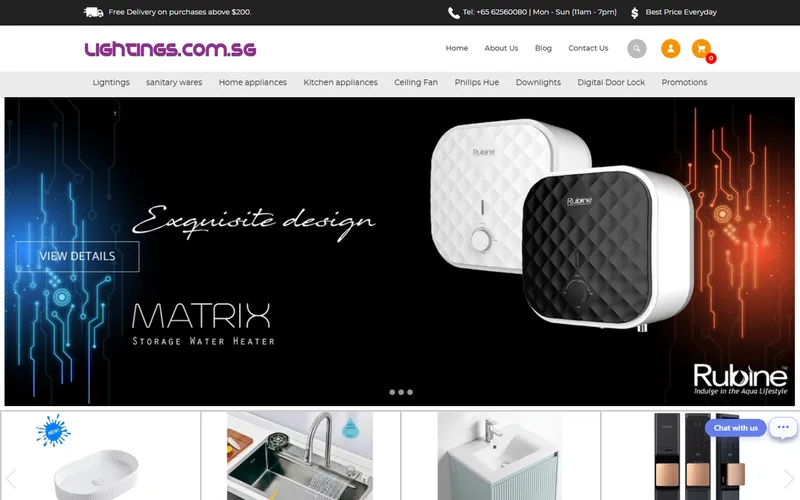
Prices span most of the market in one place: LED bulbs from S$7.90 to S$89, wall lamps around S$80, and spotlights climbing to S$899 at the top. Having that spread under one roof is genuinely useful, because the honest way to buy lighting is to see the S$80 version and the S$400 version side by side and work out whether the difference shows once the light is on. Frequently it does not.
Three showrooms also means you can plan around where you actually are. The Balestier branch puts you on the lighting street, so you can compare against the neighbouring shops in the same afternoon, which is the single best way to buy fixtures in Singapore.
- Best for
- Seeing the whole price ladder in one visit
- Range
- LED bulbs S$7.90 to S$89, spotlights to S$899, over 1,000 items
- Showrooms
- Balestier, Ubi and Jalan Berseh
- Website
- lightings.com.sg
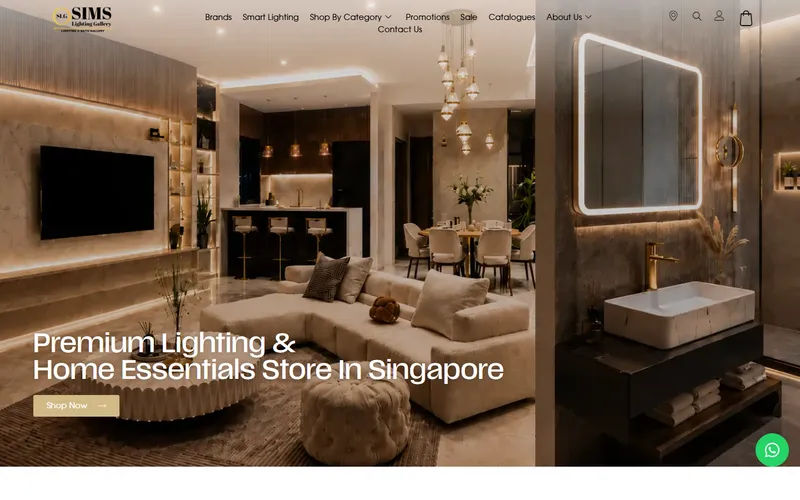
Fans start around S$150 and pendants run to about S$399, with tri-tone dimmer fittings around S$319. The tri-tone point is worth pausing on: a fitting that switches between warm, neutral and cool at the wall lets you postpone a decision you may not be able to make from a showroom. Showroom lighting is bright and neutral, your flat at 9pm is not, and being able to change your mind afterward is worth a small premium.
Buying the fan and the light together is also where the discounting lives. If you need four fans and a dozen fittings, that is a bundle conversation, and it will get you further than haggling over a single pendant.
- Best for
- Buying fans and lighting as one bundle
- Range
- Fans from about S$150, pendants to about S$399, tri-tone dimmers around S$319
- Outlets
- Jurong, Balestier, Woodlands, Boon Lay
- Website
- simslightinggallerysg.com
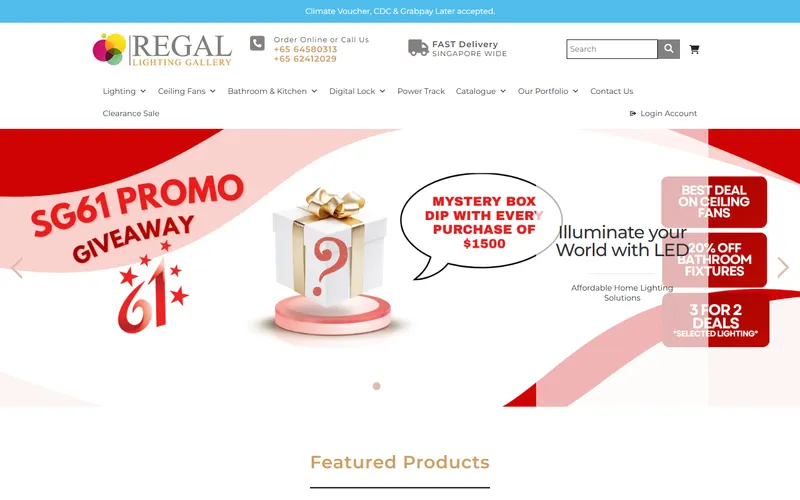
This is the shop to know if your budget is tight, because it is where the arithmetic works. A flat needs a lot of downlights, and the difference between S$29 and S$80 each stops being trivial once you multiply by twenty. Buy the volume items here, then spend the saving on one fitting that people will actually notice.
On style, the Scandinavian lean is a useful default for HDB and condo interiors, which tend to be compact and benefit from fittings that do not visually crowd a ceiling. A large ornate chandelier in a room with a 2.6 metre ceiling looks like it is being stored there.
- Best for
- The volume items, where the price difference multiplies
- Range
- Pendants from about S$68, ceiling fittings and downlights from about S$29
- Where
- Sin Ming Road and Senang Crescent
- Website
- regallighting.com.sg
What you are getting here is the Balestier experience, which is the reason to make the trip at all. Several lighting shops within a short walk, all with fixtures actually switched on, means you can compare a warm 3000K fitting against a 4000K one with your own eyes instead of trusting a photograph. Every product image online is colour corrected, and none of them tell you how much glare a bare shade throws at eye level.
One thing to know before you go: the Chan Huat website is currently a holding page saying it is being refreshed, so there is no online catalogue to browse and no screenshot to show you here. Treat this one as a walk-in or a phone call rather than an online shop, which is how most of Balestier works anyway.
- Best for
- Walking in and seeing fixtures lit, rather than browsing online
- Range
- Ceiling fittings about S$32 to S$490, LED lamps from about S$5.05
- Where
- Three shops on Balestier Road
- Website
- chanhuat.com.sg (currently a holding page)
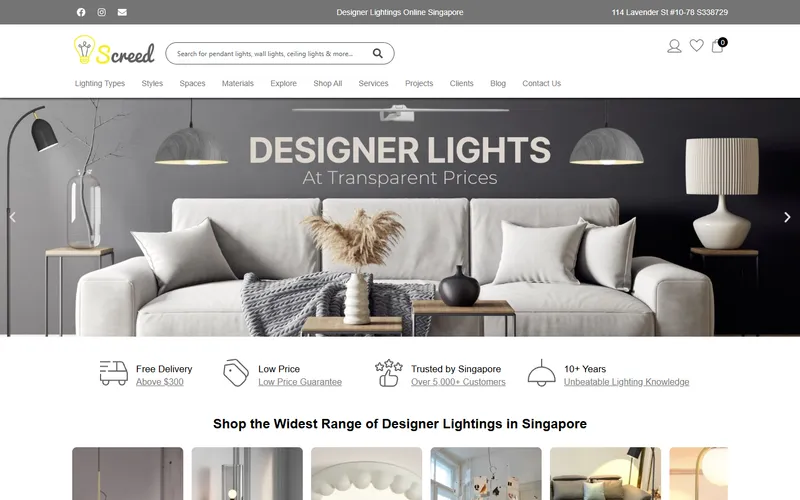
The useful thing about that range is where it stops. Genuine design-led lighting normally starts where this shop finishes, so a considered pendant at S$300 rather than S$1,500 is a real option for someone doing a normal flat on a normal budget. You are not buying an archive piece, and for most homes that was never the point.
Use it for the one or two fixtures that carry a room, the dining pendant above all. That is the light people sit under and look at for two hours at a time, and it is the only fitting in most homes where spending four times the base price genuinely shows.
- Best for
- The dining pendant, and other fixtures people actually look at
- Range
- Pendants S$88 to S$638, ceiling S$68 to S$488, wall S$68 to S$358
- Where
- 114 Lavender Street
- Website
- screed.com.sg
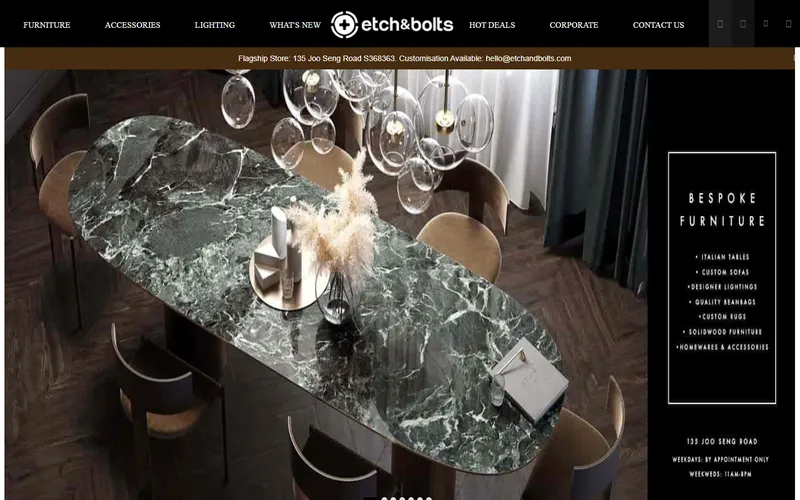
Custom is worth understanding rather than dismissing. It is not only for people spending freely. The commonest reason to commission a fixture in Singapore is dimension: a dining table longer than the standard pendant span, an awkward stairwell drop, a ceiling height that makes every off-the-shelf option either too short to read as intentional or long enough to hit someone. Those are geometry problems, and geometry problems are what custom solves.
At the top of the range you are into statement territory, which suits a double-volume space or a landed stairwell and is overkill in a standard flat. Match the fixture to the ceiling you actually have.
- Best for
- Awkward spans and drops that no standard fitting solves
- Range
- Table lamps S$30 to S$499, pendants S$139 to S$1,699
- Where
- 135 Joo Seng Road
- Website
- etchandbolts.com
Usually not the fixtures, only the points. Renovation packages itemise electrical work by point, meaning the wiring and position for a light or a socket, and a basic HDB package might include around ten lighting points along with three or four double socket points. The lamps you hang on those points are typically a separate purchase.
The number is the part that catches people out. Three or four double sockets is nowhere near enough for a home with an air fryer, a router, a coffee machine and several charging points, and adding sockets, relocating lighting points or rewiring old circuits is almost always billed per point on top of the package price. Electrical works commonly land at S$3,000 to S$5,500 on a four-room flat once that is done.
So ask two questions before you sign. How many lighting and socket points does this include, and does the price cover fittings or positions only? Then walk each room and count what you will genuinely need. Adding a point during the electrical stage is cheap. Adding one after the ceiling and plastering are finished is a different job at a different price.
Colour temperature is measured in kelvin and it changes how a room feels more than the fixture ever will. As a working rule: 2700K to 3000K, warm white, for living rooms and bedrooms. 4000K, neutral or cool white, for kitchens, bathrooms and study desks where you want to see clearly. 6500K, daylight, only where you need clinical brightness, such as a utility area or a workbench.
The common mistake in Singapore homes is 6500K everywhere, which is the default many older flats came with. It is efficient and it is bright, and it also makes a living room feel like a corridor at nine in the evening. If a room feels somehow uncomfortable and you cannot say why, the temperature is the first thing to check, and it is usually a bulb swap rather than a renovation.
Two refinements worth knowing. Keep the temperature consistent within a single open space, because a warm living area running into a cool dining area reads as a mistake even to people who cannot name it. And if you are unsure, buy tri-colour fittings, which switch between warm, neutral and cool at the wall and let you decide once you are actually living there.
Balestier Road. It has been the informal lighting district for decades, and several of the shops in this guide have a Balestier address, including branches of Lightings.com.sg, Sims Lighting Gallery and all three Chan Huat shops.
Going in person is worth an afternoon for one reason: fixtures are switched on. A product photograph is colour corrected and shot in isolation, so it will not tell you how warm a fitting genuinely looks, how much glare an open shade throws at eye level, or whether a pendant that seemed elegant online is actually enormous. All three become obvious in about four seconds when the thing is hanging in front of you.
Take the measurements with you: ceiling height, dining table length, and the distance from the light point to where people will sit. Most bad lighting purchases in Singapore are not bad taste, they are the wrong size for the room, and a shop assistant can only save you from that if you can tell them the numbers. If the table itself is still undecided, buy it first, because the pendant follows the table and not the other way round. My guide to the best dining table shops in Singapore covers the sizes.
If you want one shop that will not go wrong, Lightcraft, trading since 1977 and carrying brands you can still rebuy from in five years. If you do not yet know what you want, Lightings.com.sg, where the whole price ladder from S$7.90 bulbs to S$899 spotlights sits in one showroom.
For fans and lights as a single bundle, Sims Lighting Gallery. For the twenty downlights where price multiplies, Regal Lighting from about S$29. For the Balestier walk-in experience, Chan Huat, though go in person because the website is a holding page right now. For the dining pendant that carries the room, Screed. For a span or a drop that no standard fitting solves, Etch&Bolts.
And do the cheap thing first. Before spending anything, change the bulbs in your worst room from 6500K to 3000K and live with it for a week. It costs about twenty dollars and it fixes more homes than a new fixture does.
A closing note for the shops. Almost every business on this page publishes real price ranges, which is why they could be compared at all, and the two that could not be captured here are the two a reader cannot browse at midnight. In a category where people are buying twenty items at once and comparing across three shops, the site that shows prices and stock wins the trip. If your website is the weak link, that is fixable, and it happens to be my day job. Take a look at my web design services in Singapore, or get a quote and I will tell you honestly what I would change.
The other purchase that has to clear the same lift door is the furniture. My guide to the best furniture stores in Singapore covers the HDB lift and doorway measurements that decide what actually fits, and why indent orders take months.