


Terris Recommends 16,400+ monthly visitors Home Services
8 Best CCTV Installation Companies in Singapore (August 2026)
My honest pick of the best CCTV installation Singapore companies in 2026, plus the HDB corridor camera rules that changed in 2023 and real package prices.
This guide is part of Terris Recommends, my researched, hands-on picks of the best local businesses and services in Singapore. Every recommendation is researched and ranked by me.
See all recommendationsMost people researching CCTV installation in Singapore start with the wrong question. They ask which camera to buy, when the two things that actually decide whether the install works out are legal, not technical: whether you are allowed to point the camera where you want it, and whether the company you hire is licensed to fit it at all.
Both have clear answers, and both are widely misreported. Since May 2023, HDB flat owners no longer need HDB approval to install a corridor-facing camera at their own unit, yet I still found installers in 2026 telling homeowners to apply. And under the Private Security Industry Act 2007, any company installing, maintaining or repairing security equipment needs a Security Service Provider licence from the police, which is a real, checkable credential that plenty of one-van operators do not hold.
So this list is built on licensing and price transparency, with the rules laid out first so you know what you are buying before anyone quotes you. Eight companies, from a security engineering firm that has been going since 1982 to the installers that publish their package prices openly. If you are securing the entrance generally, read it alongside my guides to the best digital lock shops and the best smart home installers in Singapore.
The headline change is simple and still not widely known. From May 2023, HDB flat owners no longer need to seek HDB approval to install a corridor-facing CCTV camera within their own home. If an installer tells you to submit an HDB application for a camera at your own front door, they are working from a pre-2023 script.
What did not change is who controls the common areas. Town Councils still regulate devices monitoring shared spaces such as lifts, staircases and shared landings, and those generally need a temporary permit, often granted after a police report in a harassment or vandalism case. Ang Mo Kio Town Council, for example, requires residents to remove such cameras after six months. So a camera on your own door frame is your business, and a camera watching the lift lobby is the Town Council's.
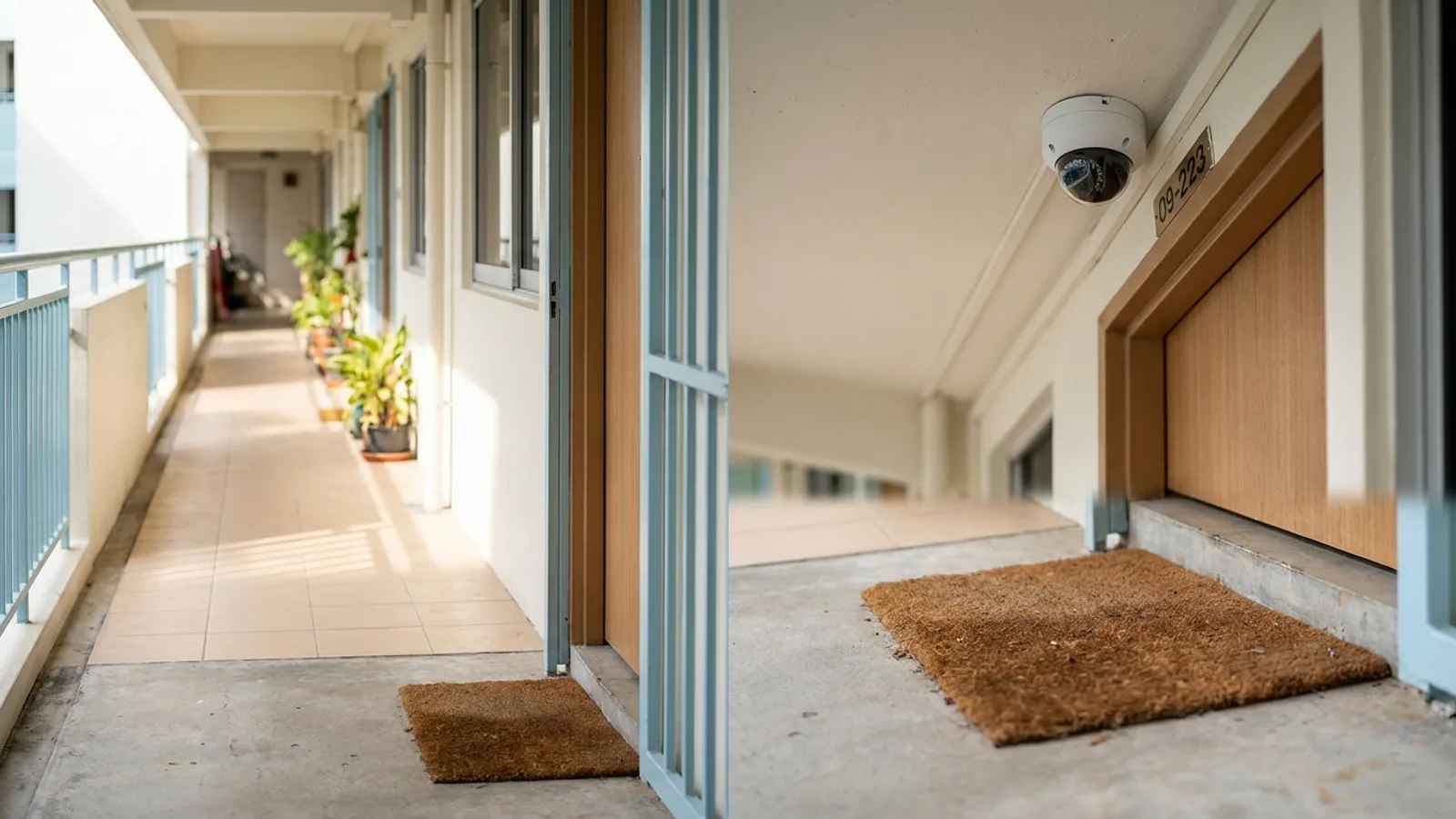
The rule that actually causes trouble is aim. Your camera has to cover your own doorstep, not your neighbour's. Pointing it directly at a neighbouring door or window is where this turns into a dispute, and the Community Disputes Resolution Tribunal can order removal and award compensation of up to $20,000. Keep the installation tidy, do not obstruct the corridor, and angle the camera down at your own mat. A good installer will raise this before you have to.
One more thing for anyone recording beyond a private home. Under the Personal Data Protection Act, CCTV footage that identifies individuals is personal data, so businesses have obligations around notification and handling, including clear signage at entry points stating that recording is taking place and whether audio is captured too. The Personal Data Protection Commission publishes the guidance. A shop or office install that skips the signage is not compliant, however good the cameras are.
This is the filter that separates the eight companies below from the long tail of handymen who will happily drill a camera into your wall. Under the Private Security Industry Act 2007, a company that installs, maintains, repairs, services, designs or sells security equipment is providing a security service, and that requires a Security Service Provider licence issued by the Police Licensing and Regulatory Department, the PLRD, under the Singapore Police Force.
It is a real licence with real conditions, not a self-awarded badge. Since 15 September 2025 these licences run for three years. The reputable operators know this and say so plainly: Lion Securisia describes itself as an SPF-licensed security integrator, and Huntaway states compliance with the Private Security Industry Act on its own site. That is the language you are looking for.
So ask one question before you book: what is your PLRD Security Service Provider licence number? A licensed company answers immediately, because it is on its paperwork. An unlicensed one will change the subject to camera resolution. You can confirm what the licence covers through the Singapore Police Force security agency licensing pages and the GoBusiness licence directory.
Why it matters beyond compliance: a licensed integrator is accountable to a regulator for how it handles your footage and your premises. An unlicensed installer has your recorder credentials, your camera angles and your absence patterns, with nobody supervising any of it. For a device whose entire purpose is security, hiring the unregulated option is a strange trade.
The single biggest technical choice is how the cameras connect, and it decides reliability more than megapixels do.
PoE, or Power over Ethernet, runs one network cable per camera carrying both data and power back to a recorder. It is the standard for anything you genuinely rely on: the video is high definition and consistent, the connection does not drop when someone streams a film, recording is centralised on an NVR in your flat, and adding cameras later is straightforward. The cost is the cabling work and a PoE switch, typically $100 to $400 on top.
Wifi cameras are cheaper, quicker to fit and need no cabling, which makes them tempting for a rental or a single spot check. The problem is that performance tracks your wifi strength, and along an HDB corridor, through a fire-rated main door, that signal is often poor exactly where you want the camera. Worse, a wifi camera goes blind the moment the router does, and anyone cutting power to a flat takes the cameras with it. Cloud subscriptions add a monthly cost that a local NVR does not.
My rule: wifi for convenience monitoring inside the home, PoE for anything covering an entrance. And whichever you choose, ask about storage. A recorder ships with a hard disk sized for a retention window, usually around 30 days, and that window is what determines whether footage still exists by the time you realise you need it.
Founded in 2010 and based at Bukit Batok, it covers CCTV installation, burglar alarms, door access and ongoing maintenance and servicing across homes and businesses. The maintenance side matters more than people expect: cameras drift out of alignment, hard disks fail silently, and a system nobody has checked in three years is decoration. Reviews highlight technical competence and responsive support rather than the cheapest quote.
It is a mid-sized operator rather than a large integrator, so for a multi-site commercial rollout the bigger firms below may suit better. For an HDB flat, a condo or a shophouse where you want someone who will tell you honestly where the camera can and cannot point, this is who I would call first.
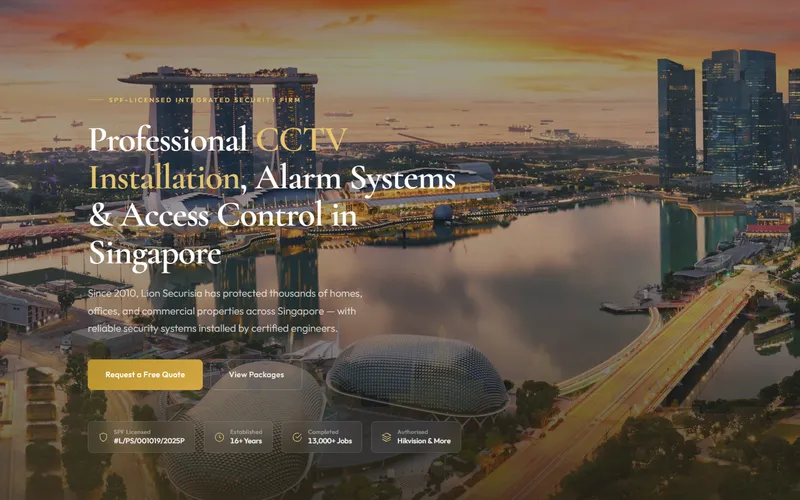
- Best known for
- Leading with its SPF security integrator licence and getting the HDB corridor rules right
- Location
- 375 Bukit Batok Street 31 #02-128
- Website
- lionsecurisia.com.sg
The scope is genuinely end to end: CCTV, access control, alarm systems, automatic gates and barrier systems, plus manned security guard services, across commercial, industrial, residential and government sectors. Government and industrial work is a useful signal here, because those clients audit their vendors properly and will not engage an unlicensed integrator.
The trade-off is that this is a commercial-first engineering firm, so a single-camera HDB job is small work for them and you should not expect the fastest turnaround or the sharpest consumer price. If you are securing a landed property, a factory, an MCST development or an office, this is the entry with the deepest bench.
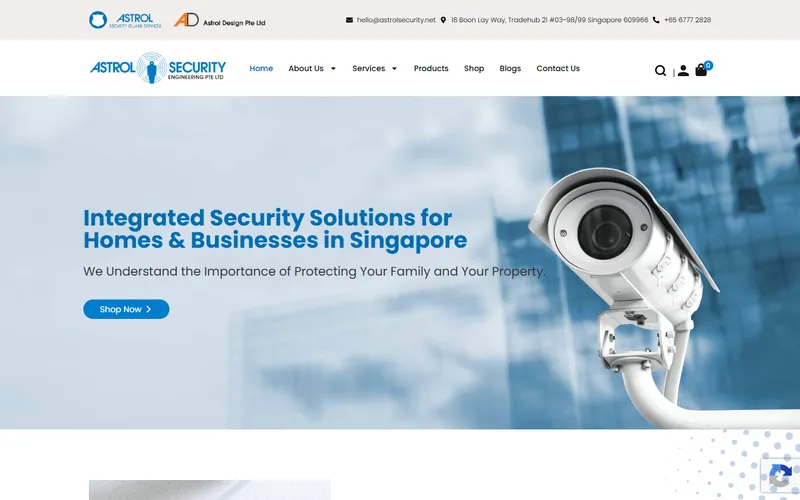
- Best known for
- Operating since 1982 across CCTV, access control, alarms, gates and manned guarding
- Location
- Singapore, serving islandwide
- Website
- astrolsecurity.net
Each package includes a hard disk sized for roughly a month of footage, and that spec being published is exactly the kind of detail that gets vague elsewhere. It states compliance with the Private Security Industry Act 2007 and recognition by the Singapore Police Force, which is the licensing box ticked.
The two-year warranty is above the one-year that several competitors offer on package deals, and worth weighing against a slightly lower headline quote. Read the separation of hardware price from wiring carefully though: a cheap package with expensive cabling is not a cheap system, so ask for the all-in number after the site survey.
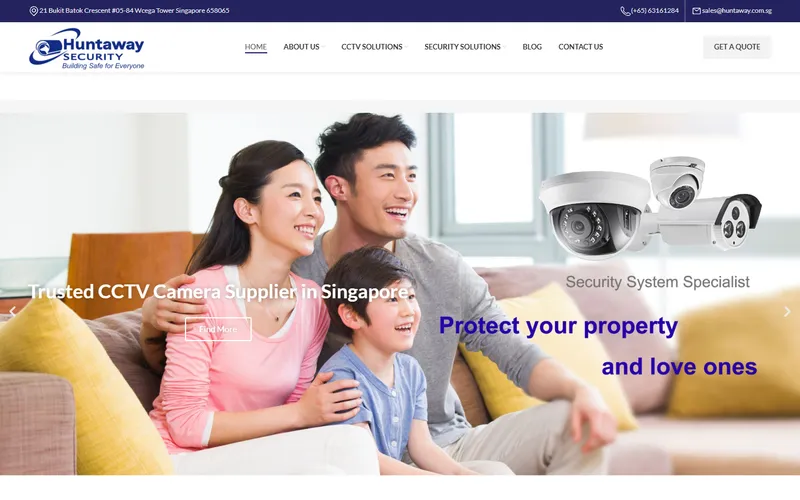
- Best known for
- Published package prices from $500 to $1,500, a free site survey and a two-year warranty
- Location
- Singapore, serving islandwide
- Website
- huntaway.com.sg
The product line centres on Hikvision IP cameras specified as Singapore Police security compliant, alongside access control, alarm systems, public address and telephone systems, with servicing and maintenance of all of it. That breadth suits an office or a shop where the cameras are one part of a larger fit-out rather than a standalone purchase.
Worth a note on the brand choice. Hikvision and Dahua dominate the Singapore market on price and features, and they are what most installers here fit. Some buyers, particularly for commercial or government-adjacent work, have procurement policies that exclude those brands, so if that applies to you, raise it at the quote stage rather than after the cameras arrive.
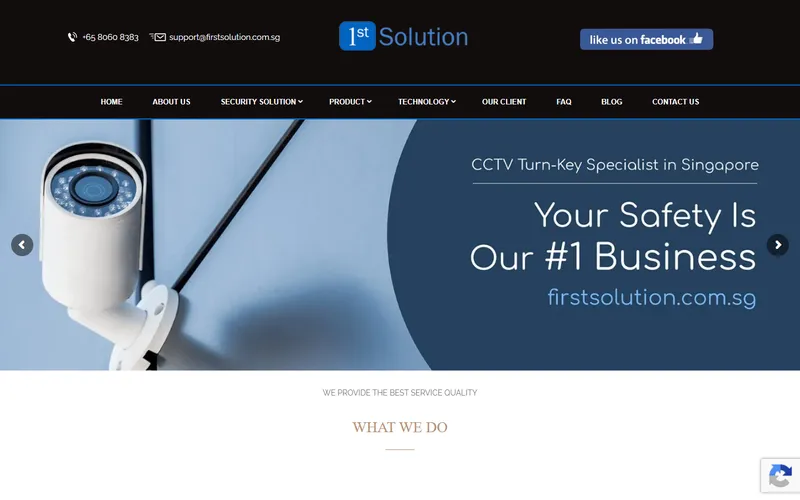
- Best known for
- Since 2010, institutional clients including SMRT and Nanyang Polytechnic, Hikvision IP systems
- Location
- 45 Kallang Pudding Road #09-02, Alpha Building
- Website
- firstsolution.com.sg
That mix makes it a natural fit for small offices and shophouses, where the actual requirement is usually a few cameras plus a door lock plus somewhere to keep the cash, and sourcing all three from one supplier means one installation visit and one number to call when something fails.
For a straightforward four-camera HDB install it is not obviously cheaper than the package specialists, and you should ask for the itemised quote rather than a bundle price so you can compare like for like. But the solar option and the safes are real differentiators that nobody else on this list matches.
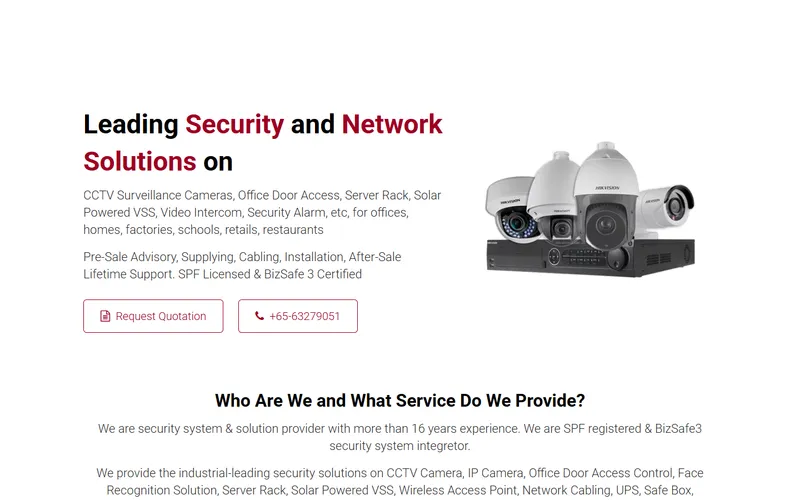
- Best known for
- CCTV alongside safes, EM locks and UPS, plus solar-powered CCTV for sites without power
- Location
- Singapore, serving islandwide
- Website
- safetrolley.com
If you manage a condo, a commercial building or a multi-tenant property, that framing is the correct one and the alternative is expensive. Buildings that buy cameras from one vendor, door access from another and an intercom from a third end up with three apps, three maintenance contracts and no single view when something happens, which is exactly the situation a security system is supposed to prevent.
For a single HDB flat this is over-specified and you will be better served by the package operators above. Its lane is genuinely the integration work, so match it to a job that has integration in it.
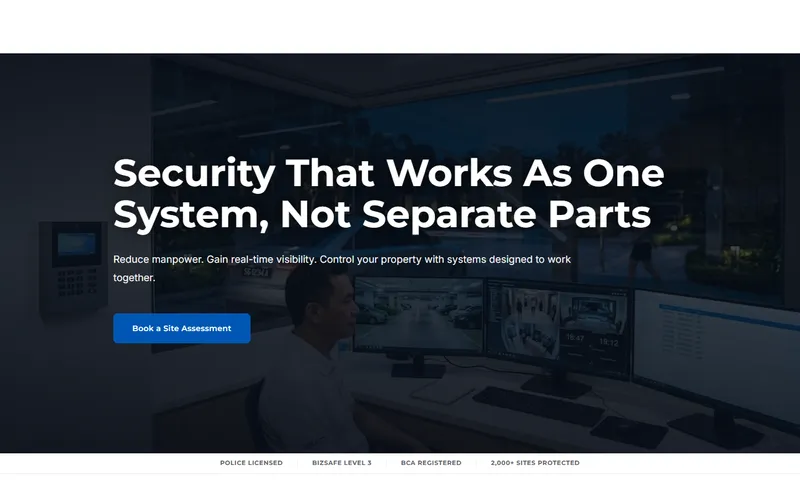
- Best known for
- Integrated systems for managing agents and facility managers rather than one-off camera installs
- Location
- Singapore, serving islandwide
- Website
- securevision.com.sg
The offering is the mainstream one, home and business camera systems with recorders and remote viewing, and it sits in the middle of the market on price. Fourteen years of continuous trading is a decent proxy for the thing you cannot verify directly, which is whether anyone will still be there to service the system in 2031.
Its website sits behind a bot-protection wall, so I could not capture a homepage preview for this entry the way I did for the others. Nothing sinister, plenty of legitimate sites do it, but it is why this entry has no screenshot. Ask for the PLRD licence number when you enquire, as with everyone here.
- Best known for
- Trading since 2011, with after-sales support that reviewers single out
- Location
- Singapore, serving islandwide
- Website
- cctvsg.net
The structured cabling and server side is the differentiator. Plenty of CCTV firms will run a cable to a camera and stop there; fewer will do the whole network properly, and for an office where the cameras, the door access and the data all share infrastructure, having one contractor who understands all three avoids the finger-pointing that follows when something drops out.
It also publishes a clear guide on installing cameras legally in Singapore, which is a small thing but a good sign: an installer that has bothered to read the rules is an installer less likely to point your camera at a neighbour's door and leave you with the tribunal case. For a Yishun, Sembawang or Woodlands job, this is the local call.
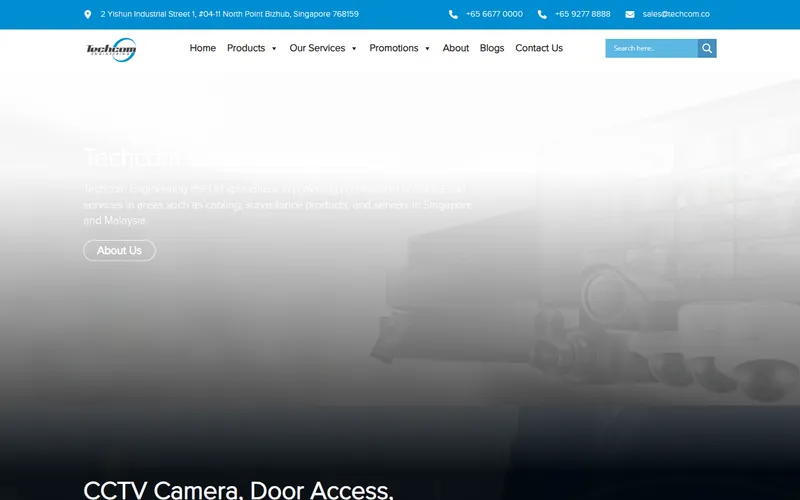
- Best known for
- CCTV plus structured cabling and servers, across Singapore and Malaysia
- Location
- 2 Yishun Industrial Street 1, #04-11 North Point Bizhub
- Website
- cctvcamera.sg
| Company | Since | Published pricing | Strongest lane | Best for |
|---|---|---|---|---|
| Lion Securisia | 2010 | On request | Home and shophouse | Licensing clarity and correct HDB advice |
| Astrol Security | 1982 | On request | Commercial and industrial | Longest track record, full security scope |
| Huntaway Security | Established | $500 to $1,500 packages | Home and small office | Knowing the price before the site visit |
| 1st Solution Group | 2010 | Promotional packages | Office and retail | Institutional references, Hikvision IP |
| SafeTrolley | Established | On request | Small business | Solar CCTV, safes and EM locks together |
| Securevision | Established | On request | Managed buildings | Integrating CCTV with access and intercom |
| CCTV Singapore | 2011 | On request | Home and business | After-sales support |
| Techcom Engineering | Established | On request | Office and industrial | Cabling and servers alongside cameras |
CCTV installation in Singapore costs about $500 to $1,500 for a typical home or small office system installed. A four-camera dome package with recorder, cabling and a year of warranty lands around $850. Recorders alone start near $500, and PoE installs add roughly $100 to $400 for the switch and additional cabling.
These are the 2026 bands across the companies here. The variables that move the number are camera count, resolution, whether you want infrared or PTZ, and how difficult the cable runs are, which is why every decent installer insists on a site survey before committing.
| Setup | Typical installed price | Notes |
|---|---|---|
| Single entrance camera (HDB) | $250 to $450 | Wifi or single PoE run |
| 3-camera package | From $500 | Recorder and HDD included |
| 4-camera dome package | Around $850 | Includes cabling, recorder, 1-year warranty |
| 8-camera system | $900 to $1,300 | Typical shophouse or landed setup |
| 16-camera system | Up to $1,500 plus wiring | Small office or multi-unit |
| PoE switch and extra cabling | $100 to $400 | Usually quoted separately |
| 4K, PTZ or long-range infrared | Add $150 to $500 per camera | Rarely needed for a doorway |
Two costs people forget. Hard disk capacity determines how long footage survives, usually around 30 days, and a larger disk is far cheaper bought now than after an incident. And ongoing maintenance is a real line item: a system nobody services will have a failed disk or a drifted camera within a few years, and you will find out at the worst possible moment.
If you are shopping for CCTV installation in Singapore, this is the order I would work in. The first two steps are the ones that separate a good outcome from an expensive dispute.
- Ask for the PLRD licence number. Under the Private Security Industry Act 2007, installing and maintaining security equipment requires a Security Service Provider licence from the police. Check the scope on the GoBusiness licence directory. A licensed firm answers this in one message.
- Settle the camera angle before the quote. Your camera covers your doorstep, not a neighbour's door or window. Get the installer to show you the intended field of view. The Community Disputes Resolution Tribunal can order removal and award up to $20,000, and that is a far more expensive mistake than picking the wrong camera.
- Check whether a Town Council permit is involved. Not for a camera at your own unit, which has needed no HDB approval since May 2023. Yes for anything watching a lift, staircase or shared landing, where permits are often temporary.
- Insist on a site survey before the price. Cable runs are the real cost driver, and a quote given over the phone will be revised on the day. A free survey is standard among the companies here.
- Choose PoE for entrances. Wifi cameras fail when the router does, and corridor signal through a fire-rated door is usually poor. Budget the switch and cabling rather than discovering it later.
- Ask what the storage retention actually is. Get the number in days for your camera count and resolution, not "one month" as a slogan. This decides whether footage still exists when you need it.
- Agree the maintenance terms. Warranty length, whether callouts are included, and what a service visit costs after the warranty ends. Two years beats one, but only if the callout is covered.
- For business premises, plan the PDPA signage. Recording identifiable people is personal data. Clear notices at entry points, stating whether audio is captured, are part of the install, not an afterthought.
One habit worth keeping after installation: log in and check the recording every few months, and confirm you can actually export a clip. Almost nobody does this, and the moment you need it is not the moment to learn the interface.
I started with the regulation, because in this category the two most consequential facts are legal rather than technical, and both are widely misreported. Establishing the post-2023 HDB position and the PLRD licensing requirement first meant I could rank on whether a company reflects the current rules accurately, which turned out to be a surprisingly effective filter.
From there I checked every installer ranking for the main Singapore search terms, verified each domain was live, and confirmed founding years, addresses and service scope against the companies' own published material. Companies that still tell homeowners to seek HDB approval for a camera at their own door did not make the list, because if the rules page is three years stale, the advice at your door will be too.
Where a company publishes package pricing, I have quoted it and said so, because price transparency is rare here and worth rewarding. Where pricing is quote-only, the table says so rather than inventing a range. Two companies also market related trades under group brands, so as always, confirm who is actually being dispatched.
One practical note on the list itself: CCTV Singapore's website sits behind a bot-protection wall, so unlike the other seven it has no homepage preview here. That has no bearing on the recommendation. Prices are August 2026 bands for comparison, not quotes, and every one of these firms will want a site survey before committing.
You do not need HDB approval to install a corridor-facing CCTV camera at your own HDB unit. That requirement was removed in May 2023, so a camera fitted within your home and covering your own doorstep can go up without an application. Any installer still telling you to submit an HDB application for this is working from outdated guidance.
Town Council permission is a separate matter and still applies to cameras monitoring common areas such as lifts, staircases and shared landings. Those permits are often temporary, sometimes around six months, and are usually granted in connection with a police report. Your camera must also not point directly at a neighbour's door or windows.
Your neighbour can install a corridor-facing camera at their own unit without HDB approval, but it must cover their own doorstep rather than point directly at your door or windows. If it does, that is a private nuisance you can act on, and the Community Disputes Resolution Tribunal can order the camera removed or repositioned and award compensation of up to $20,000.
Start with a conversation, because most cases are careless aiming rather than surveillance, and repositioning takes an installer ten minutes. If that fails, the Community Mediation Centre is the usual next step before the tribunal. Photograph the camera position and field of view first, since that is the evidence the process turns on.
PoE is better for any camera covering an entrance. It runs one cable per camera carrying both power and data, so the video stays high definition and stable, recording is centralised on an NVR in your home, and the system keeps working when the wifi does not. The extra cost is roughly $100 to $400 for the switch and cabling.
Wifi cameras suit convenience monitoring inside the home, a nursery or a living room, where cabling is a nuisance and an occasional dropout does not matter. Their weaknesses are specific: performance tracks wifi strength, which is often poor along an HDB corridor through a fire-rated door, and the camera goes blind whenever the router loses power.
Most home CCTV systems in Singapore store around 30 days of footage, because installers size the recorder's hard disk for roughly a month at the camera count and resolution supplied. After that the system overwrites the oldest recordings automatically. More cameras or higher resolution shorten that window considerably.
Ask for the retention figure in days for your specific setup rather than accepting "about a month", and consider a larger disk at installation, since it costs far less then than a retrofit. If footage matters for an incident, export the clip immediately rather than assuming it will still be there next week.
The company doing the work needs one, not you. Under the Private Security Industry Act 2007, installing, maintaining, repairing or servicing security equipment is a regulated security service, requiring a Security Service Provider licence issued by the Police Licensing and Regulatory Department under the Singapore Police Force. Since 15 September 2025 these licences run three years.
What you carry as a business is the data obligation. CCTV footage identifying individuals is personal data under the PDPA, so you need clear signage at entry points stating that recording is taking place, including whether audio is captured, and you must handle and retain the footage accordingly. Ask your installer for its licence number and handle the signage before you switch the system on.
For a home, a condo or a shophouse, start with Lion Securisia. It leads with its SPF security integrator licence and it is one of the few that states the HDB corridor rules correctly, which is exactly the judgement you are hiring. If you want the price before the site visit, Huntaway Security publishes packages from $500 to $1,500 with a two-year warranty, which is the most transparent offer here.
For commercial, industrial or government-adjacent work, Astrol Security has been operating since 1982 and covers the full security scope including manned guarding. 1st Solution Group is the office and retail pick with institutional references behind it, Securevision the one for managed buildings that need CCTV, access control and intercoms working as one system, and Techcom Engineering the north-side choice when cabling and servers are part of the job. SafeTrolley covers the odd requirements, solar-powered cameras and safes, and CCTV Singapore has fourteen years of after-sales history behind it.
Whoever you choose, do three things: ask for the PLRD licence number, agree the camera angle before the quote so it covers your doormat and not your neighbour's door, and ask how many days of footage you actually get. The rest is negotiable. My guides to the best digital lock shops, the best locksmiths and the best smart home installers in Singapore cover the rest of the entrance.
And a note for the trade. This category is won on being the company that explains the rules correctly, and right now most of the sites ranking for these searches are still repeating a requirement HDB dropped in 2023. Fixing that gap is the cheapest marketing available to a security firm, and it happens to be my day job. Have a look at my web design services in Singapore, or get a quote and I will tell you honestly what would move the needle.