
If your credit card and personal loan balances have crept up and the minimum payments are barely denting them, a debt consolidation plan in Singapore is often the sensible next move. It replaces several high-interest debts with one facility at a much lower rate, so you make a single monthly repayment and can actually see the balance falling. The trick is knowing whether you qualify, and which bank gives you the best terms.
The Debt Consolidation Plan, or DCP, is not a marketing product a bank dreamed up. It is a scheme regulated by the Monetary Authority of Singapore and offered by participating banks under common rules. You generally qualify if you are a Singaporean or permanent resident earning between S$30,000 and S$120,000 a year, with total interest-bearing unsecured debt above twelve times your monthly income. I will explain who it suits, how a DCP differs from a balance transfer or a plain personal loan, and, just as important, what to do if you do not qualify.
This is part of my Terris Recommends Finance and Insurance series, and it is general information, not financial advice. It pairs with my guides to financial advisers and insurance brokers.
Key Takeaways
- 1 A Debt Consolidation Plan, or DCP, is a MAS-regulated scheme offered by participating banks that rolls all your unsecured debt into one facility at a lower interest rate with a single monthly repayment.
- 2 To qualify you generally need to be a Singaporean or PR earning S$30,000 to S$120,000 a year, with total interest-bearing unsecured debt of more than 12 times your monthly income and net personal assets below S$2 million.
- 3 A DCP is not the same as a balance transfer or a fresh personal loan. It is purpose-built for people whose card and loan balances have grown beyond a comfortable level.
- 4 Standard Chartered and HSBC tend to lead on the lowest indicative EIR and the longest tenure, while HSBC, UOB and OCBC often waive the processing fee. Always confirm the current rate before applying. Jump to Standard Chartered
- 5 If you do not qualify, or you are already in serious arrears, the answer is not another loan. Speak to Credit Counselling Singapore about its Debt Management Programme. This is general information, not financial advice.
What I look for in a debt consolidation plan in Singapore
Before you compare banks, get these things straight, in this order.
- Whether a DCP is even the right tool. The DCP is a MAS-regulated scheme for people whose unsecured debt has grown beyond a comfortable level. If your debt is small and short-term, a balance transfer may be cheaper. If it is already in serious arrears, a loan is the wrong answer entirely.
- The effective interest rate, not the headline rate. Banks advertise a low flat or promotional rate, but the EIR, which includes the processing fee and how interest is charged, is the number that lets you compare like for like. Always ask for the EIR.
- The processing fee and the tenure. Some banks waive the fee, others charge S$99 to S$300. A longer tenure lowers the monthly payment but raises the total interest you pay. Match the tenure to what you can realistically afford, not the smallest possible instalment.
- Whether you qualify. The income band, the citizenship rule and the twelve-times-monthly-income debt threshold are set by the scheme. If you sit outside them, no amount of shopping around will help.
- The alternative if you do not qualify. If a DCP is not open to you, or you are already missing payments, the route is Credit Counselling Singapore and its Debt Management Programme, which negotiates a repayment arrangement with your creditors rather than lending you more.
One tip: the government's MoneySense site has neutral guidance on managing debt and on the DCP scheme, and is a good place to read up before you apply for anything.
How the best debt consolidation plans in Singapore compare
These are indicative figures, and banks change their rates and promotions often, so treat this as a starting point and confirm the current EIR directly with the bank.
| Bank | Indicative EIR | Processing fee | Max tenure |
|---|---|---|---|
| DBS / POSB | From about 8% p.a. | Around S$99 | Up to 8 years |
| Standard Chartered | From about 6.5% p.a. | Around S$199 | Up to 10 years |
| HSBC | From about 7.5% p.a. | S$0 typically | Up to 10 years |
| UOB | From about 8% p.a. | S$0 typically | Up to 8 years |
| OCBC | From about 8% p.a. | S$0 typically | Up to 8 years |
| Maybank | Mid to high single digits | Varies, confirm | Up to 10 years |
| CIMB | High single digits | Varies, confirm | Up to 8 years |
| Hong Leong Finance | Indicative, confirm | Varies, confirm | Up to 10 years |
The market EIR for a DCP generally sits somewhere between roughly 7% and 11% per year, which is a world away from the 26% to 28% per year that revolving credit card balances attract. That gap is the whole point of consolidating.
How much does a debt consolidation plan save in Singapore?
Here is an illustration of consolidating S$50,000 of card debt. These are rounded figures for comparison only, not a quote, and your actual EIR and instalment will depend on the bank and your profile.
| Option | Rough monthly cost | What happens |
|---|---|---|
| Cards revolving at about 26% p.a. | Around S$1,100 in interest alone | Barely touches the principal, can drag on for years |
| DCP at about 8% EIR over 5 years | Around S$1,010 total instalment | Clears the S$50,000 in 5 years, roughly S$10,800 total interest |
| DCP at about 8% EIR over 8 years | Around S$710 total instalment | Lower monthly, but roughly S$17,800 total interest |
The lesson is twofold. First, moving off revolving card interest is the big win, because almost all of your DCP instalment goes to clearing the balance rather than feeding interest. Second, a longer tenure eases the monthly squeeze but costs you more overall, so pick the shortest tenure you can comfortably keep up.
1. DBS / POSB
Its promotional rates are usually competitive, and the processing fee sits at the modest end. For someone who wants to start with the bank they already know and keep the application simple, DBS is the sensible opening move. Compare its EIR against Standard Chartered and HSBC before you commit.
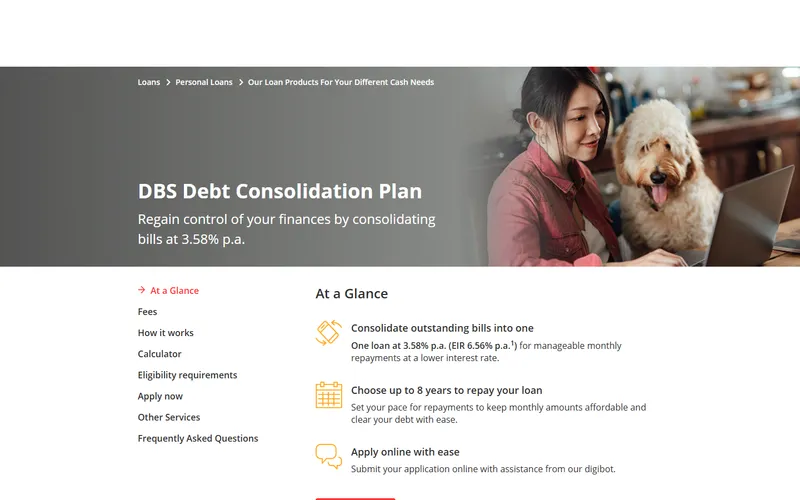
- Best known for
- The default first stop, easy digital application for existing customers
- Indicative EIR
- From about 8% p.a., confirm current
- Website
- dbs.com.sg
2. Standard Chartered
It does charge a processing fee, so factor that into the EIR rather than being drawn only by the headline rate. For a borrower with a larger balance who wants both a low rate and a long runway to repay, Standard Chartered is a strong choice worth pricing against HSBC.
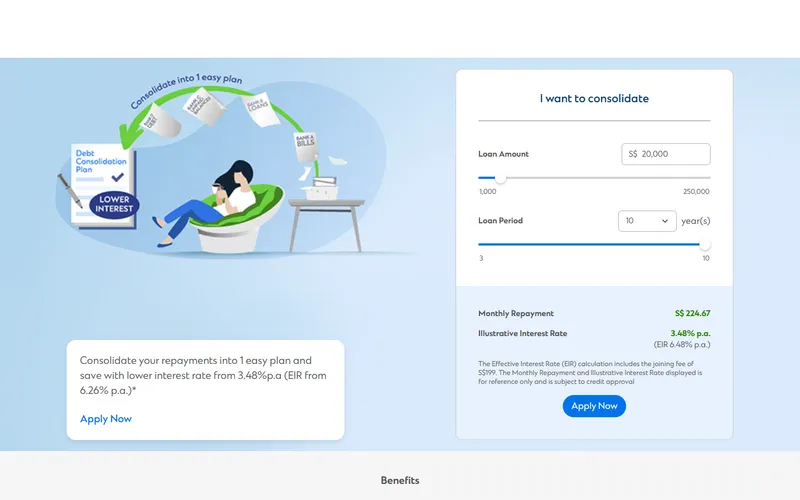
- Best known for
- Among the lowest advertised rates and the longest tenure, up to 10 years
- Indicative EIR
- From about 6.5% p.a., confirm current
- Website
- sc.com
3. HSBC
The combination of a zero fee and a long tenure often gives HSBC a very competitive EIR once everything is counted, which is exactly why the EIR matters more than the advertised rate. For a borrower who wants a low headline cost with no fee surprises, HSBC is one to shortlist alongside Standard Chartered.
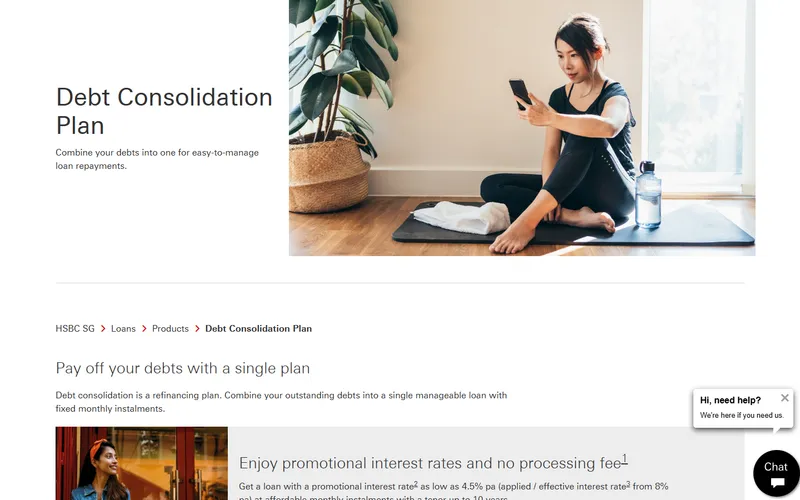
- Best known for
- Often no processing fee plus a long tenure
- Indicative EIR
- From about 7.5% p.a., confirm current
- Website
- hsbc.com.sg
4. UOB
Because UOB absorbed the former Citibank consumer business in Singapore, it now serves a very large base of cardholders, so for many people this is the bank their existing debt already sits with. For a borrower who wants a straightforward plan from a large local bank, UOB is a dependable option.
- Best known for
- Fee waivers and a large local cardholder base
- Indicative EIR
- From about 8% p.a., confirm current
- Website
- uob.com.sg
Recommended reads
5. OCBC
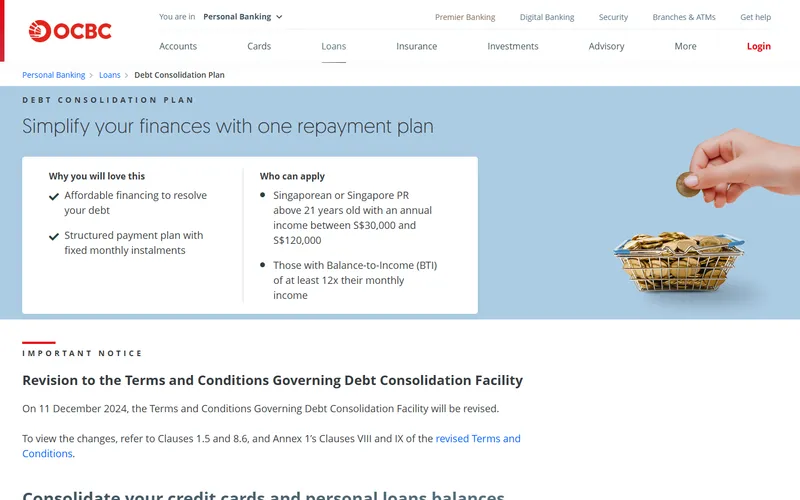
OCBC often waives the processing fee too, and as one of the three big local banks it is easy to deal with in branch or online. For a borrower who prizes a predictable, no-surprises instalment over chasing the very lowest rate, OCBC is a solid pick.
- Best known for
- A fixed, predictable monthly repayment
- Indicative EIR
- From about 8% p.a., confirm current
- Website
- ocbc.com
6. Maybank
As a large regional bank with a solid Singapore presence, Maybank is a credible alternative to the big three locals, and worth a quote if the flexibility on tenure suits your cash flow. As always, weigh the lower monthly payment against the higher total interest a long tenure brings.
- Best known for
- A long tenure of up to 10 years
- Indicative EIR
- Mid to high single digits, confirm current
- Website
- maybank2u.com.sg
7. CIMB
As a smaller player here, CIMB can be a useful benchmark when you are gathering EIR quotes to compare like for like. For a borrower who is shopping around properly and wants a genuine point of comparison, CIMB earns its place on the shortlist.
- Best known for
- A competitive challenger to benchmark the big banks against
- Indicative EIR
- High single digits, confirm current
- Website
- cimb.com.sg
8. Hong Leong Finance
For a borrower who has not had luck with the big banks, or who simply wants one more quote to compare, Hong Leong Finance is worth including. As with every option here, ask for the EIR in writing and confirm the current fee and tenure before you sign.

- Best known for
- The finance-company alternative to the banks
- Indicative EIR
- Indicative, confirm current
- Website
- hlf.com.sg
How I put this list together
I focused on the banks and finance companies that participate in the MAS Debt Consolidation Plan scheme and that most Singaporeans actually use, then compared them on the things that decide value: the effective interest rate, the processing fee and the maximum tenure. I deliberately spread the list so there is a clear low-rate leader, a fee-free option, the predictable local banks, a long-tenure choice and a finance-company alternative, because the right plan depends on your balance, your income and your cash flow.
I left out lenders that do not offer a scheme DCP, and I have not quoted precise EIRs as fixed facts because banks change them constantly. This is general information, not financial advice. Confirm the current rate, fee and tenure with the bank, and if a DCP is not the right tool for your situation, speak to Credit Counselling Singapore before taking on any new loan.
Who qualifies for a Debt Consolidation Plan in Singapore?
To qualify for a DCP you generally need to be a Singapore citizen or permanent resident, earn a gross annual income of between S$30,000 and S$120,000, and hold net personal assets of less than S$2 million. Crucially, your total interest-bearing unsecured debt across all financial institutions, meaning your credit cards and unsecured personal loans, must exceed twelve times your monthly income. That last rule is the key one: the DCP is designed for people whose unsecured debt has genuinely grown beyond a manageable level, not for tidying up a small balance. If your income or debt sits outside these bands, you will not be eligible, and a balance transfer or a plain personal loan may suit you better.
Does a DCP affect my credit score?
Applying for and holding a Debt Consolidation Plan is recorded in your credit file, so it does form part of your credit history. In the short term the application may show up as an enquiry, but the more important effect is positive over time: consolidating scattered high-interest debts into one plan you actually keep up with, and steadily reducing the balance, tends to improve your credit standing rather than harm it. What genuinely damages your score is the opposite path, missing payments and letting card balances revolve. Under the DCP rules you also close or freeze most of your other unsecured facilities while on the plan, which is deliberate, because it stops you running the balances back up while you are paying them down.
What is the difference between a DCP, a balance transfer and a personal loan?
A Debt Consolidation Plan is a MAS-regulated scheme for people whose unsecured debt is above twelve times their monthly income, and it rolls everything into one lower-interest facility over a long tenure while freezing your other cards. A balance transfer moves an existing balance onto a card or account at a very low or zero rate for a short promotional window, usually three to twelve months, and suits smaller debts you can clear quickly before the promo ends and the rate jumps. A fresh personal loan simply lends you a lump sum at a fixed rate, which you could use to pay off cards, but it does not carry the DCP scheme protections or its eligibility rules. In short: small and short-term points to a balance transfer, genuinely heavy unsecured debt points to a DCP, and a personal loan sits somewhere in between.
What if I do not qualify for a DCP or I am already in arrears?
If your debt is above the scheme limits, your income is outside the band, or you are already missing payments, then taking on another loan is usually the wrong move. The right route is Credit Counselling Singapore, a non-profit that runs a Debt Management Programme. Rather than lending you more, it reviews your income, expenses and debts, and negotiates a realistic repayment arrangement with your creditors, often with reduced interest and a structured schedule. It is free to approach, confidential, and designed for exactly the situations a commercial DCP cannot help with. If you are feeling overwhelmed by debt, that phone call is the better first step than any loan application.
Which bank has the lowest debt consolidation plan interest rate in Singapore?
Standard Chartered and HSBC tend to advertise the lowest rates on debt consolidation plans, and both offer tenures of up to ten years, while HSBC, UOB and OCBC often waive the processing fee. But the honest answer is that the lowest headline rate is not always the cheapest plan, because a bank with a low advertised rate but a S$200 fee can work out dearer than a fee-free rival. The number that lets you compare fairly is the effective interest rate, or EIR, which folds in the fee and the way interest is charged. Ask each bank for the EIR on your specific amount and tenure, and let that decide. Rates and promotions change month to month, so confirm the current figure before you apply.
Advising on money? Credibility has to show before the first call
Anyone searching for debt consolidation plans in Singapore is being careful, and they will check whether you look legitimate before they pick up the phone.
Licence details, named people with real faces, plain explanations instead of jargon. Financial firms lose enquiries to sites that feel anonymous, because being anonymous is exactly what the reader is worried about. I build websites for Singapore finance and advisory firms that make the credentials easy to verify, and the SEO to reach people at the moment they start looking.
If your site was built once and never touched again, get a quote and I will tell you what is costing you enquiries.
The best debt consolidation plan in Singapore is the one whose effective interest rate, fee and tenure fit your actual balance and cash flow, so compare the EIR rather than the headline rate. Standard Chartered and HSBC tend to lead on rate and tenure, DBS is the easy default for existing customers, and OCBC suits anyone who wants a fixed, predictable instalment. Confirm the current terms with the bank, and make sure you qualify before you apply.
Above all, remember what a DCP is for. If your debt is beyond the scheme limits or you are already in arrears, do not reach for another loan. Speak to Credit Counselling Singapore first. This guide is general information, not financial advice.
If you run a financial or professional-services business and your website is not bringing in enquiries, that is what I do. I design websites for businesses across Singapore. Get in touch for a free consultation.
Spotted something out of date in this guide?
Suggest an edit or a business to add. This guide is pre-filled for you.
Sources & References (11)
- dbs.com.sg › dbs debt consolidation plan
- sc.com › debt consolidation
- hsbc.com.sg › debt consolidation
- uob.com.sg › debt consolidation plan.page
- ocbc.com › debt consolidation.page
- maybank2u.com.sg › debt consolidation plan.page
- cimb.com.sg › debt consolidation plan
- hlf.com.sg › debt consolidation plan
- mas.gov.sg
- moneysense.gov.sg
- ccs.org.sg

Professional Opinion-haver
Terris
Chief Recommender · I do the digging so you don't have to
Terris is a Singapore-based web designer and digital strategist who has spent 8+ years building websites for local businesses. His Terris Recommends series shares personal picks for the best service providers across Singapore, informed by his experience working with businesses across industries.
Want to see these strategies in action? Browse our portfolio or get in touch to discuss your project.