

Terris Recommends 16,400+ monthly visitors Home Services
7 Best Solar Panel Installers in Singapore (August 2026)
My honest pick of the best solar panel installer Singapore options in 2026, with real per-kWp pricing and what the $0 upfront rent-to-own deals actually cost.
This guide is part of Terris Recommends, my researched, hands-on picks of the best local businesses and services in Singapore. Every recommendation is researched and ranked by me.
See all recommendationsSolar finally makes plain financial sense for a Singapore landed home, and the marketing has caught up fast. Almost every solar panel installer in Singapore now leads with the same two words, zero upfront, and it takes a while to notice that most of them are not selling you a solar system at all. They are leasing you one.
That is not a scandal, and for some households renting is the right answer. But it is a completely different transaction from buying, with a different total cost, different ownership and a genuinely awkward conversation when you sell the house. Nobody in the industry leads with that, so I have put it near the top.
The other thing worth knowing before you take a single quote: every grid-connected solar installation here, at any size, legally requires a Licensed Electrical Worker to take charge of it and certify it before SP PowerGrid will connect it. That is a real credential with grades attached, and asking about it is the fastest way to separate an engineering firm from a sales operation. Seven installers below, ranked on track record, ownership model and how straight they are about the paperwork.
Here is the requirement that governs everything else. Every grid-connected solar installation in Singapore needs a Licensed Electrical Worker, regardless of system size. Five kilowatts on a terrace roof or five megawatts on a warehouse, same rule. The LEW takes charge of the electrical work, submits the electrical installation application, and certifies the system safe before it can connect to SP PowerGrid.
What most homeowners never hear is that LEW licences come in grades, and the grade caps what that person can sign off. Grade 7, an Electrician, covers installations up to 1,000V and up to 45 kVA working independently, or 500 kVA under supervision. Grade 8, an Electrical Technician, goes to 150 kVA for design submissions. Grade 9, an Electrical Engineer, has no capacity limit. A normal landed-home system of 10 to 30 kWp sits comfortably inside Grade 7, so this is rarely a problem for a house, but it becomes one on a large landed property or a commercial roof.
So ask two questions at quote stage: is the LEW in-house or subcontracted, and what grade are they. An installer with its own LEW is accountable for the certification. One that hires a freelance LEW to sign off work done by a subcontracted crew has inserted two layers between you and the person legally responsible. You can read the requirements yourself on the Energy Market Authority worker licences page.
The rest of the paperwork is lighter than people expect. Systems below 1 MWac need no EMA generation licence at all, which covers every home in Singapore by a wide margin. Your LEW registers the system with SP Services under Simplified Credit Treatment before you start exporting, which is what lets surplus power earn credit on your bill. EMA sets out the whole sequence in its solar implementation guide.
Two approvals people worry about needlessly. URA planning permission is generally not required for roof panels on a landed home, unless the property sits in a conservation area or is subject to special urban design guidelines. And SCDF does not need to approve a standard solar-only system; it becomes relevant once you add battery storage above 20 kWh, where the Fire Code kicks in.
Rent-to-own is now the dominant sales model for residential solar in Singapore, and you will meet it under several names: RTO, zero upfront, solar as a service, monthly plan. The mechanics are the same. The provider pays for and owns the system, installs it on your roof, and you pay a fixed monthly fee, usually for something like 7 to 15 years, after which ownership transfers to you.
It genuinely solves a real problem. A 10 kWp system is $14,500 to $19,500 in cash, and plenty of households would rather keep that capital and start saving on the bill immediately. If your monthly fee is comfortably below your monthly saving, you are cash-flow positive from month one with no capital at risk.
But price the two properly before you sign, because the comparison is not close to obvious:
- Ask for the total cost across the full term, not the monthly figure. Monthly fee times months, plus any transfer or admin fee at the end. Compare that number to the cash price. The gap is the financing cost, and you are entitled to see it.
- Ask who owns the panels during the term. Until transfer, they are the provider's asset sitting on your roof. That matters for insurance and for roof repairs.
- Ask what happens when you sell the house. This is the question that catches people. The usual options are that the buyer assumes the agreement, or you buy out the remaining term. Both need to be acceptable to a buyer's lawyer, so get the terms in writing now, not at completion.
- Ask who maintains it and who is responsible if output drops. A good rent-to-own contract puts maintenance and performance risk on the provider for the whole term, which is a genuine advantage over buying outright.
My rough rule: if you plan to stay in the house for the full term and you would rather not tie up capital, rent-to-own is reasonable and the maintenance transfer is worth something. If you have the cash and expect to stay, buying outright is cheaper over the life of the system and much simpler when you sell. What you should not do is treat "zero upfront" as though it means free.
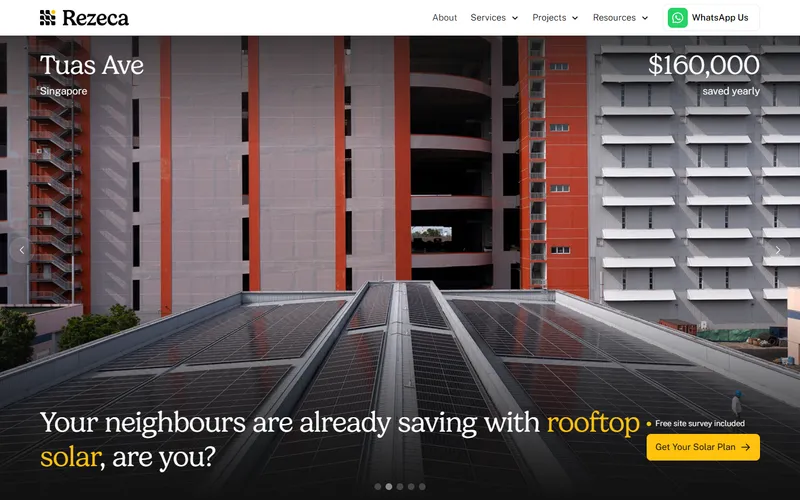
The two things that put it first are structural. It uses an in-house team rather than subcontractors, which means the people on your roof and the LEW certifying the work sit inside the same company and the same accountability. And it handles the SP Group, EMA, BCA and URA submissions itself rather than leaving you to chase paperwork, which on a job with this many touchpoints is worth real money in avoided hassle.
It specifies Tier-1 equipment only and publishes genuinely useful comparison writing on panel brands and the approvals process, including material that contradicts its own commercial interest. That is the behaviour of a firm confident in its pricing. If you want to buy a system outright and have it done properly, start here.
- Best known for
- Installing since 2009, 1,300+ landed-home jobs, in-house crews and full handling of the approvals
- Location
- Singapore, serving islandwide
- Website
- rezeca.com
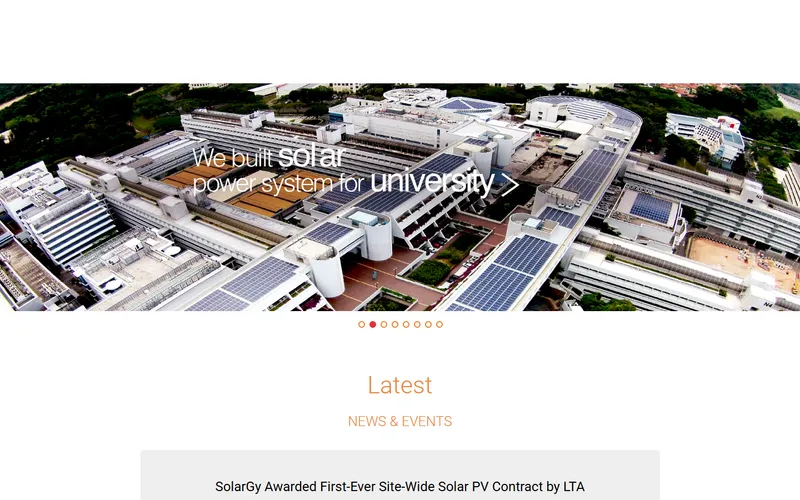
Its distinctive capability is building-integrated photovoltaics, meaning solar designed into facades, skylights and roof structures rather than bolted on top of an existing roof. If you are building or substantially rebuilding a landed property and want the panels to be part of the architecture instead of an addition to it, very few firms here can genuinely do that work.
It also holds the strongest review record of any dedicated residential installer I looked at, a 5.0 average across 112 Google reviews, and it works across HDB roofs under SolarNova, landed homes and condominiums with rooftop access. Operating from Ubi in the east. If your project is design-led or you simply want the most audited operator on the list, this is it.
- Best known for
- 18+ years, first SG solar firm with ISO 9001/14001 and bizSAFE Star, and real BIPV capability
- Location
- Ubi Road
- Google Rating
- 5.0 stars (112 reviews)
- Website
- solargy.com.sg
That backing is not a marketing detail. In a rent-to-own agreement you are entering a contract that runs for a decade or more, in which the counterparty owns hardware on your roof and owes you maintenance for the whole term. The single largest risk in that arrangement is the provider not existing in year eight. A parent company with a balance sheet materially reduces it, and it is the reason I would take a GetSolar lease over a slightly cheaper one from a firm founded last year.
The offer is the standard shape: $0 upfront, a fixed monthly fee, islandwide coverage for landed homes, maintenance included through the term. Apply the same questions I set out above, particularly the total-cost-over-term number and the transfer terms on sale. Being the largest player does not exempt anyone from showing you the arithmetic.
- Best known for
- Pioneering rent-to-own solar locally, 3,200+ customers, and ENGIE backing behind the contract
- Location
- Singapore, serving islandwide
- Website
- getsolar.ai
What earns it the spot is the data it publishes. It runs a live Singapore solar data hub covering electricity tariffs and export rates, and writes up the subsidy and grant landscape in detail. In a market where the export rate is the number that decides your payback, an installer publishing the current figure openly rather than quoting whatever suits the pitch is doing something useful.
It is a younger operation than Rezeca or SolarGy and its offer is squarely the lease model, so run the total-cost-over-term calculation and check the guarantee terms. Based at Robinson Road. For a homeowner who wants a defined package rather than an open-ended consultation, this is the easiest starting point.
- Best known for
- Three fixed residential packages at $0 upfront and a published live solar and tariff data hub
- Location
- 63 Robinson Road, #08
- Website
- sunollo.com
Its published residential range is $15,000 to $20,000 for a typical setup with a payback of three to five years, and I appreciate that it commits to a number publicly rather than hiding behind a consultation. Those figures line up with the wider market bands, which is a decent sign that the pricing is normal rather than promotional.
It is less specialised in landed residential than Rezeca or SolarGy, so if your roof is unusual you may get a more tailored design elsewhere. But if you have a commercial property and a home and would rather use one contractor for both, or you simply want an established group behind the warranty, LHN is a sensible shortlist entry.
- Best known for
- Solar since 2018 across residential and commercial, with published $15,000 to $20,000 home pricing
- Location
- Singapore, serving islandwide
- Website
- lhnenergy.com
The argument for going with an incumbent on a lease is the same one I made for GetSolar, and it is a good argument. A rent-to-own agreement is a long-dated contract, and a company that has been billing Singapore households for decades is unlikely to disappear midway through it. If the thing making you hesitate about solar is trusting a young company with a fifteen-year commitment, this addresses that directly.
The trade-off is that solar is one line in a broader energy business rather than the entire company, so you should expect less depth on unusual roof geometry or panel-level design than from a dedicated installer. Get the total-cost-over-term figure and the resale transfer terms in writing, exactly as with any lease.

- Best known for
- A rent-to-own solar scheme from a long-established Singapore energy supplier
- Location
- Singapore, serving islandwide
- Website
- unionenergy.com.sg
The detail I would highlight is the five-year labour warranty included with its maintenance offering. Panel manufacturers warrant panels for 20 to 25 years and everyone quotes that, but panels are rarely the thing that fails. Mounting, wiring, inverters and the workmanship holding it all to your roof are, and a long labour warranty is the installer betting on its own work. Ask every firm on this list what their labour warranty is, then notice how the answers differ.
It is based at Pandan Loop and it is genuinely small, so it will not have the capacity or the balance sheet of the venture-backed entrants above, and it sells outright rather than leading with a lease. If you want a hands-on installer who will be on site rather than dispatching a crew, this is the one.
- Best known for
- A hands-on team in solar since 2017 and a five-year labour warranty on its own workmanship
- Location
- 196 Pandan Loop, #04-03
- Website
- akandosolutions.com
| Installer | Since | Model | Speciality | Best for |
|---|---|---|---|---|
| Rezeca Renewables | 2009 | Buy outright | Landed residential, in-house crews | Buying a system properly |
| SolarGy | 18+ years | Buy outright | BIPV, ISO-certified EPC | Design-led and audited work |
| GetSolar | 2020 | Rent-to-own | $0 upfront, ENGIE-backed | Leasing with a solid counterparty |
| Sunollo | Recent | Rent-to-own | Fixed packages, published data | Comparing a defined package |
| LHN Energy | 2018 | Buy outright | Residential and commercial | One contractor for home and business |
| Union Energy | Long-established | Rent-to-own | Incumbent energy supplier | Wanting a familiar counterparty |
| aKanDo Solar | 2017 | Buy outright | Hands-on small team | 5-year labour warranty, no subcontracting |
Solar panels in Singapore cost roughly $1,200 to $1,950 per kWp fully installed in 2026, with larger systems landing at the lower end. A 10 kWp system, which suits most landed homes, comes to about $14,500 to $19,500. Payback typically runs 5 to 8 years, or 3 to 4 for a high-consumption household with a well-oriented roof.
The economics rest on two numbers: what you avoid buying from the grid, and what you earn exporting surplus. Under Simplified Credit Treatment, surplus export currently credits at roughly $0.20 to $0.26 per kWh, around 75 to 80 percent of the prevailing tariff. Self-consumption is worth more than export, which is why a household that runs aircon during the day gets a shorter payback than one that is out until 8pm.
| System size | Typical installed cost | Suits |
|---|---|---|
| 5 kWp | $8,000 to $10,000 | Small terrace, modest consumption |
| 10 kWp | $14,500 to $19,500 | The typical landed home |
| 20 kWp | $26,000 to $36,000 | Large semi-detached or bungalow |
| 30 kWp | $36,000 to $45,000 | Bungalow or GCB with a big roof |
| Rent-to-own, 10 kWp | $0 upfront, fixed monthly | Keeping capital free, maintenance included |
| Battery storage, over 20 kWh | Adds substantially, plus SCDF requirements | Rarely worth it in SG today |
Two costs to pin down before signing. Ask whether the quote includes the LEW submission and SP registration or treats them as extras, because they are unavoidable. And ask what the inverter warranty is separately from the panel warranty: panels are warranted 20 to 25 years, inverters typically 5 to 12, and the inverter is the component most likely to need replacing during the system's life.
If you are getting quotes for solar in Singapore, work through these in order. The first three eliminate most of the risk, and none of them are about panel brands.
- Ask about the LEW before anything else. Is the Licensed Electrical Worker in-house or subcontracted, and what grade? Every grid-connected system needs one, and an installer that answers crisply is an installer that has done this properly before. The EMA worker licences page sets out the grades.
- Establish buy versus lease, then compare like for like. Never put a cash quote next to a monthly figure. Convert the lease to total cost over the full term including any transfer fee, and compare that with the cash price.
- If leasing, get the resale terms in writing now. What happens when you sell the house, whether the buyer can assume the agreement, and what a buyout costs. Discovering this at completion is a bad time.
- Ask for the labour warranty, not the panel warranty. Everyone quotes the manufacturer's 20 to 25 years on panels. The number that reflects the installer's confidence in its own work is the labour and workmanship warranty, and it ranges from one year to five.
- Confirm who files the paperwork. LEW submission, SP Services registration under Simplified Credit Treatment, and any BCA or URA touchpoints. A good installer absorbs all of it; the process is set out in the EMA implementation guide.
- Get a roof condition assessment first. Panels last 25 years. If your roof needs work within ten, do the roof first, because removing and reinstalling an array is expensive and nobody mentions it at quote stage.
- Check the company is actually still trading. This sounds absurd for a capital purchase, and it is exactly why I say it. See the next section.
- Ask about the inverter separately. Brand, warranty length, and whether it is a string inverter or microinverters or optimisers. Shading from neighbouring houses is common on Singapore terraces and it is the inverter architecture that determines how badly shade hurts output.
One more that costs nothing: ask for the projected annual generation in kWh and the assumptions behind it. Any competent installer models this. A quote with a dollar saving but no kWh figure has skipped the engineering.
I started from the EMA requirements rather than the product, because the LEW obligation and the SP registration sequence are what actually make a solar system legal and connected, and they are the parts the marketing skips. Ranking on whether a firm handles that paperwork itself turned out to sort the list quickly.
Then a finding worth flagging. SolarPVExchange, which appears in most current Singapore solar roundups and was for years one of the better-known residential names, no longer has a working website: the domain now redirects to a GoDaddy parking page offering it for sale. I have no information about the company's status beyond that, and I am not going to send anyone shopping for a five-figure capital purchase to a business whose domain is for sale. It is not on this list. It is also a reminder to check that a solar company still exists before paying a deposit, because a 25-year warranty is only worth as much as the company behind it.
Sunseap, another name in older listicles, was acquired and folded into EDPR and no longer trades under that domain either. If you are reading a solar listicle that still lists both, it has not been checked in a while.
Where I have quoted a star rating it comes from a single verifiable profile, which here means SolarGy's 5.0 from 112 reviews. Prices are August 2026 bands drawn from installers' published figures and current market guides, not quotes. Every system is priced off your roof, your consumption and your orientation, so get at least three quotes and insist each one states projected annual generation in kWh. You can also cross-check which companies are active through the National Solar Repository of Singapore, maintained by SERIS at NUS.
Solar is worth it for most Singapore landed homes. A 10 kWp system costs about $14,500 to $19,500 installed, cuts grid consumption substantially, and pays back in roughly 5 to 8 years, or 3 to 4 for a household with high daytime usage and a well-oriented roof. Panels then run for 25 years, so most of that life is return.
The economics are weaker in two situations. HDB flat owners cannot install their own rooftop system, since block roofs are handled centrally under the SolarNova programme. And a home that is empty all day exports most of its generation at roughly 75 to 80 percent of the tariff rather than self-consuming it at full value, which lengthens payback.
You need a Licensed Electrical Worker, and in most cases that is the only approval that matters. The LEW takes charge of the electrical work, files the electrical installation application, and certifies the system before SP PowerGrid connects it, then registers you with SP Services under Simplified Credit Treatment so surplus export earns credit. Your installer arranges all of this.
You do not need an EMA generation licence below 1 MWac, which covers every home. URA planning permission is generally not required for roof panels unless your property is in a conservation area or under special urban design guidelines. SCDF requirements apply only once you add battery storage above 20 kWh.
Buying outright is cheaper over the life of the system; rent-to-own is cheaper today. Under rent-to-own you pay nothing upfront and a fixed monthly fee for roughly 7 to 15 years, after which ownership transfers to you. The provider owns and maintains the system through the term, which removes maintenance risk but costs more in total than a cash purchase.
Choose rent-to-own if you would rather keep the capital, expect to stay in the house for the full term, and value maintenance being someone else's problem. Choose outright if you have the cash and want the lowest lifetime cost and a clean sale later. Before signing any lease, get the total cost across the full term and the terms for transferring or buying out the agreement if you sell.
Individual HDB flat owners cannot install their own solar panels. HDB block rooftops are common property and solar there is deployed centrally through the government's SolarNova programme, run with EMA and HDB, under which appointed vendors install and maintain panels for the block rather than for individual units.
Residential rooftop solar in Singapore is effectively a landed-property and private-condominium option, where you either own the roof or the MCST can approve its use. SolarNova has still helped flat dwellers indirectly, by driving down panel and installation costs across the market and building a pool of experienced local installers.
Solar panels last about 25 to 30 years in Singapore, and manufacturers typically warrant performance for 20 to 25 years with a guaranteed output percentage at the end of that period. Our climate is favourable for generation but hard on hardware, so heat and humidity, not sunlight, are what age a system.
The inverter is the part that will need replacing first, usually warranted for 5 to 12 years against the panels' 20 to 25, so budget for one replacement across the system's life. Panels also need occasional cleaning here, because dust and bird droppings reduce output more than most owners expect, and that is what a maintenance plan is actually buying you.
If you are buying a system outright for a landed home, start with Rezeca Renewables. Installing since 2009, in-house crews rather than subcontractors, and it handles the whole approvals chain itself, which on a job with this much paperwork is the difference between a project and a chore. If your job is design-led or you want the most audited operator, SolarGy has the ISO stack, real BIPV capability and the strongest verifiable review record here.
If rent-to-own suits you better, GetSolar is the one I would lease from, because ENGIE behind a fifteen-year contract answers the question that matters most in a lease. Union Energy makes the same argument from the incumbent-utility side, and Sunollo is the easiest to compare because the packages are fixed and it publishes its tariff data. LHN Energy suits a household that also has a commercial roof, and aKanDo Solar is the hands-on small team, with the five-year labour warranty to back it.
Whichever way you go, do these three: ask whether the LEW is in-house and what grade, convert any lease to a total cost across the full term before comparing it with a cash quote, and get the labour warranty in writing rather than the panel warranty everyone quotes. While you are working on the house, my guides to the best electricians, the best smart home installers and the best renovation contractors in Singapore cover the trades that usually come with this one. If a car is going to sit under those panels, the same LEW usually handles EV charger installation too, and it is cheaper to do both on one visit.
A closing note for the industry. Singapore solar is being sold almost entirely on finance terms right now, which means the firms with the best engineering are often losing to the firms with the best landing pages. If that is you, it is a fixable problem and it happens to be my day job. Take a look at my web design services in Singapore, or get a quote and I will tell you honestly what would move the needle.