
SEO AI & GEO
Is SEO Dead? What the Data Says in Singapore (October 2026)
Is SEO dead? Google still handles 92% of searches in Singapore. What AI Overviews and ChatGPT changed, what they didn't, and when SEO is still worth paying for.
"Is SEO dead" gets about 10 searches a month in Singapore (Google Ads data, October 2026). Almost nobody types it. But when I pulled Google Singapore's results on 27 October 2026, it and "Is SEO replaced by AI?" kept turning up in the People Also Ask boxes for "seo company singapore" and "seo consultant singapore", searched about 590 times a month each. So the people asking are mostly business owners about to pay for SEO.
No, SEO isn't dead. Google still handled 92% of Singapore's searches in September 2026, and its AI answers are built from pages it can find. The easy click has gone, though. When an AI Overview sits on top, far fewer people scroll down to the links, so a ranking earns less traffic than it did in 2023. Below is the data, including a month of my own site's traffic.
I'm Terris, a Singapore web designer, full-time since 2018. I sell SEO myself (an SEO and GEO retainer), so I have a stake in the answer. That's why this post leans on other people's numbers more than on my opinion.
SEO is evolving in 2026, and it's far from dead. Google held 92.16% of Singapore's search engine market in September 2026 (StatCounter), and Google says its AI features are adding searches. More searches now end on Google's own AI answer, with no click to any website.
StatCounter's chart of search engine market share in Singapore puts Bing second at 4.53%. It counts search engines, not chatbots, so it can't say how many questions went to ChatGPT instead. But when people in Singapore do search, they search on Google.
Google, hardly a neutral witness, says the same. On its July 2026 earnings call, Sundar Pichai said AI Mode had passed 1 billion monthly users and "is driving an incremental increase in Search queries overall". People haven't stopped searching. The results page answers more of their questions by itself.
| What changed since 2023 | What's still true |
|---|---|
| A top-ranking page gets far fewer clicks when an AI Overview shows | Google still sends most of the visitors: 13,058 from google.com to my site last month, 16 from ChatGPT |
| AI Overviews, AI Mode, ChatGPT and Gemini answer questions on their own page | Google says AI Overviews need nothing beyond normal SEO |
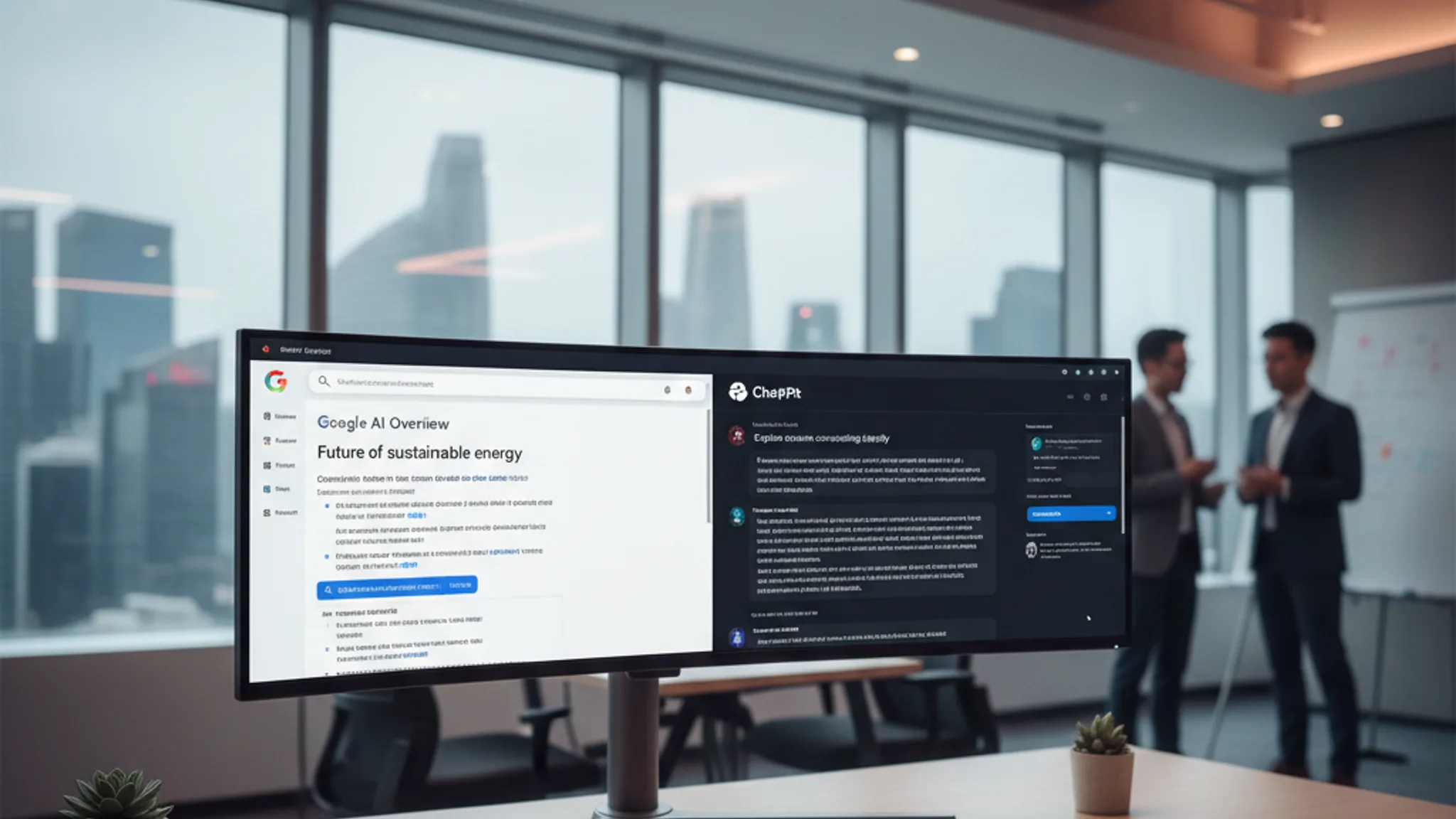
AI Overviews have cut clicks to websites hard on the searches where they appear. Pew Research Center found US Google users clicked a normal result on 8% of visits when an AI summary appeared, against 15% without one. Ahrefs found the top-ranking page's click-through rate was 58% lower when an AI Overview showed.
- Pew Research Center tracked the browsing of 900 US adults through March 2025. About 18% of their Google searches produced an AI summary. Only 1% of visits to those pages involved a click on a link inside the summary.
- Ahrefs compared 300,000 keywords using desktop Search Console data from December 2023 and December 2025. Where an AI Overview showed, the top result's click-through rate was 58% lower. Position two lost about half its clicks and position ten about 19%. Ahrefs calls it a correlation, not proof of cause.
Neither study uses Singapore data, and both lean on informational searches, so read them as direction. If your traffic came from explainer articles ("how often should I service my aircon?"), that's the kind of search they measured. If it comes from people looking for a business to hire, compare clicks on your service pages with a year ago in Search Console before you panic. The full breakdown, with Seer Interactive's numbers, is in my guide to Google AI Overviews and SEO.
ChatGPT and Gemini sent my own Singapore website very little traffic. In the 30 days to 27 October 2026, terris.sg got 13,058 visitors from google.com, 40 from Gemini and 16 from ChatGPT. Six AI assistants together sent 80 visitors, about one for every 160 that came from google.com.
These are the referrers Umami, the analytics I run on terris.sg, recorded for that period:
| Referrer | Visitors, 30 days to 27 Oct 2026 |
|---|---|
| google.com | 13,058 |
| bing.com | 1,489 |
| gemini.google.com | 40 |
| chatgpt.com | 16 |
| perplexity.ai | 10 |
| copilot.microsoft.com | 7 |
| claude.ai | 4 |
| doubao.com | 3 |
These numbers come from one site, and most of its visitors are people looking for a pest controller or a maid agency in my Terris Recommends guides, not marketers. And Singapore is no stranger to ChatGPT: in an Economic Development Board article from May 2026, OpenAI's Oliver Jay said Singapore ranks among the highest in the world for ChatGPT use per person.
Umami misses two kinds of AI influence. An AI app that opens a link without saying where it came from counts as a direct visit, so the AI rows are a floor. And an AI answer can name your business without anyone clicking. Even so, Bing alone sent more than 18 times as many visitors as every AI assistant combined. If you've been ignoring a search channel, it's probably Bing.
SEO isn't replaced by AI, because AI search is built on search results. Google says there are no additional requirements to appear in AI Overviews or AI Mode: a page only needs to be indexed and eligible to show with a snippet. Getting a page to that point is ordinary SEO work.
The line comes from Google's guide to AI features and your website: "There are no additional requirements to appear in AI Overviews or AI Mode, nor other special optimizations necessary." The same page says both may use "query fan-out", running several related searches across subtopics before writing the answer.
Fan-out probably explains one of Ahrefs' findings. In March 2026 it looked at 4 million AI Overview citations across 863,000 searches and found only about 38% of the cited pages ranked in the top 10 for that same search, down from 76% in its July 2025 study. Ahrefs thinks Google now pulls more of its sources from the related searches it runs behind the scenes.
So a site that answers the follow-up questions around a topic has an edge over a single page polished for one big keyword. Building that kind of site is still SEO. UCOATE is a small example from my own work. The site, which I rebuilt in 2025, now has 42 published guides, sits on page 1 at #7 for "formaldehyde remover singapore" (DataForSEO check, October 2026) and gets three times the client enquiries it did before.
Whether AI replaces the channel is a different question from whether AI can do the work. For the second one, read can ChatGPT do SEO for you.
Nothing is replacing SEO in Singapore yet. The scorecard is changing instead. Rank positions and raw traffic say less about results than they did, and being named in AI answers says more. The work underneath, pages Google can crawl that answer the questions customers ask, hasn't changed.
Some owners decide Google Ads is the replacement. Ads hit the same wall. Seer Interactive tracked 3,119 informational searches across 42 organisations from June 2024 to September 2025: on searches with an AI Overview, organic click-through fell from 1.76% to 0.61%, and paid click-through fell from 19.7% to 6.34%.
Here's how I'd sort SEO work now:
- Losing value: articles written only to catch "what is" traffic, and reports that count rank positions without asking whether anyone clicked.
- Same as ever: a fast site Google can crawl, a page for each service, internal links, schema that says who you are, and reviews on your Google Business Profile.
- Worth more: pages that answer one question each in their first two sentences, with a number in the answer, which is the shape AI Overviews and People Also Ask lift.
- New: checking whether ChatGPT, Gemini, Perplexity and AI Overviews name you for the questions your customers ask, and fixing your pages and listings when they don't.
Checking AI answers is the only genuinely new job, and most of it is a monthly check. I re-run the same set of prompts across those four every month for my clients, and I don't sell GEO separately, because the work that ranks a page is the work that gets it cited.
AI SEO is usually called GEO now, short for generative engine optimisation: the work of getting a business cited or recommended in answers from ChatGPT, Gemini, Perplexity and Google's AI Overviews. You'll also hear AEO (answer engine optimisation) and LLMO (large language model optimisation). All of them name roughly the same job.
AEO gets used two ways: some people mean winning featured snippets and direct answers in Google, others mean any AI answer. "AI SEO" is the plain-English version, and it's the one buyers type. Google Ads data for Singapore in October 2026 has "ai seo singapore" at about 170 searches a month and "generative engine optimization singapore" at zero.
So if an agency quotes you once for SEO and again for GEO, ask what they'd do differently for the second fee. Most of the list should overlap. For the method itself, page by page, read my guide to generative engine optimisation.
SEO will likely still exist in 5 years, because AI answers are assembled from web pages that search engines can find. Nobody can promise 2023's click-through rates will return. But the loudest prediction so far, a 25% fall in search engine volume by 2026, hasn't shown up in any data I could find.
Gartner made that forecast in February 2024: "By 2026, traditional search engine volume will drop 25%." Well, it's 2026. SparkToro's analysis of a US panel from Datos found searches per Google user grew 21.64% from 2023 to 2024, and Google said in July 2026 that its AI features are increasing searches. Google has every reason to say so, and none of this is Singapore data. Still, I couldn't find a study showing the 25% drop happened.
Five years is a long time, so here's what I'd watch instead of guessing:
- Google's share on StatCounter's Singapore chart. It was 92.16% in September 2026. If it starts falling fast, change your mix with it.
- The AI rows in your own analytics. When ChatGPT or Gemini sends you more people than Bing does, treat it as a channel of its own.
- Clicks against impressions in Search Console. Impressions rising while clicks fall often means people see you in an AI answer and stop there.
My bet is that the name changes again before 2031 and the work underneath barely moves.
You should still pay for SEO in 2026 if your customers search for what you sell and one new customer is worth more than a month of the work. Hold off if you need enquiries this month, sell something nobody searches for yet, or can't keep publishing for at least six months.
- You need leads by next month. SEO takes months. Google Ads can send traffic this week.
- Nobody searches for what you do. A new kind of product needs awareness first. There's no search to rank for yet.
- You run on referrals and you're already booked out. Spend the money on a site that turns those referrals into jobs.
For everyone else, the maths changed less than the headlines suggest. A Singapore customer looking for a renovation contractor or a tuition centre still mostly searches on Google, and the AI answer at the top of that results page quotes websites Google has indexed.
So, is SEO dead? Not on this evidence. But a #1 ranking no longer brings a steady stream of clicks on its own, so pay for SEO that gets you named and chosen, and judge it by enquiries rather than positions.
If you'd like to know where your own site stands, on Google and in AI answers, ask me for a free check. I'll tell you plainly whether SEO is worth it for your business, even if the answer is no.
Sources and references (10)
- gs.statcounter.com › singapore
- blog.google › alphabet earnings q2 2026
- pewresearch.org › google users are less likely to click on links when an ai summary appears in the results
- ahrefs.com › ai overviews reduce clicks update
- developers.google.com › ai features
- ahrefs.com › ai overview citations top 10
- ppc.land › google ai overviews reduce organic ctr 61 paid traffic 68
- cmswire.com › will search engine traffic really drop 25 by 2026 as gartner predicts
- sparktoro.com › new research google search grew 20 in 2024 receives 373x more searches than chatgpt
- edb.gov.sg › big techs global aspirations take root in asia