







See brand identity work before you commission any
Most branding portfolios show you a logo on a tote bag. That tells you nothing about whether the person can build a system a business can still run three years later.
So the three projects below are published whole. Every page of every guideline document, the logo family, the colour proportions, the type rules, the photography direction and the applications. Read them and judge the work rather than the presentation of it.
Three different businesses wearing the same three colours
A beauty and wellness business in Singapore described what it wanted: facials, body treatments and full-body hair removal under one roof, beige and gold and black, beauty and technology given equal weight. Rather than send old work, I built three complete directions against it over a weekend.
They are not three versions of one idea. Oréa sells craft and keeps the machines out of sight. Meridian sells measurement and puts the equipment in the window. Lumé sells the hour itself, which is what a membership actually is. Each is priced differently by the customer as a result, and each page says where its direction costs you something.
The names belong to the directions, not to a company. Nobody commissioned these, nothing here is a client's brand, and none of it is presented as a job that shipped.
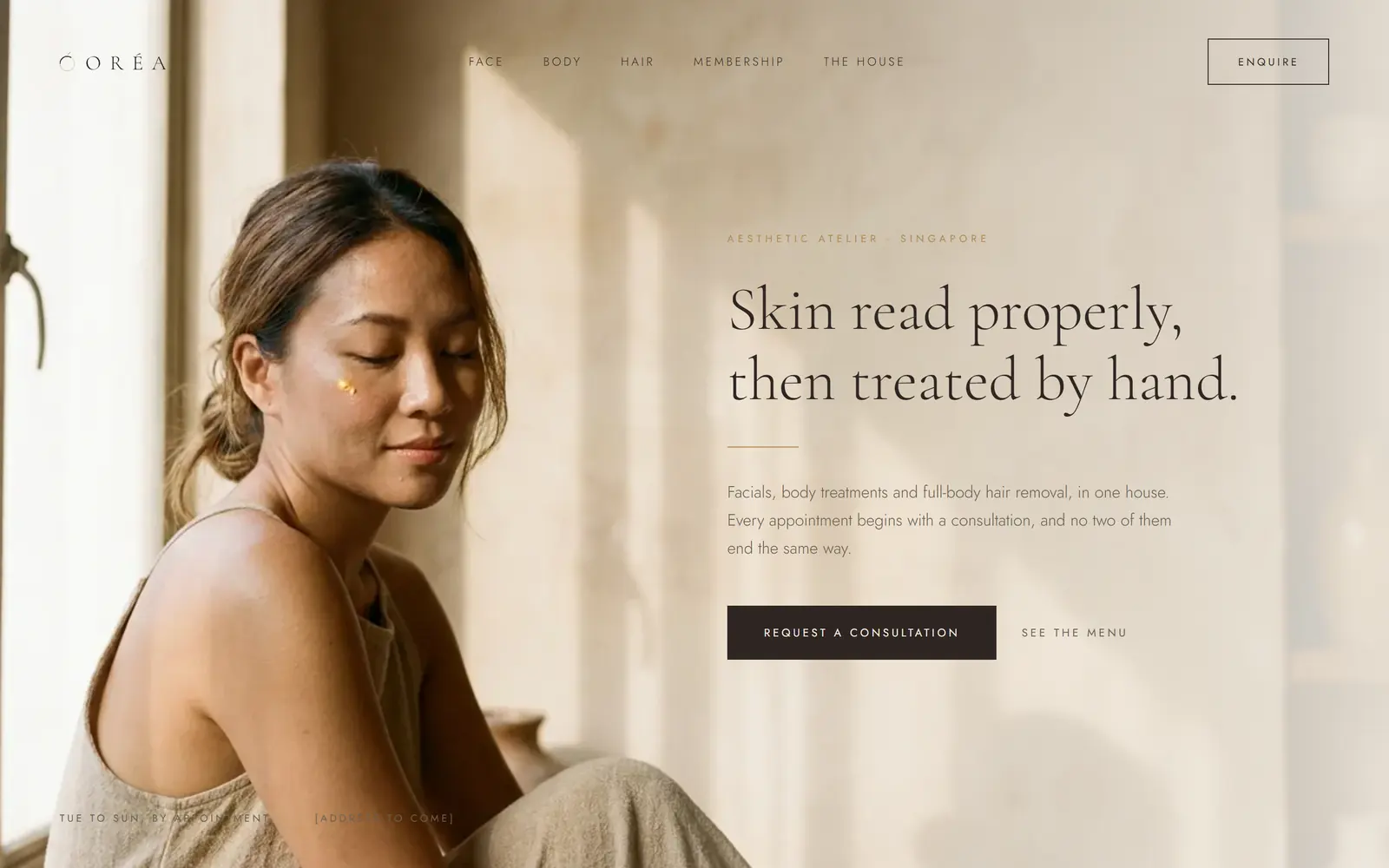
Oréa
A warm, hand-made identity for a beauty and wellness house, built on bone, oat and brass. The machines stay behind the curtain.
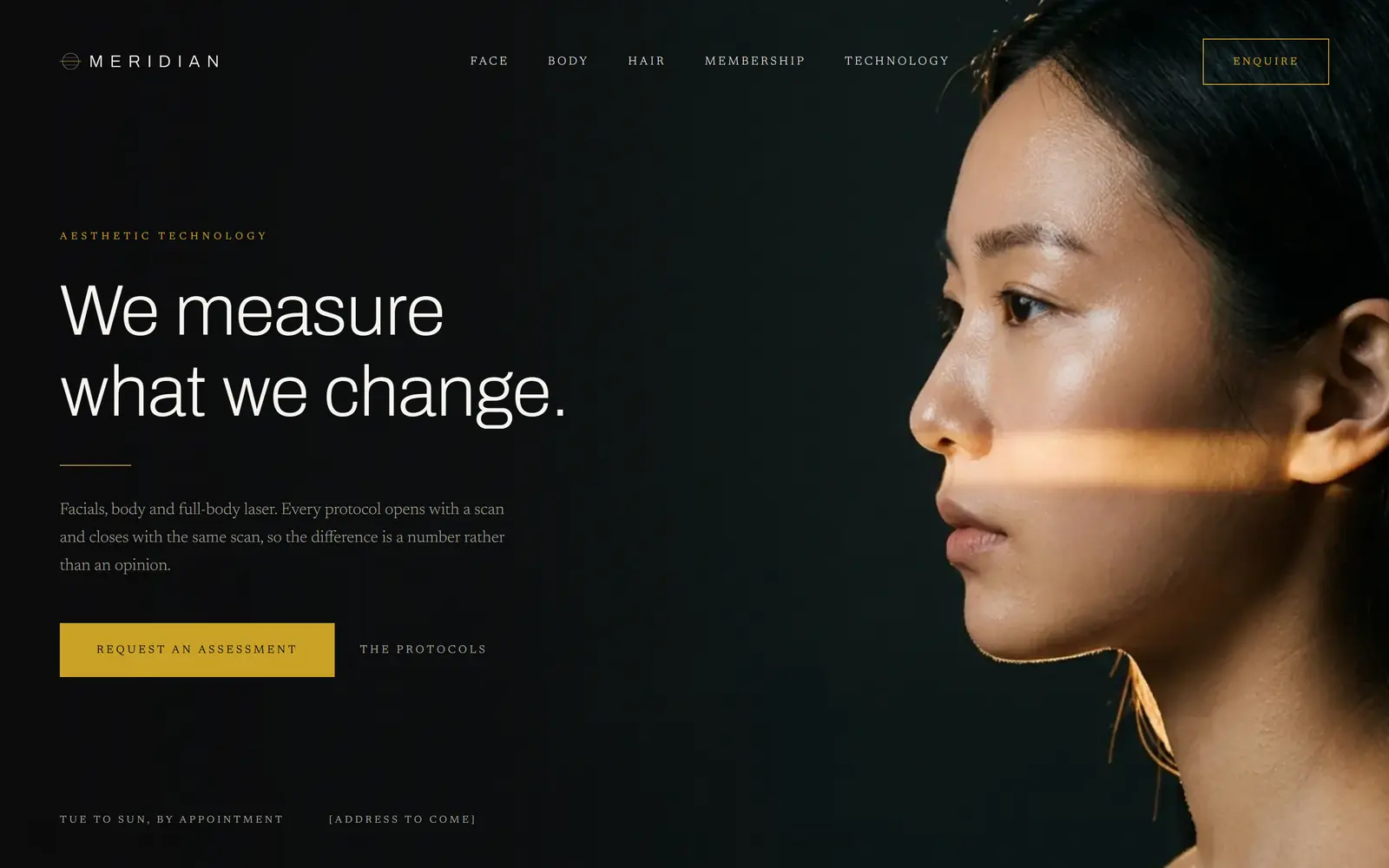
Meridian
Black, gold and hairline rules for a beauty business that wants to be paid for its equipment. The technology is the luxury, and the brand says so.
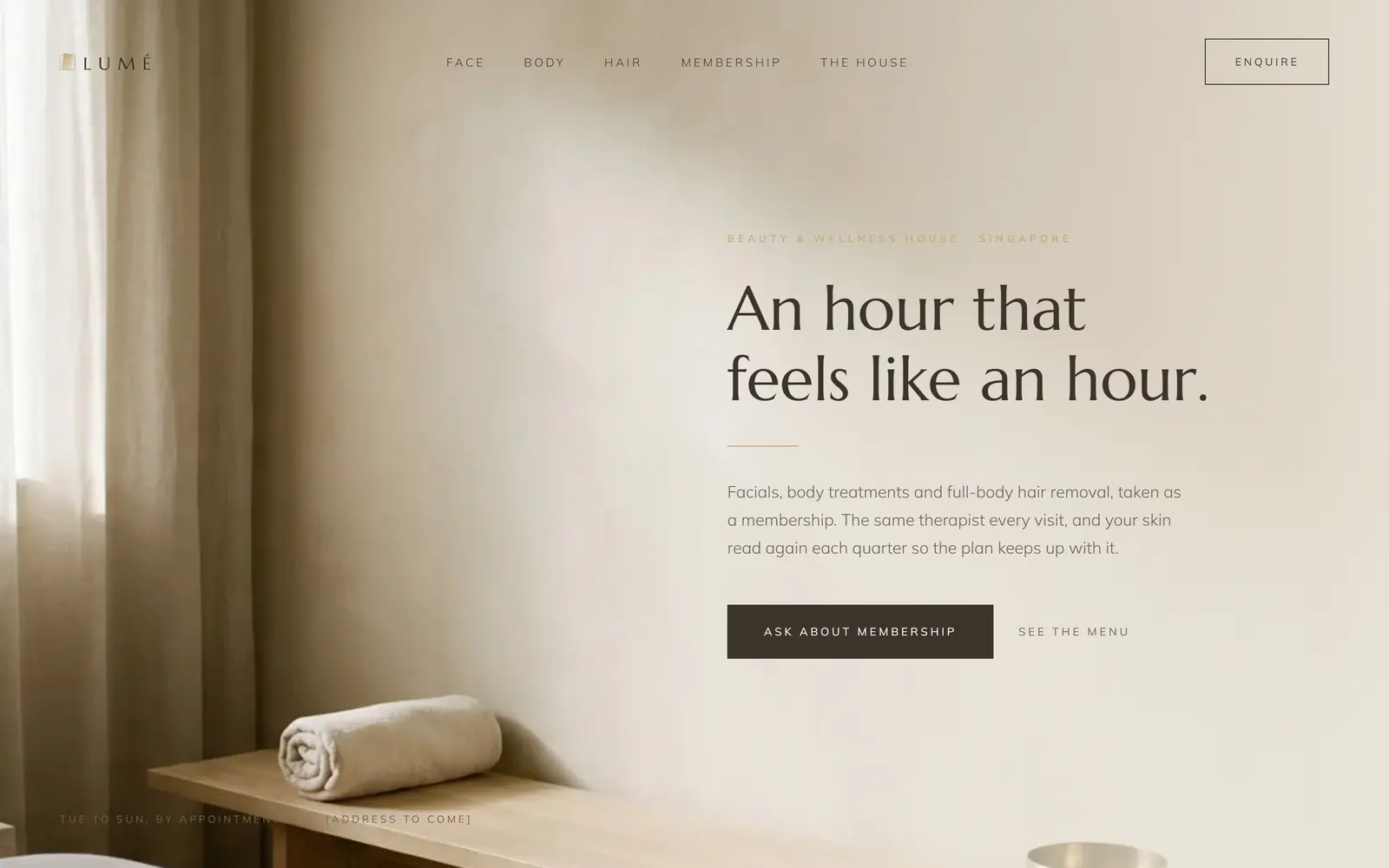
Lumé
Limewash, daylight and a membership model. An identity that sells the hour rather than the result, for a business whose revenue is renewals.
Everything a business needs to run the brand itself
The difference between a brand that holds and one that drifts is whether the rules were written down. Every direction ships with all of this.
The mark, in every lockup
Primary, reversed, wordmark, stacked and monogram, all outlined so they cannot be re-typed in a font nobody has installed. PNG at three sizes and a favicon on top.
Colour with proportions
Five swatches, and the share of a layout each one is allowed to take. Hex, RGB and CMYK, plus an .ase file for Adobe and the palette as JSON, CSS and SCSS.
Two typefaces and a scale
A heading face and a body face, both open licence, with a full type scale as CSS. Nothing to buy, nothing to renew, and it can be self-hosted.
Photography direction
What the light does, what stays in frame and what never appears. Written as a brief a real photographer can shoot from, with reference frames art directed to the palette.
A 14-page guideline document
Clear space, minimum sizes, the misuse rules, contrast grades, hierarchy, and the identity applied to stationery, signage, packaging and a homepage.
The homepage it implies
Every direction is applied to a first screen, so the brand and the website are decided together instead of arriving a month apart and disagreeing.
Questions people ask before commissioning branding
How much does brand identity design cost in Singapore?
It depends on how much of the system you need. A logo and a small set of files is one thing; a full identity with a colour system, two typefaces, art direction and a guideline document another business can actually follow is a bigger piece of work. Tell me what you are opening or rebranding and I will quote properly rather than give you a number that changes later.
Do I get the source files?
Yes. Every direction ships as an asset pack: outlined SVG logos in every lockup, transparent PNGs at three sizes, a favicon, an .ase swatch file for Adobe, the palette as JSON, CSS and SCSS, a type scale, and the art-direction frames. The fonts used here are open licence, so there is nothing to buy and nothing to renew.
Why three directions instead of one?
Because a brand is a business decision before it is a picture. Three real directions make the choice concrete: this one prices on craft, this one prices on measurement, this one prices on membership. Presenting one option asks the client to approve a look. Presenting three asks them to pick a business, which is the question that actually matters.
Can you do the website too?
That is usually the point. Branding runs either as its own engagement or as the first stage of a website build, and the last page of every guideline document is the identity applied to a homepage so the two never arrive disagreeing with each other.
Is the photography real?
No, and the pages say so. The imagery is generated and art directed to each palette. It holds a site together until the business has shot its own space, and it doubles as a brief for whoever shoots it. That is how imagery works on every project here and it is included rather than quoted as an extra.
Looking for websites rather than brands?
The rest of the portfolio is client web design and SEO work, grouped by industry, with real results attached.
Ready to settle your brand?
Tell me what the business does and who it is for. I will come back with directions like these, then build the website on whichever one you pick.